June is recognized worldwide as Pride Month, a time to celebrate identity within the LGBTQ+ community and acknowledge the hardships the community has faced and continues to face. But for people who identify as both LGBTQ+ and Jewish, this year’s Pride Month arrives with a familiar tension. Since October 7, 2023, many LGBTQ+ Jewish individuals have reported feeling increasingly isolated, describing experiences of tension and exclusion within broader LGBTQ+ spaces.
The Blue Square Alliance has tracked this trend since 2024, and the data for this year is already significant. In just the first week of Pride Month, our Command Center recorded over 40,000 social media mentions linking Pride Month and LGBTQ+ identity to conversations about Jewish communities, Israel, and antisemitism, a portion of which centered on accusations of genocide, with messaging explicitly framing Jewish or Israeli identity as disqualifying from LGBTQ+ spaces.
Pinkwashing
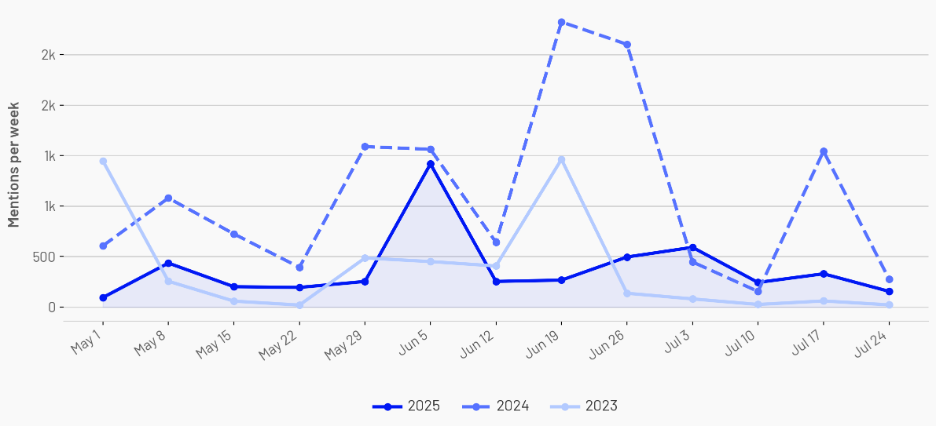
As part of this conversation, the term “pinkwashing” has become more popular. This term describes the promotion of LGBTQ+ friendliness as a way to deflect from other controversies. This term is often used to attack Israel, which is widely regarded as the most LGBTQ+-inclusive nation in the Middle East, with Tel Aviv and Jerusalem hosting pride parades that draw hundreds of thousands of attendees annually. But critics argue that this visibility serves to obscure Israeli actions in Gaza, a framing that delegitimizes the very real and vibrant LGBTQ+ community that exists within Israel. The Blue Square Alliance has found that this term spikes each year around Pride month and has since even before October 7, 2023. The largest spike in this term was in 2024, the first pride month following the October 7 attack and when anti-Israel sentiment was particularly potent. While usage of the term has dropped in 2025, it is still higher than it was pre-October 7, demonstrating a sustained increase.
“Pinkwashing” mentions online: Three-month range (2023-2025)
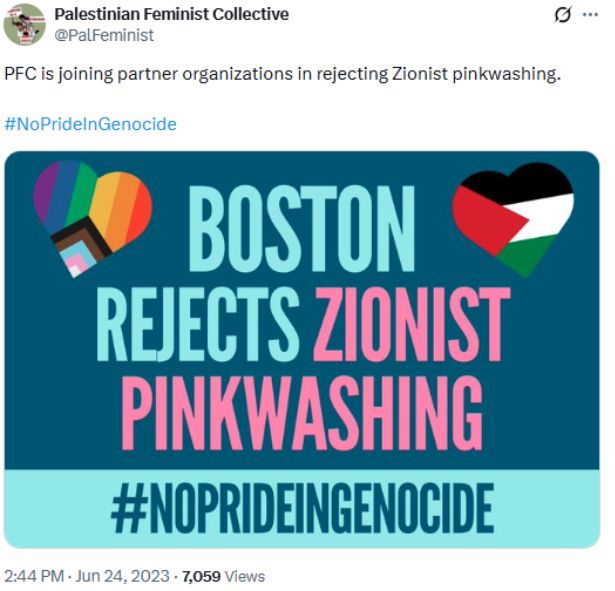
Spaces once considered safe and inclusive have become increasingly hostile to Jewish members, as anti-Israel factions within LGBTQ+ communities demand that their Jewish peers denounce Israel and Zionism, the belief in the right to Jewish self-determination and sovereignty. In the past couple of years, Jewish LGBTQ+ people have reported being called Nazis for wearing a Star of David at a pride parade and encountering local pride march advertisements that explicitly state “no Zionists allowed.” The result is a growing sense of invalidation and “othering” among Jewish members of the community.
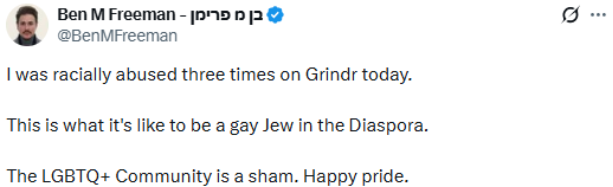
These dynamics have real-world consequences. Incidents reflecting the tension between Jewish and non-Jewish members of the LGBTQ+ community emerged this year even before Pride Month officially began.
Recent Incidents
- Rome, Italy: Organizers of a pride parade barred at least two Jewish LGBTQ+ organizations from participating with a float, citing their failure to “sufficiently distance themselves from the genocide in Gaza.” One of those organizations, Keshet Italia, had been subjected to antisemitic attacks at the same parade the year before.
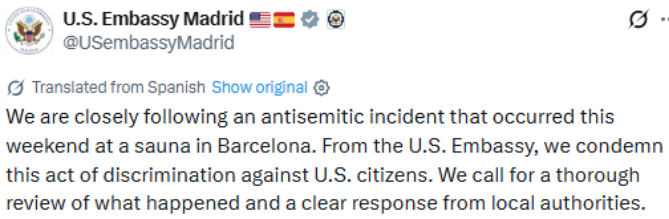
- Barcelona, Spain: Two Jewish women were denied entry to an LGBTQ+ sauna after staff noticed one of them was wearing a Star of David necklace. Staff asked if they were Zionists before telling them they were not welcome and had to leave. The sauna owners issued an apology following community backlash, and the U.S. Embassy in Madrid issued a direct condemnation of the discriminatory act against U.S. citizens.
These incidents point to a broader tension in which some LGBTQ+ Jewish individuals have found their Jewish identity is treated as incompatible with community membership. For many, full inclusion has felt contingent on distancing themselves from any connection to Israel.
The exclusion of Jewish individuals from LGBTQ+ spaces is antisemitism hidden under the pretense of social justice activism. When Jewish people are interrogated about their loyalties at pride parades, denied entry to LGBTQ+ venues for proudly wearing religious symbols, or told their presence is conditional on compliance, those are discriminatory acts that contradict the foundational values of inclusion that Pride Month represents.