
Jewish American Heritage Month (JAHM), observed during the month of May, honors the generations of Jewish Americans who helped shape the cultural, civic, and intellectual life in the United States. Established by Congress in 2006, it is a federally recognized celebration. Every JAHM prompts a wave of social media posts from institutions, community organizations, educators, elected officials, and public figures. These posts celebrate Jewish contributions to American life, highlight cultural and historical milestones, and signal support for the Jewish community. But what happens in the replies?
This report analyzes social media discussions about Jewish American Heritage Month across Twitter from 2021 through 2026, and across Instagram, Facebook, and TikTok in 2026. Using AI-assisted analysis, we classified posts and replies as supportive of, hostile toward, or neutral toward JAHM. A separate antisemitism flag identified replies containing explicit anti-Jewish content, including tropes, slurs, conspiracies, collective blame, and dehumanizing language directed at Jews as a group.
The core finding is straightforward. The posts themselves are overwhelmingly supportive across every platform and every year we examined. The hostility appears almost entirely in the replies, and on Twitter it has increased dramatically since 2022 with no sign of reversal.
All 2026 data was collected through May 25 and does not reflect the full month.
The Post/Reply Gap
When looking only at original posts that mention Jewish American Heritage Month, the picture is positive. Across all platforms and years in our dataset, 92% of posts were classified as supportive. Institutions, educators, community organizations, and public figures continue to celebrate Jewish American Heritage Month consistently and at scale. The replies tell a different story.

Across more than 30,000 replies in our dataset, 67% were classified as hostile toward JAHM. While supportive posts dominate the conversation at the publishing level, hostility dominates much of the response. This distinction matters because looking only at original posts would paint a misleading picture of the online environment surrounding JAHM. The posts suggest broad support. The replies reveal a much more contentious reality.
As the sections that follow show, that hostility is not distributed evenly. It varies significantly across platforms, has changed dramatically over time on Twitter, and in many cases includes explicit anti-Jewish content rather than mere disagreement or criticism.
Twitter Over Time
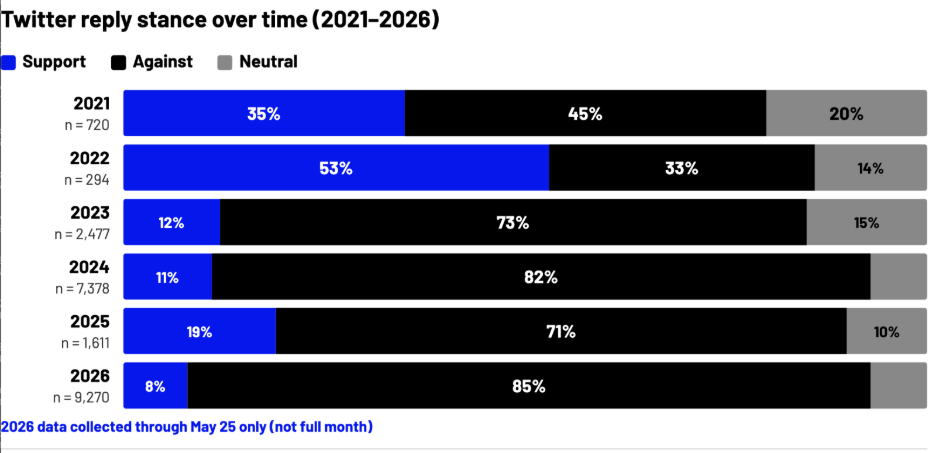
Because Twitter data was available across multiple years, it offers a longitudinal view that is not possible for the other platforms in this study. In 2022, Twitter’s reply environment around Jewish American Heritage Month was relatively positive. Most replies (53%) were classified as supportive, while 33% were classified as hostile.
The biggest shift occurred between 2022 and 2023, and it has not reversed.
The sharp increase in hostility coincides with major changes in Twitter’s moderation and governance systems. During this period, the platform reduced portions of its trust-and-safety infrastructure, altered content moderation practices, and increasingly relied on Community Notes as a primary mechanism for addressing disputed claims. While our data cannot establish causation, the timing suggests that these changes may have contributed to a reply environment in which hostile and antisemitic content became more visible and more persistent.
2024’s JAHM was the first to take place after the October 7, 2023 Hamas attacks and the subsequent war in Gaza. Hostile replies reached 82%, while supportive replies fell to 11%.
In 2026, hostility increased further, reaching 85% of all replies analyzed.
The original posts themselves did not change. Twitter posts about JAHM remained between 94% and 97% supportive throughout the study period. What changed was the audience response.
How Platforms Compare in 2026
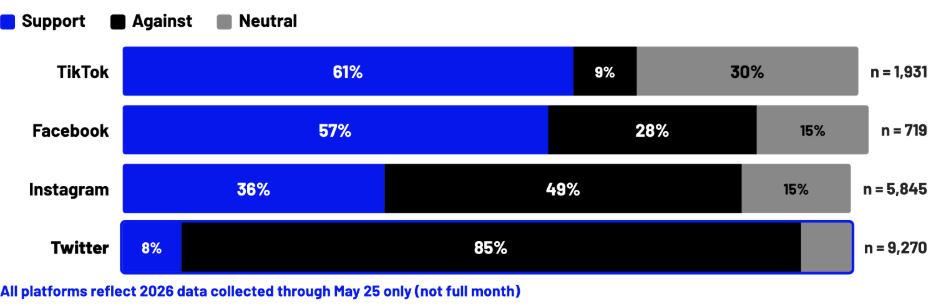
In 2026, the differences between platforms in how JAHM replies were distributed were substantial. Twitter stood apart from the three others. 85% of Twitter replies were classified as hostile, while just 8% were supportive. The contrast is especially striking because the original posts looked remarkably similar across platforms. The overwhelming majority of JAHM posts on every platform were supportive.
On TikTok, 61% of replies were supportive and just 9% were hostile, making it the most favorable environment in the dataset. Its high neutral rate of 30% suggests a meaningfully different audience or content type than the other platforms. These findings should be interpreted with some caution. First, this analysis focused exclusively on text-based comments. On TikTok, opposition may sometimes be expressed through images or GIFs that fall outside the scope of our dataset. Second, platform sample sizes varied, particularly on Facebook, where the volume of relevant posts and replies was smaller than on the other platforms.
Antisemitism Within Hostile Replies
Not all hostile replies are the same, and one of the goals of this study was to distinguish between general opposition to Jewish American Heritage Month and explicit antisemitism.
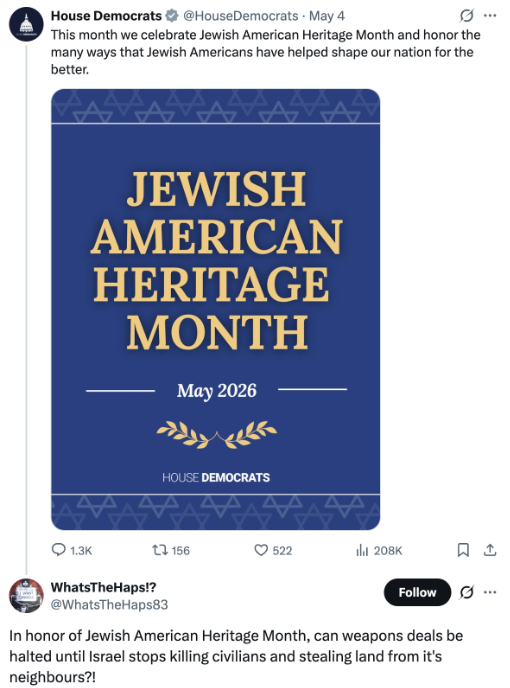
The Against label was applied broadly. It includes replies that are openly hostile toward Jewish people, but it also captures a different and very common pattern in JAHM reply threads: for example, using the Israel-Palestine conflict to redirect, dismiss, or undercut the commemoration or celebration.
A reply that responds to a post celebrating Jewish American Heritage Month by pivoting to Gaza, demanding policy action, or questioning why JAHM deserves recognition given current events was classified as Against, even if it contained no explicit antisemitic content. This reflects a deliberate methodological choice. Redirecting a Jewish heritage commemoration toward a geopolitical conflict is itself a form of opposition to that commemoration, regardless of whether it contains anti-Jewish language. Given how frequently this pattern appeared in reply threads, it was likely a significant driver of the elevated hostility rates observed during those years.
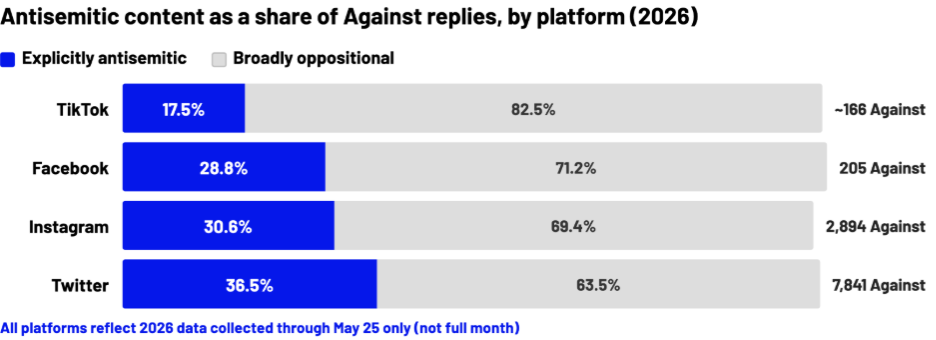
Twitter had the highest rate of antisemitism. 36.5% of hostile replies were flagged as explicitly antisemitic.
The antisemitism flag was applied only when anti-Jewish content was explicit and unambiguous. Replies containing coded language, implications, dog whistles, or indirect references were not flagged unless they clearly invoked a recognized trope, conspiracy, slur, collective accusation, or dehumanizing claim, to keep the analysis as straightforward and accurate as possible. As a result, the figures reported here are best understood as lower-bound estimates of explicit antisemitic content within JAHM reply threads.
What this means.
Jewish American Heritage Month exists to celebrate a community’s contributions to American life. The overwhelming majority of original posts were supportive, which suggests that institutions, organizations, and individuals continue to see value in that mission. The challenge emerges in the comment sections, where commemoration is frequently met not with engagement on Jewish history or culture, but with hostility, deflection, and in many cases, explicit antisemitism.
In many cases, these conversations about Jewish heritage are redirected toward unrelated political disputes or are targeted with anti-Jewish rhetoric. The result is an online environment that can discourage participation and undermine the purpose of public commemoration.
These patterns suggest that measuring sentiment through posts alone misses an important part of the story. The health of a digital public square depends not only on what people choose to publish, but also on how communities respond. In 2026, Jewish American Heritage Month remained widely celebrated across social media. Yet on some platforms, especially X (Twitter), the public reaction surrounding those celebrations reflected a level of hostility that cannot be ignored.
Methodology
The findings presented above are based on an analysis of social media posts and replies discussing Jewish American Heritage Month across Twitter, Instagram, Facebook, and TikTok. This section describes how the data was collected, how content was classified, and how model performance was evaluated.
How We Collected Data
Posts and replies were collected using keyword and hashtag filters related to Jewish American Heritage Month. For Twitter, data spans 2021 through 2026. For Instagram, Facebook, and TikTok, data was collected for 2026 only.
All 2026 data was collected through May 25 and does not reflect the full month.
On Twitter, we identified the 100 most-viewed original posts each year mentioning Jewish American Heritage Month. Because the overall volume of JAHM-related content increased substantially over the study period, the minimum view threshold required to isolate roughly 100 posts rose from 10,000 views in 2021 to 40,000 views in 2026.
All replies to those posts were collected in full regardless of how many replies an individual post received. As a result, differences in reply volume between years reflect changes in audience engagement with high-visibility JAHM content rather than changes in collection methodology. Posts that matched JAHM keywords but were unrelated to the commemoration were removed prior to analysis.
How We Classified Posts and Replies
Every post and reply was classified using Anthropic’s Claude Haiku model.
Content was assigned one of three labels based on its relationship to Jewish American Heritage Month:
- Support: Positive, celebratory, educational, or institutional acknowledgment of JAHM.
- Against: Hostile, critical, dismissive, or oppositional toward JAHM, including replies that use the Israel-Palestine conflict to redirect or undercut the commemoration.
- Neutral: Ambiguous content, broadly political discussion, or content with no clear stance toward JAHM.
Classification was performed with respect to the commemoration itself rather than the political content of a reply in isolation.
A separate antisemitism flag was applied independently of the stance labels. Replies were flagged only when they contained explicit anti-Jewish tropes, conspiracies, slurs, collective blame, religious demonization, or dehumanizing language directed at Jews as a group. The two classification tasks were intentionally separated to distinguish opposition to JAHM from hostility toward Jews.
How We Validated the Model
Model performance was evaluated against a set of 145 human-labeled examples drawn from across platforms and stance categories. The model achieved acceptable agreement with human annotators (0.75 Cohen’s Kappa). Performance was particularly strong on the Against category, correctly identifying 94.5% of hostile replies in the validation sample.
This makes substantial undercounting of hostile content unlikely. Performance on Support and Neutral labels was somewhat lower, reflecting the greater ambiguity often present in positive or noncommittal language compared with overt hostility.
Appendix
Full dataset sizes
After filtering out keyword false positives, the final dataset contained 1,617 total posts (Twitter 560, Instagram 509, TikTok 308, Facebook 240) and 30,527 total replies (Twitter 21,274, Instagram 5,845, TikTok 2,213, Facebook 719).
Twitter sampling thresholds by year
The minimum view threshold used to identify the top 100 posts per year on Twitter was 10,000 views in 2021, 15,500 in 2022, 30,500 in 2023, 32,000 in 2024, 16,000 in 2025, and 40,000 in 2026. The lower threshold in 2025 relative to 2024 may reflect off-cycle posting patterns outside the immediate post-October 7 surge period. All replies to the identified posts were collected in full regardless of individual post reply count.
Annotation prompt structure
The primary stance classification prompt was structured as a single-turn classification task. The model received the text of a post or reply along with a system instruction defining the three label categories and their boundaries, and was asked to return exactly one label. The prompt specified that the classification should be made with respect to the post or reply’s relationship to Jewish American Heritage Month specifically, not to Israeli policy or Jewish identity in the abstract. Crucially, the Against definition included replies that use the Israel-Palestine conflict to dismiss or undercut JAHM, even when those replies contained no explicitly antisemitic content. This instruction was central to the study design. It reflects the judgment that redirecting a Jewish heritage commemoration toward geopolitical grievance is itself a form of opposition to that commemoration, and that capturing this pattern was necessary for an accurate picture of how JAHM is received online.
The antisemitism flag prompt was structured separately and run as a second pass. It provided the model with a detailed set of criteria for what constitutes anti-Jewish content, including named conspiracy categories, examples of trope categories without reproducing specific slurs, and explicit guidance that political hostility toward Israel or toward JAHM as a commemorative act does not meet the threshold for flagging. The model was asked to return a binary flag rather than a label. Borderline cases were instructed to be resolved toward not flagging, building a conservative bias into the output.
Antisemitism coding conservatism and lower bound interpretation
The antisemitic flag was applied only when a reply contained unambiguous anti-Jewish content. That means explicit invocation of a recognized conspiracy trope such as banking control, expulsion history, dual loyalty, or demographic replacement; use of slurs or derogatory ethnic terms; religious demonization; collective blame attributed to Jews as a people; or dehumanizing language. Replies that were hostile to JAHM on political grounds, including criticism of Israeli government policy, objection to the commemoration given current events, or frustration toward specific political figures or institutions, were classified as Against but not antisemitic, even when crude or offensive in tone.
The figures reported throughout this document, 30.9% of Twitter replies antisemitic, 15.2% on Instagram, 8.2% on Facebook, and 1.3% on TikTok, should therefore be read as floors. The actual prevalence of antisemitic discourse in these threads is likely higher than what was captured.
Example Replies in Against Category
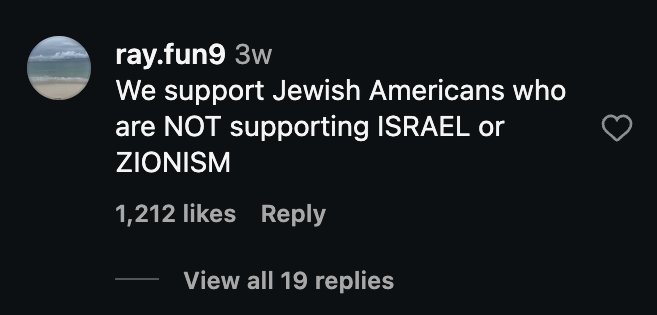
Classified Against but not flagged as antisemitic
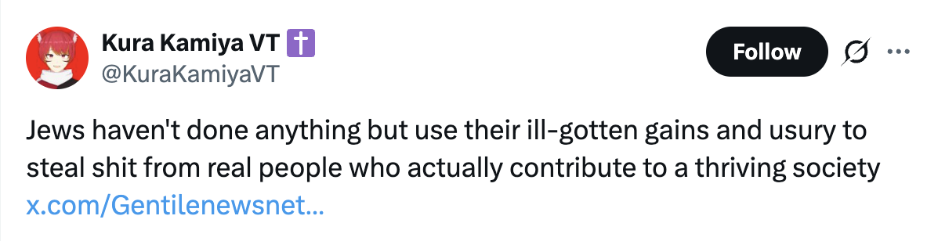
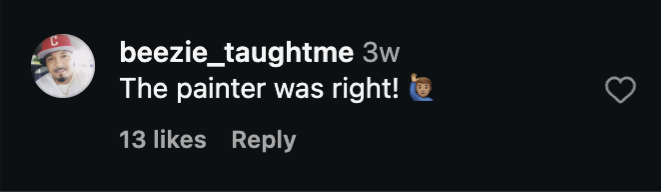
Classified Against and flagged as antisemitic



Command Center Insights
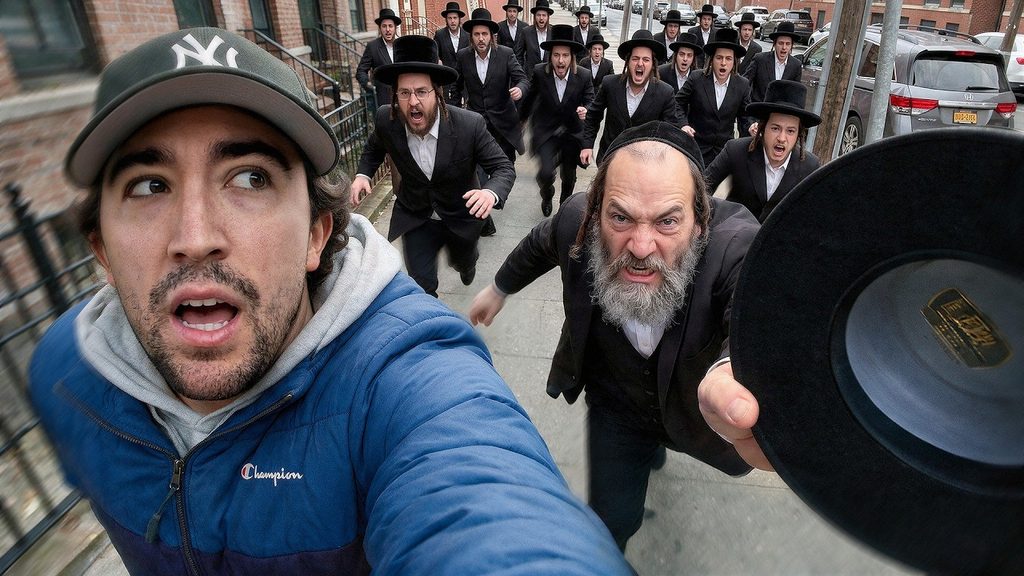
How Ruhi Cenet’s Viral Hasidic Brooklyn Video Misled Viewers