
On June 7, Colombian President Gustavo Petro wrote two words on X: “Heil Hitler.” His tweet was posted in response to a Colombian newspaper’s op-ed endorsing a right-wing presidential candidate who is Petro’s opponent in the country’s upcoming runoff election. His tweet, which is still available online, quickly gathered attention, with 36.3 million X users having viewed the tweet between when it was posted and June 12.
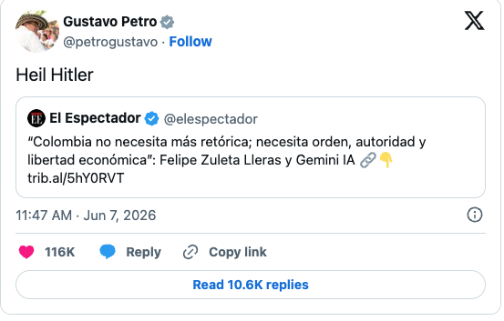
Politicians and Jewish advocacy groups were quick to emphatically condemn his words. The Anti-Defamation League wrote on X, “An elected head of state shouldn’t have to be told why posting a Nazi slogan is monstrous and unacceptable. There is no excuse for it and no context that justifies it.” Petro’s peers also made a clear statement against his tweet, with 24 lawmakers from 14 Latin American countries signing onto a declaration organized by the Combat Antisemitism Movement which stated that Nazism “must not become a rhetorical tool to discredit political or ideological positions.”
President Petro initially attempted to justify his actions by claiming the tweet was intended as a critique of fascism, meant to evoke a comparison between his opponent and the Nazi regime. But then, on that Wednesday, President Petro again invoked Nazi comparisons. While chairing a UN Security Council meeting in New York, Petro declared that “we’re going back to the era of the Nazis” during a debate on global conflicts and migration.
This was not the first instance in which President Petro employed Nazi comparisons for political rhetoric. Petro previously invoked Holocaust language, having compared Israel’s actions to Nazi Germany following October 7, 2023, and calling the Israeli national security minister a “true Nazi” just last month.
Mixed Response on Social Media
President Petro’s tweet received a lot of exposure, with 36.3 million individuals having viewed it in the five days since it was posted. X users also engaged with the post by responding directly to it over 11k times. The post also amassed over 116K likes and 16K retweets.
The Blue Square alliance analyzed a subset of 3,550 replies in both Spanish and English to determine whether reactions were generally supportive of Petro’s tweet or opposed to it. We found that a clear majority (63%) condemned the tweet while 17% were neutral. However, a portion of Petro’s X audience seemed to receive the post as he intended, with 21% expressing support.
Implications
The episode illustrates something worth noting. Petro did not frame his post as antisemitic, but rather as anti-fascist. Some of his supporters, and others online, accepted and even embraced his explanation of why he chose to use harmful rhetoric. But the majority condemned his rhetoric. Regardless of motive, the effect was the same – a sitting head of state deployed a Nazi slogan as a political weapon in a national election, without acknowledging why the use of language in that context was perceived as offensive and harmful.




Command Center Insights
How Ruhi Cenet’s Viral Hasidic Brooklyn Video Misled Viewers