
On Tuesday, July 7th, Argentina defeated Egypt in the World Cup, advancing to the quarterfinals and eliminating Egypt from the tournament. Before the game had even concluded, it became a lightning rod for antisemitic conspiracy theories. Even as conversations about Argentina’s team and star player Lionel Messi exploded across X and other platforms, a striking share of the conversation had nothing to do with the content of the game itself. Instead, social media users cast FIFA, the referee, and the Argentine national team as instruments of a Jewish or Zionist conspiracy — mirroring a pattern the Blue Square Alliance Command Center has previously documented across sports, entertainment, and politics alike.
The Data: Measuring the Surge in Online Antisemitism
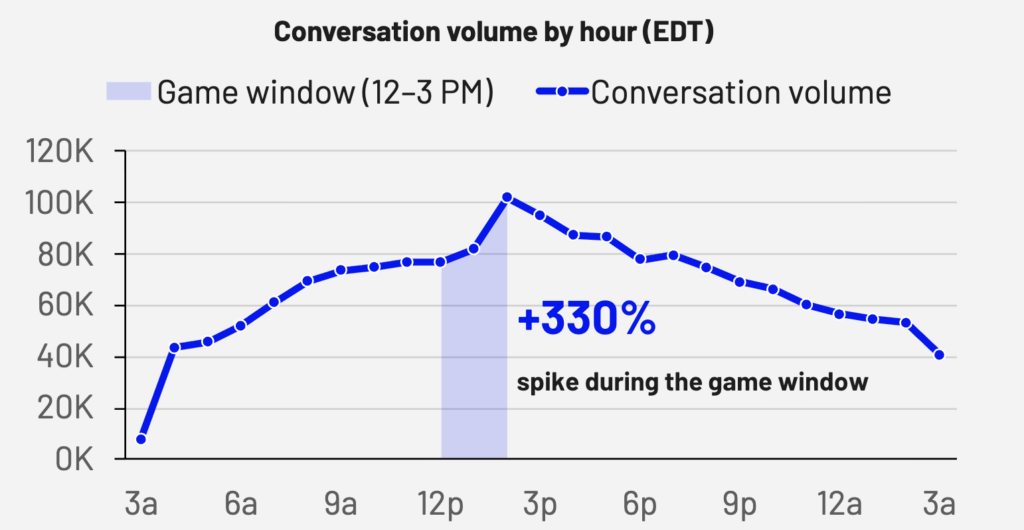
The Command Center tracked a 330 percent increase in conversations related to antisemitism, Jewish culture, and Israel between 12:00pm and 3:00pm EST, corresponding to the window from kickoff to one hour after the game’s conclusion. In the 24 hours following the game, the Command Center found that roughly 10 percent of all conversations on Argentina or Messi were antisemitic or about antisemitism-adjacent topics, resulting in over 300,000 mentions. These posts generated over 38 million impressions, far outsizing the volume of posts produced during that window.
The first spike in content related to Messi or Argentina occurred around 1:30pm EST, which corresponded to the moment an Egyptian goal was disallowed by the referee. This produced an initial wave of posts alleging that the goal was disallowed due to Zionist influence. A second, larger spike followed in the hour after Argentina overcame a 2-0 deficit to win the game 3-2. Following this second spike, conversation volume remained elevated in our dataset.
How False Narratives About Argentina and FIFA Spread
Online users were quick to cast Argentina’s victory over Egypt as evidence of Israeli and Zionist control over FIFA to influence the game’s outcome. The Command Center found that antisemitic conspiracy theories increased by 22 percent when comparing the hours before and after the game.
Online users generated a range of explanations, some rooted in credible news stories and others fabricated entirely:
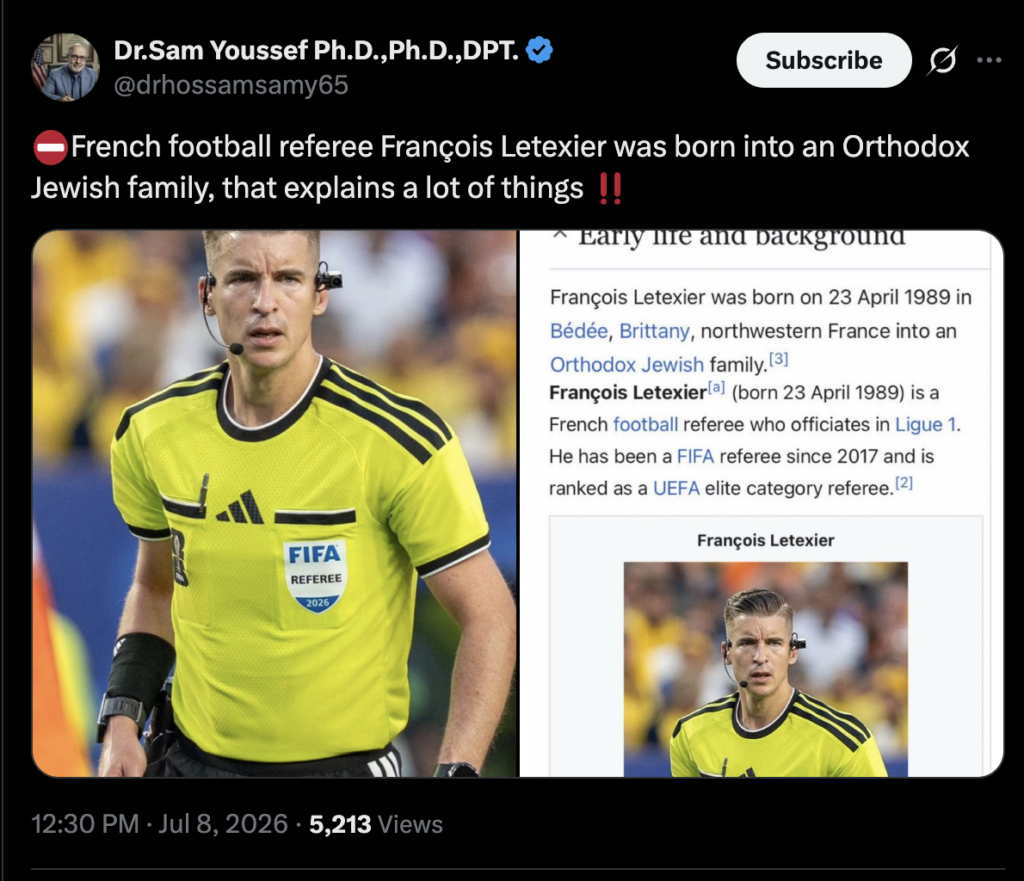
- The referee’s Wikipedia page was edited to falsely claim he is Jewish. Following Egypt’s exit, someone altered the “early life” section of French referee François Letexier’s Wikipedia page to suggest he was born into an Orthodox Jewish family in Brittany. The edit was reverted within hours, with editors noting there was no evidence or reliable sourcing for the claim, but screenshots had already spread widely and were used as “proof” the game was fixed.
- X’s AI chatbot Grok amplified the false claim before reversing it. When users asked Grok whether the referee was Jewish, the chatbot reportedly confirmed the fabricated claim, lending it a veneer of authority beyond the vandalized Wikipedia page, before later reversing its answer.
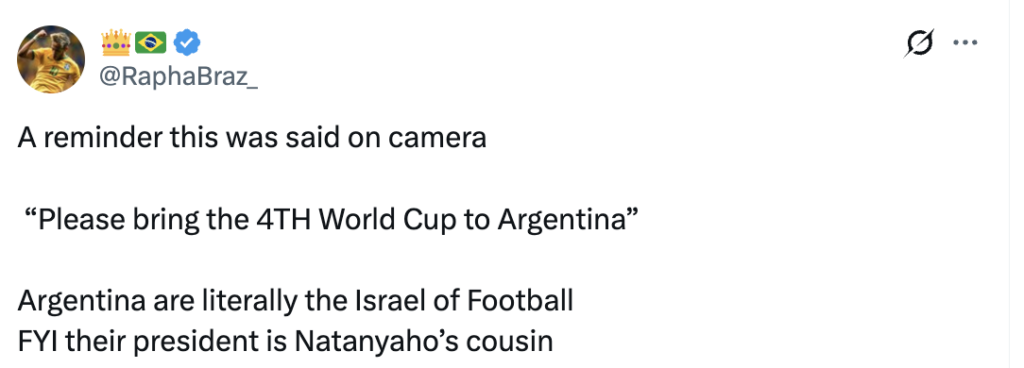
- A pre-tournament clip of Israel’s foreign minister was reframed as a “promise” of the trophy. A video of Israeli Foreign Minister Gideon Sa’ar speaking alongside Argentine President Javier Milei during a visit to Israel was recast online as Sa’ar jokingly asking Milei to “bring Argentina its fourth World Cup trophy,” with the poster declaring “Argentina is literally the Israel of football.”
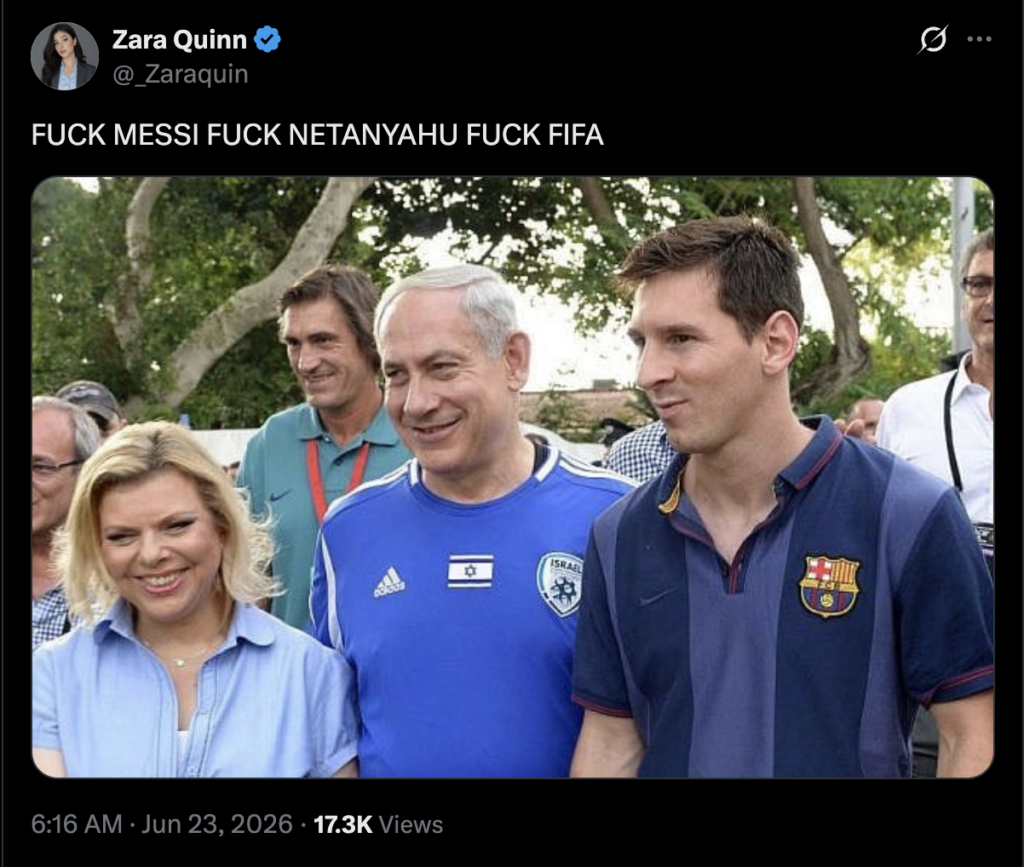
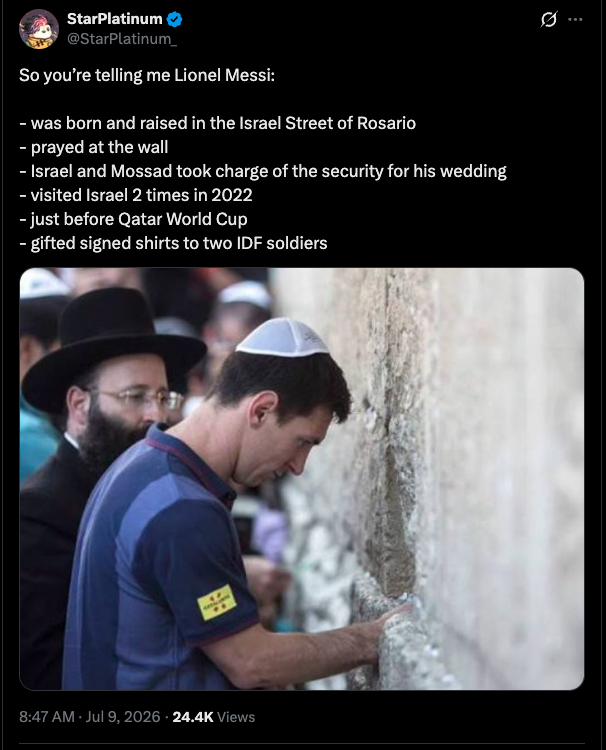
- Messi’s 2013 Israel visit was recycled as evidence of active collusion. Old photos of Messi meeting Netanyahu and visiting the Western Wall during his 2013 Barcelona “peace tour” trip were recirculated to paint him and Argentina as ideologically bound to Israel.
- A street name was misconstrued as evidence of Messi’s alleged connection to Israel. A viral claim asserted Messi was raised in Israel. In fact, he grew up on Estado de Israel (“State of Israel”) Street in the La Bajada neighborhood of Rosario, Argentina — a real Argentine street — before moving to Barcelona’s academy at 13.
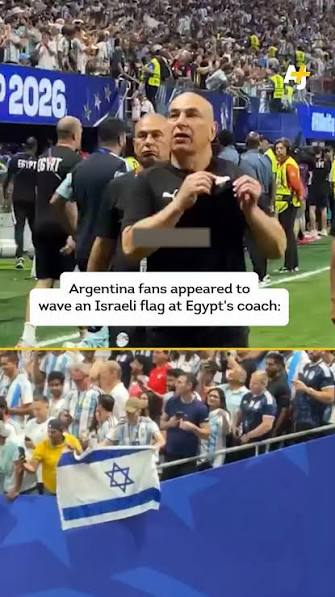
Additionally, an incident in which fans waved an Israeli flag became a flashpoint of its own. After the final whistle, footage circulated of supporters waving an Israeli flag in the stands, which visibly angered Egypt’s coaching staff and was quickly folded into the broader “Zionist conspiracy” framing. One Egyptian YouTube video, titled “Egypt loses to Zionism, the referee, FIFA and Argentina: A complete World Cup scandal,” turned a moment of fan celebration into supposed proof of ideological allegiance between Argentina and Israel.
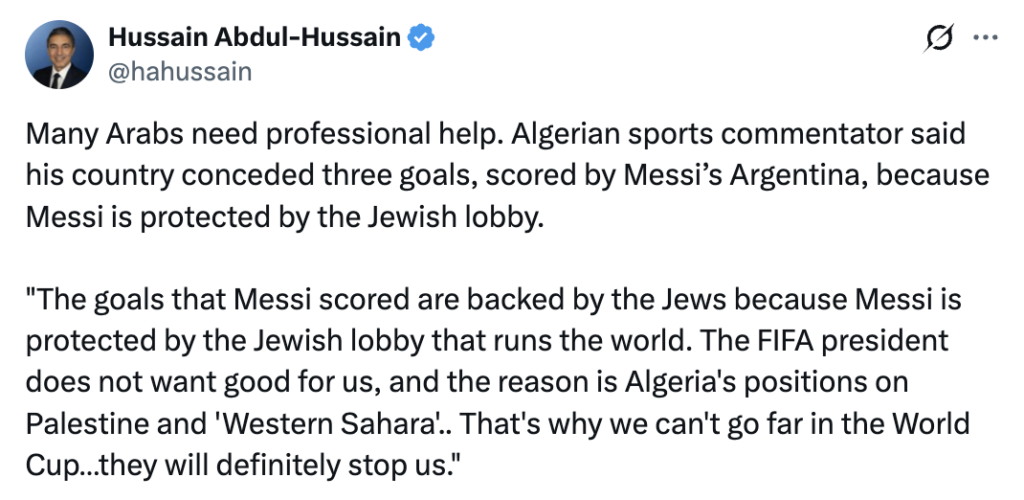
This was not the first time this type of conspiracy theory has spread. Following Argentina’s win over Algeria in the World Cup group stage, an Algerian broadcaster accused Messi of being “protected by the Jewish lobby,” claiming the group “controls the world” and runs it “however they want, as if they were the mafia,” and suggesting FIFA president Gianni Infantino was suppressing Algeria’s success because of its stance on Western Sahara and the Palestinian issue.
Most importantly, none of these conspiracies required a tangible connection to Israel. A disallowed goal, a decades-old photo, a street name, a diplomat’s small talk, and a flag in the stands were each, in turn, treated as confirmation of the same underlying claim: that Argentina’s win was not really a sports outcome but a Zionist one. The specific “evidence” changed by the hour, but the conclusion never did — which is itself the clearest marker of conspiracist reasoning rather than genuine inquiry. This pattern echoes the false-flag and Chabad narratives the Command Center has tracked elsewhere. It shows how readily a real-world event, even one as far removed from geopolitics as a soccer game, gets pulled into an existing antisemitic framework, and how quickly that framework can scale once high-reach accounts amplify it — in this case, aided by an AI system users treated as a neutral source of fact.
A Parallel Narrative: Nazi Comparisons
A smaller but notable slice of the conversation cast the country of Argentina as a Nazi nation. Posts compared Messi to Hitler or accused Argentina’s team of benefiting from a “Nazi agenda” in officiating. For example, one tweet that called Argentina “filled with Nazis and Israelis” in the same breath has since drawn over 980,000 views. Social media users also circulated memes directly comparing Argentine team members to Nazis.
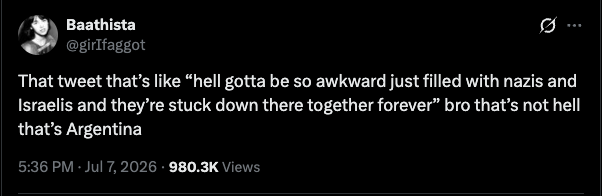
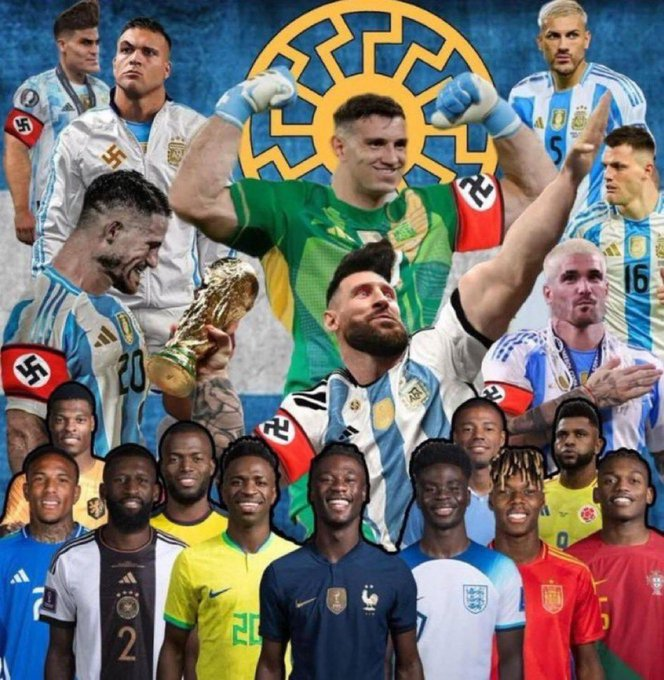
Even though “Zionist” and “Nazi” are not compatible accusations, both were being used the same way: as an insult drawn from the most historically loaded vocabulary available, chosen for its capacity to wound rather than its descriptive accuracy. That two opposite antisemitic tropes could be deployed against the same target within the same news cycle, without friction, illustrates how detached the rhetoric is from any coherent ideological content.
This detachment showed up in the broader data as well: the Command Center tracked a nine percent increase in Holocaust-related conversation on the day of the game, suggesting the Nazi framing wasn’t confined to a handful of viral posts but registered as a measurable shift in the day’s overall conversation.
Why This Matters
Major sporting events are increasingly functioning as high-velocity testing grounds for antisemitic narratives, and this incident illustrates why that matters beyond any single game. The conspiracy did not require an antisemitic premise to start, but it resolved, within hours, into a decades-old and highly portable script. That portability is the risk: the same “hidden Zionist hand” framework can attach itself to virtually any high-profile result, win or lose, and requires no prior connection to Jewish or Israeli subject matter to take hold.
The coexistence of the Zionist-control and Nazi-nation narratives makes the same point from a different angle. These are not variations on one coherent accusation; they are opposite and mutually incompatible tropes, yet both were deployed against Argentina within the same news cycle without contradiction registering for the users posting them. That is the clearest evidence that this rhetoric functions as an insult drawn from the most historically loaded vocabulary available, not as a genuine ideological claim — which is precisely what makes it so portable and so hard to pre-empt. A narrative that doesn’t need to be internally consistent to spread is a narrative that can attach itself to almost anything.


Command Center Insights
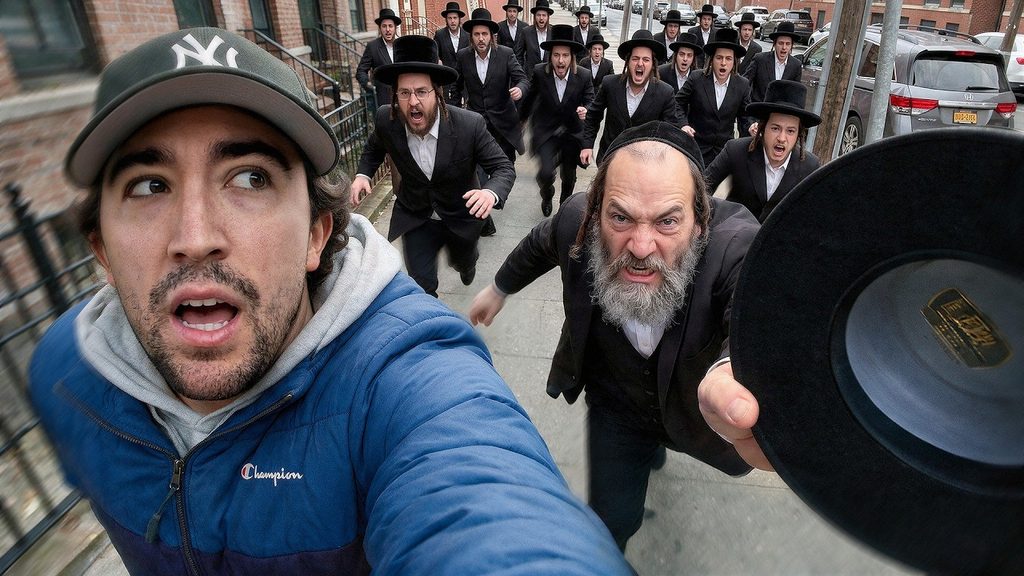
How Ruhi Cenet’s Viral Hasidic Brooklyn Video Misled Viewers