
Each year on April 20th the Blue Square Alliance’s Command Center registers a noticeable spike in online Hitler glorification. This is because some users commemorate Hitler’s birthday. Looking back over the past five years, there have been an average of about 19,000 mentions annually on this day related to Hitler’s birthday.
Before 2024, these conversations were mixed. Many users expressed anger or disappointment, while others pushed back against smaller groups openly praising Hitler. There were also consistent efforts to call out and challenge extremist voices.
Volume of Conversations on April 20th related to “Hitler’s Birthday” From 2021 – 2026
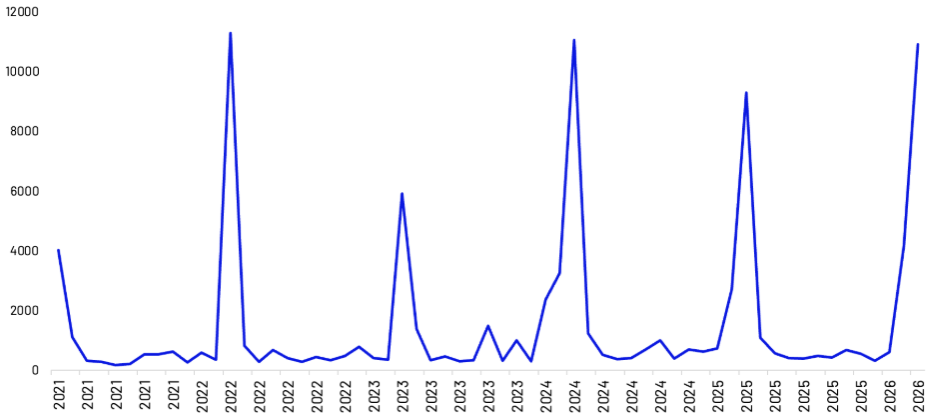
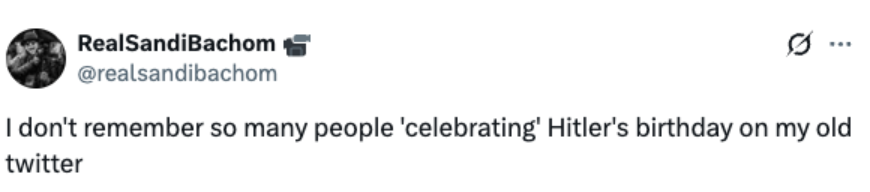
However, after the October 7 Hamas attacks, the tone of these conversations began to shift. On April 20, 2024, there were more than 10,000 mentions tied to Hitler’s birthday. Users online pushed conspiracy theories related to Covid and the 9/11 attacks, saying how “they” (referring to Jews) are planning something on Hitler’s birthday. Another mentioned how “next year” (referring to 2025), people will get to celebrate Hitler’s birthday and Easter, as they fall on the same day. All this bizarreness was captured by a user online, who wrote, “I don’t remember so many people ‘celebrating’ Hitler’s birthday on my old Twitter.”
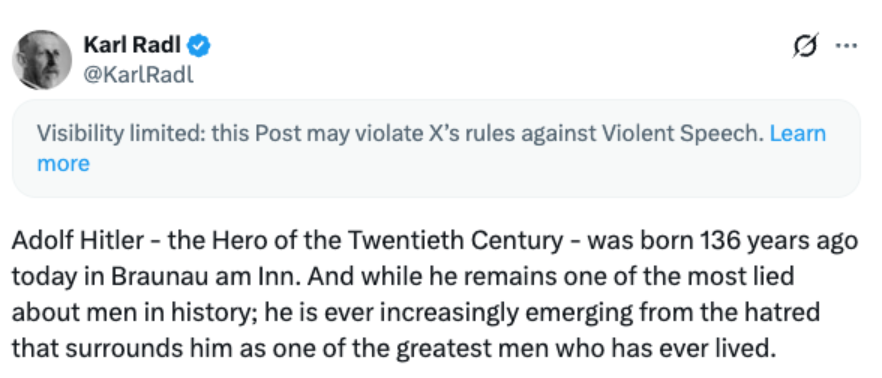
In 2025, the trend intensified. Because April 20 fell on Easter Sunday, online discussions took on a new dimension. Mentions of Hitler rose sharply, increasing by nearly 90% compared to the previous year. Conversations largely split into two patterns, both glorying the Nazi leader. One group of users openly praised Hitler, describing him as misunderstood or influential, and in some cases attempting to reframe his legacy in a positive light. The second group blended references to Easter and Hitler’s birthday, drawing comparisons between the two and framing both figures within the same narrative space. Alongside this, conspiracy theories also circulated with some users claiming that Hitler’s actions ultimately benefited Jewish or Zionist interests, portraying him as either a tool or a manipulated figure in a broader historical agenda.
This year follows a similar pattern in overall volume, but the nature of the conversation has changed significantly. In previous years, phrases like “happy birthday Hitler” or “happy Hitler day” appeared fewer than 890 times. This year, those same phrases were used approximately 10,800 times. This is an increase of more than 1,100%, showing that openly celebratory language is no longer on the sidelines, but far more visible in mainstream online spaces.
Volume of Conversations on April 20th, using celebratory phrases related to “Hitler’s Birthday” From 2021 – 2026
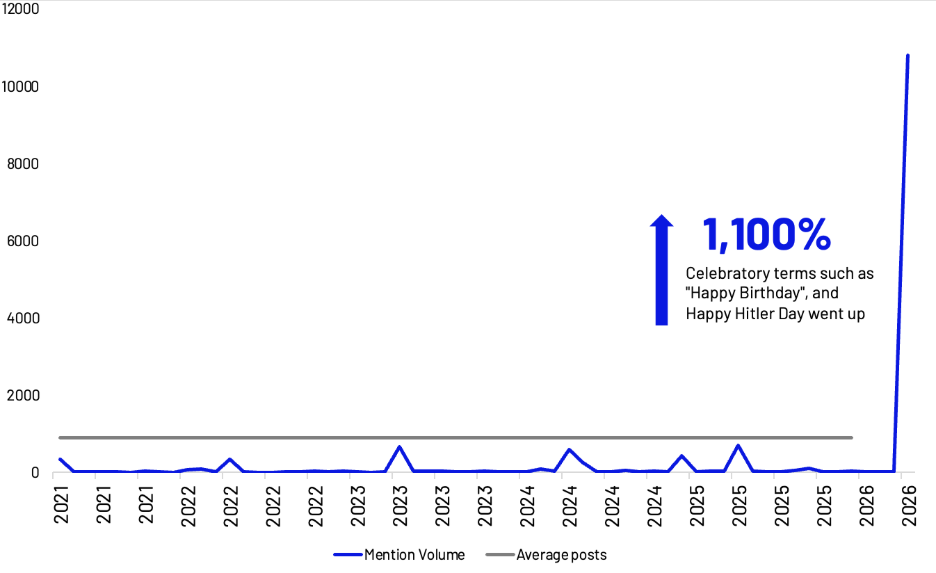
This year, posts wishing “Happy Birthday Adolf Hitler” made up about 25% of all Hitler-related conversations on the day. The rest included phrases like “celebrating Hitler’s day,” “Happy Hitler Day,” and “Happy 137th.” Users also relied on coded language, such as “88 happy birthday 137,” with “88” referring to “Heil Hitler” and “137” marking his age.
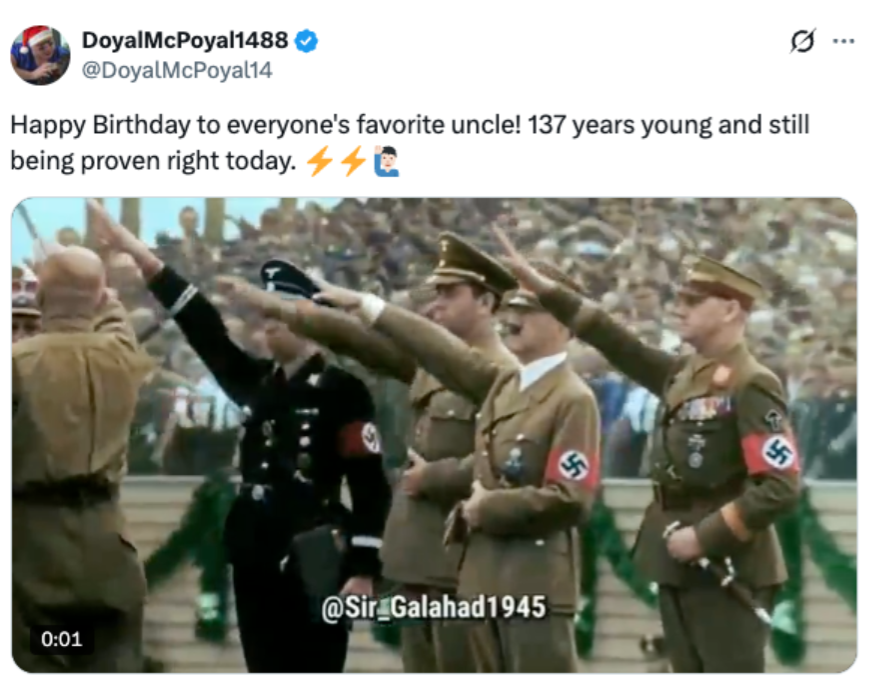
Another code that has emerged is “egg dumplings” or “Eiernockerl,” a dish, allegedly, known as Hitler’s favorite meal, which is now being used as a subtle birthday reference. A Report noted that an Austrian cafe faced restrictions or scrutiny around promoting the dish on April 20, due to its association with Hitler’s birthday.
Users echoed this trend online, with comments like “celebrated his life” by making Eiernockerl, or questioning why restaurants cannot advertise “egg dumplings (Eiernockerl)” on April 20. Some users appeared desensitized, commenting on the Austrian cafe restrictions by saying, “Isn’t all this WW2 crap just going a bit too far now?” Overall, while the volume of conversation remains consistent with previous years, the tone has clearly shifted. What was once more mixed and often challenged is now seeing a rise in normalization, with celebratory phrases and coded language becoming more visible in mainstream online spaces.



Command Center Insights
How the Internet Reacted to the Cost of Jewish Security