
Overview
Last week marked Yom HaShoah, Israel’s official day of remembrance for the six million Jewish victims of the Holocaust. The day is observed annually, on the Hebrew calendar anniversary of the Warsaw Ghetto Uprising.
This analysis examines how social media users respond to Holocaust remembrance, based on roughly 6000 replies to widely viewed X (Twitter) posts commemorating Yom HaShoah between 2021 and 2026.
Results
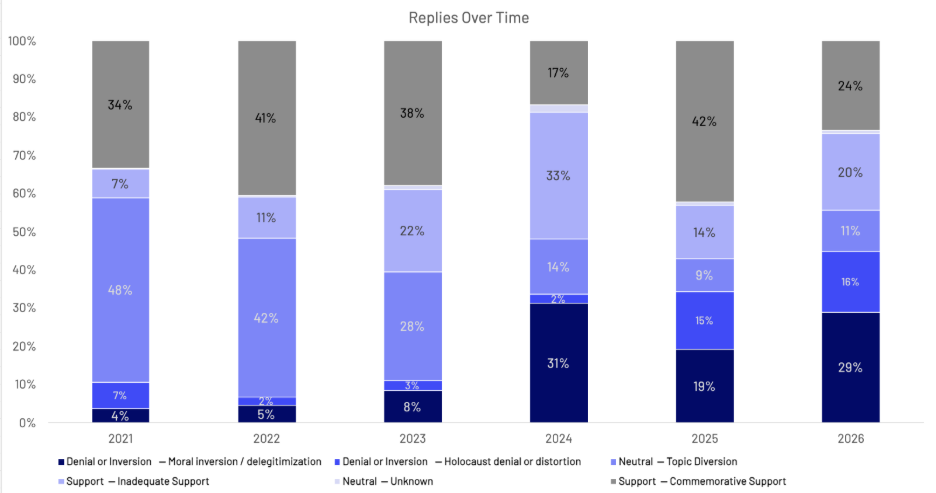
Across the six-year period, the distribution of reply types shows a shift in how users engage with posts commemorating Yom HaShoah. Full definitions of each category are provided later in the article.
| Category | Explanation |
| Commemorative Support | Expresses respect for Holocaust remembrance and keeps the focus on honoring victims and the day itself. |
| Topic Diversion | Redirects the conversation to other issues, groups, or events instead of focusing on Holocaust remembrance. |
| Moral Inversion & Delegitimization | Recasts Jews or Israel as perpetrators or frames Holocaust remembrance as insincere, exploitative, or illegitimate. |
| Holocaust Denial, Distortion, and Rejection | Denies, minimizes, or rejects the Holocaust or the legitimacy of commemorating it. |
| Calling Out Inadequate Support | Criticizes the poster for not showing enough support for Jews or for being hypocritical or unsupportive. |
Summary of Key Shifts
The clearest turning point comes in 2024, the Holocaust remembrance day following October 7, 2023. That period sees a sharp increase in both calling out inadequate support and moral inversion, bringing them from secondary categories to dominant ones. Moral inversion alone rises from 8.4 percent in 2023 to 31.2 percent in 2024, while calling out inadequate support increases from 21.5 percent to 33.2 percent. This shift reflects both rising concern within parts of the Jewish community, as well as a growing tendency to connect the Holocaust to the situation in Gaza.
In 2025, commemorative support rises again while calling out inadequate support declines, suggesting a partial return to comfort within the Jewish community. However, this does not represent a full reset. The combined share of moral inversion and Holocaust denial remains elevated at over one third of replies, as a sharp increase in denial from 2.4 percent in 2024 to 15.0 percent in 2025 offsets the decline in critique.
Across the final three years of the dataset, moral inversion and Holocaust denial increase to levels far above those seen in earlier periods and show no clear sign of returning to baseline. By 2026, these trends culminate in their highest combined share, with moral inversion at 28.9 percent and Holocaust denial at 16.0 percent, together accounting for nearly half of all replies.
Methodology
Command Center analysts collected replies to 150 X (Twitter) posts commemorating Yom HaShoah between 2021 and 2026.
For each year, the 25 highest-reach posts were identified, and from those posts, approximately 1000 of the highest-viewed replies were collected based on estimated visibility and engagement. The dataset was limited to replies posted within the two days preceding and the day of Yom HaShoah.
This resulted in a total sample of approximately 6000 replies.
Replies were classified into thematic categories using an initial round of automated labeling with ChatGPT, followed by human review and correction. All labels were verified by human annotators, and ambiguous cases were resolved through review.
Each reply was assigned to one of five categories:
Commemorative Support
Expresses respect for Holocaust remembrance or acknowledges the day without shifting focus away from it. This includes neutral or supportive references to victims, as well as inclusive mentions of other persecuted groups when the primary focus remains on commemoration. Example post linked here.
Topic Diversion
Shifts the conversation to other groups, events, or issues instead of focusing on the Jewish victims of the Holocaust. This includes references to other genocides, contemporary conflicts, or politics, as well as rhetorical challenges such as “what about” or “why aren’t you mentioning,” which redirect attention away from the primary focus of commemoration. Example post linked here.
Moral Inversion & Delegitimization
Reframes Jews or Israel as perpetrators or suggests that Holocaust remembrance is being misused or exploited. This includes drawing comparisons between the Holocaust and contemporary conflicts in a way that implies equivalence or reversal, as well as accusations that the original post is insincere or controlled by Jews or Zionists. Example post linked here.
Holocaust Denial, Distortion, and Rejection
Denies or distorts the Holocaust or simply rejects the original commemorative post. This includes explicit denial, minimization, or broader claims that Holocaust remembrance is illegitimate. Example post linked here.
Calling Out Inadequate Support
Criticizes the original poster for not doing enough for Jewish people or for being unsupportive or antisemitic. These replies often frame the commemoration as inadequate, hypocritical, or ironic. Example post linked here.
A small number of replies were categorized as ambiguous.
Activity and Sampling Context
Total Mentions of Yom HaShoah Each Year
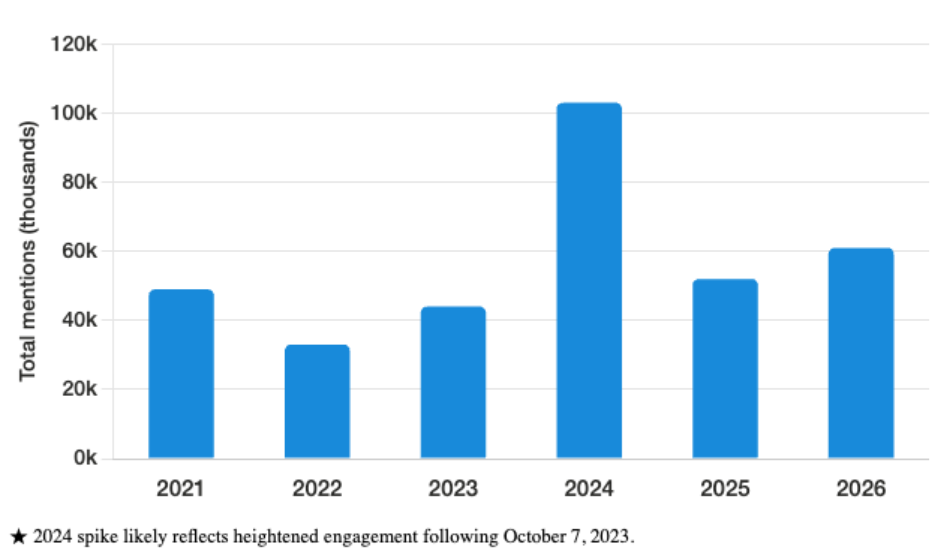
Overall mention volume of Yom HaShoah across the three-day observation window fluctuated across the study period, with a pronounced spike in 2024. This increase likely reflects heightened public attention following the events of October 7, 2023, which may have intensified engagement with Holocaust remembrance in the subsequent year.
Reply Volume and Minimum Impression Threshold by Year
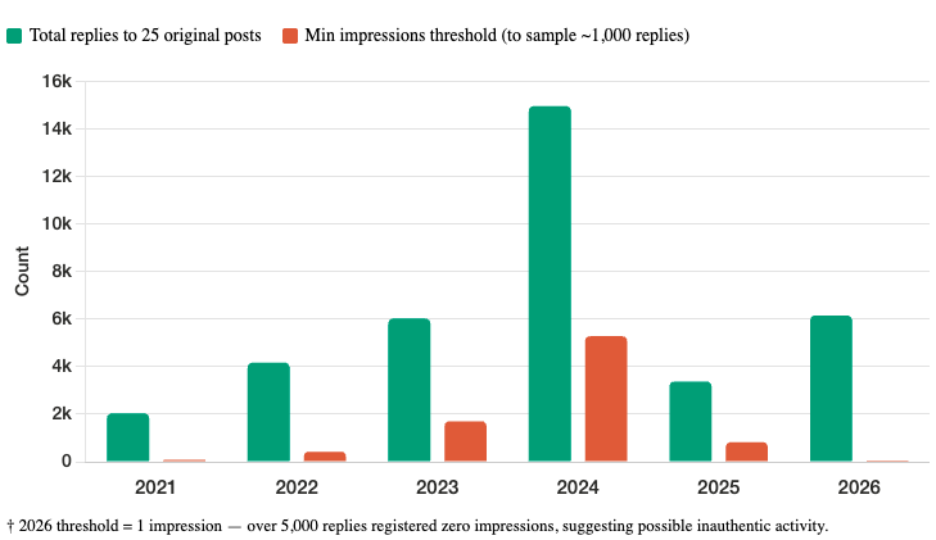
A comparison of the number of total replies and the minimum impression (view) threshold used to sample approximately 1000 replies per year reveals a notable anomaly.
The chart above shows total reply volume in green and the minimum impression threshold required to reach the sample of roughly 1000 replies in orange. In most years, a relatively high impression threshold was required, meaning mostly widely viewed replies were included in the sample.
In 2026, however, the threshold dropped to a single impression, yet only 942 replies met the sampling criteria. Given a total of 6153 replies across the selected posts from 2026, this implies that a large share of replies, over 5000, registered zero impressions.
This pattern may indicate the presence of inauthentic or low-visibility activity within reply threads in 2026. However, these posts are the most recent in the dataset, and while Yom HaShoah had passed more than a week prior to analysis, some engagement patterns may still be stabilizing.
Conclusion
Across the full period, the most significant shift is in how people engage with Holocaust remembrance at all. In the early years, a large share of replies avoided the topic, often redirecting attention elsewhere. Over time, that pattern declines sharply, and more users respond directly to the commemoration itself.
However, this shift toward direct engagement is not driven only by increased support. It is also marked by a rise in criticism, reframing, and moral inversion, particularly after 2023. The most dramatic change occurs between 2023 and 2024, when adversarial responses move from a secondary role to a dominant one. During that period, moral inversion increases from 8.4 percent to 31.2 percent, while insufficient support critique rises from 21.5 percent to 33.2 percent, together accounting for nearly two thirds of all replies in 2024.
By 2026, these trends converge into a more clearly polarized environment. Fewer replies ignore the commemoration, but a growing share actively challenge or reinterpret it. At the same time, Holocaust denial reaches its highest level in the dataset, reinforcing the extent to which the conversation has shifted from commemoration alone to a more contested and divided space.



Command Center Insights
How the Internet Reacted to the Cost of Jewish Security