On Thursday, November 19, Rockstar Games released Grand Theft Auto VI (GTA6), the first new mainline game in the Grand Theft Auto video game series since 2013. Grand Theft Auto has a long history of controversy for allegedly promoting violence and misogyny. The series’ controversies are matched only by its popularity. After more than a decade of anticipation, the launch became one of the most discussed events online. As often happens with conversations this large, part of it quickly turned hateful.
Last week, the Blue Square Alliance Command Center identified over 37,000 mentions of GTA6 in connection with Jews or antisemitism, much of it hateful.
How GTA VI Became Part of an Antisemitic Online Narrative
Unlike previous stories of hateful trends about popular media, the volume of hateful rhetoric online rose after the game came out and people began playing it. GTA6 was released Thursday, November 19th at midnight, regardless of each player’s time zone. As a result, franchise enthusiasts set their location to New Zealand, which allowed them to first play the game earlier than they would otherwise be able to. The graph below shows that virtually all the hateful rhetoric occurred after the game came out.
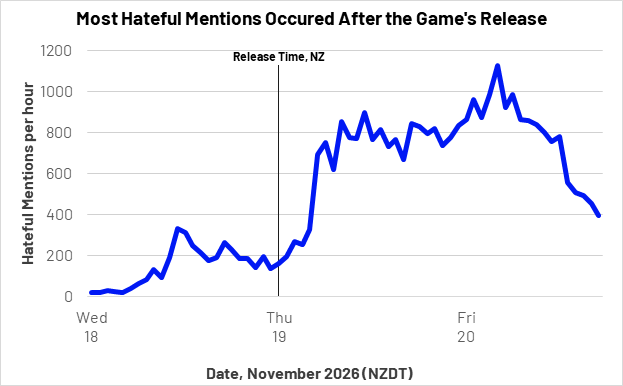
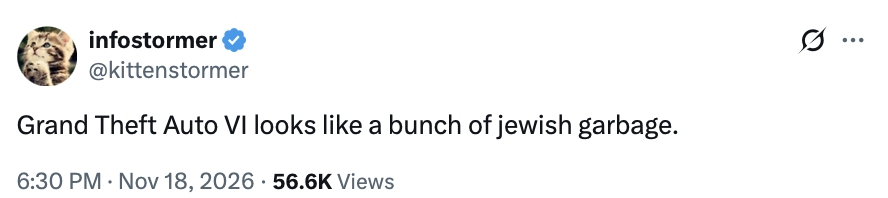
This surge in hateful posts seemed to be driven by people engaging with the game itself. The antisemitic posts reflect this, with many of them expressing disappointment about the game alongside accompanying gameplay footage. Throughout these posts, one word came up more than any other: goyslop.
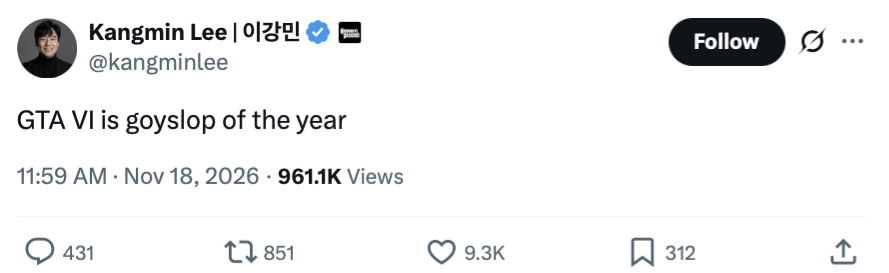
What “Goyslop” Means in Antisemitic Online Spaces
“Goy” is a Hebrew and Yiddish word that simply refers to non-Jews. Antisemites have misused the word as proof that Jews believe they are superior to non-Jews. In antisemitic spaces online, “goy” has taken on a new meaning: a person who questions nothing and does whatever Jews supposedly want.
“Goyslop” builds on that misappropriated meaning of “goy”. The term describes low-quality or harmful products that Jews supposedly feed to non-Jews, who are imagined as happily consuming whatever “they” provide. The audience is cast as passive, while the producer is cast as a hidden, manipulative force.
The label can be applied to almost any mass-market product, including fast food, movies, television, and video games. In each case, it carries the same assumption: that Jews are deliberately supplying non-Jews with poor-quality goods. Because it ties Jews to the products of big business, the term reinforces two tropes at once: Jewish control and the stereotype linking Jews to money.
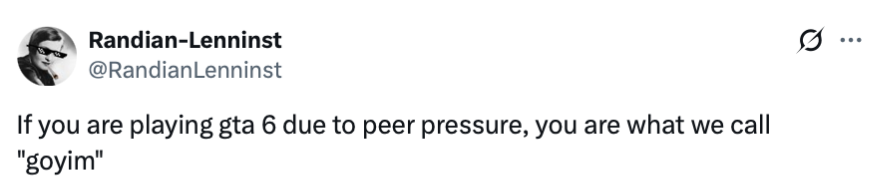
Why GTA VI Was Cast as “Goyslop”
GTA VI fits easily into the goyslop narrative. It is a hugely hyped release from a large corporation, and large corporate products are an easy stand-in for the “they” said to control mass culture. The series is also especially popular with younger players, an audience which the Blue Square Alliance’s Command Center has found is more likely than older generations to hold antisemitic beliefs.
The scale of the hype around GTA6’s release also made some disappointment unavoidable. For users already drawn to the goyslop narrative, a complaint about the game became proof that it lacked artistry. A product without artistry is “slop,” and slop is something businesses supposedly create to keep people sedated. Once that kind of narrative is accepted, the only thing separating it from the goyslop narrative is the blame.
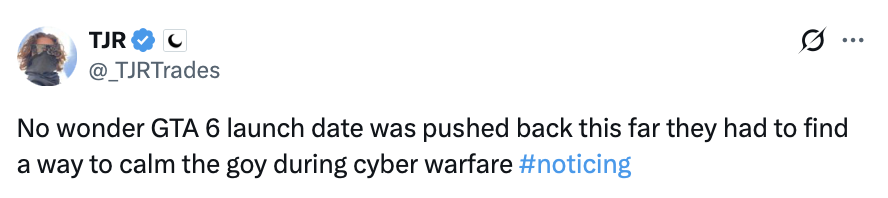
Through this chain of reasoning, any criticism of the game, even an ordinary complaint, can be folded into the conspiracy. Players who enjoy the game are cast as the passive “goyim” happily eating what they are fed.
How Misogyny and Racism Entered the GTA VI Debate
Disappointment alone does not explain the reaction. Plenty of games are panned without being called goyslop, and GTA VI has received mostly positive reviews. The goyslop rhetoric around GTA VI is tied to a much more specific narrative.
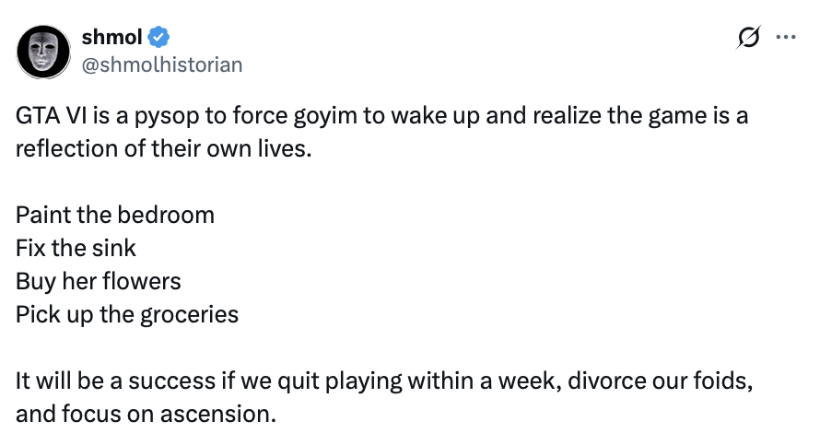
Much of the GTA VI conversation that used “goy” language focused on anger at the inclusion of women and racial minorities. The game features Lucia, a prominent female character with her own wants and a degree of control over the main character. Some users treated her presence as evidence of a deliberate agenda rather than a creative choice, as if a female character whose wants are addressed at all were inherently political. The absurdity of these complaints really becomes clear once one realizes that the emasculating behavior described is innocuous gestures like buying a woman flowers.
The post below demonstrates this dynamic. While the anonymous poster briefly criticizes the game as “goyslop,” they devote most of their post hating women. They complain that the main character is a cuck/simp, both words used to describe men seen as being overly deferential to women in an emasculating way. Meanwhile the female character is referred to as a “foid”, a derogatory term for women based on a portmanteau of ‘female’ and ‘android’. After blaming female developers for these issues, this poster calls the game “redpilling”, a term used to describe acceptance of misogynistic ideology.
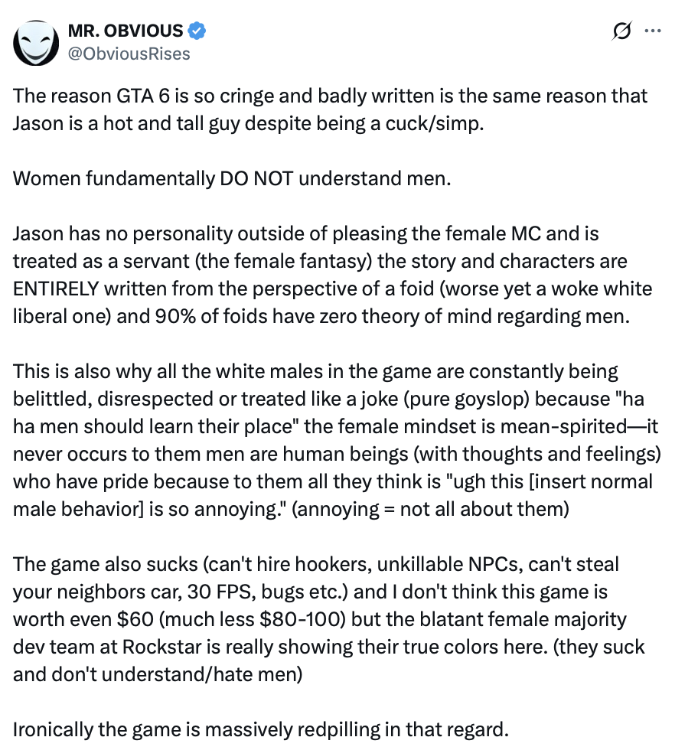
Together, these posts build a story in which GTA6 is a targeted plot to emasculate white men and empower women. Greater representation is framed as something done to white men, not as a creative decision.
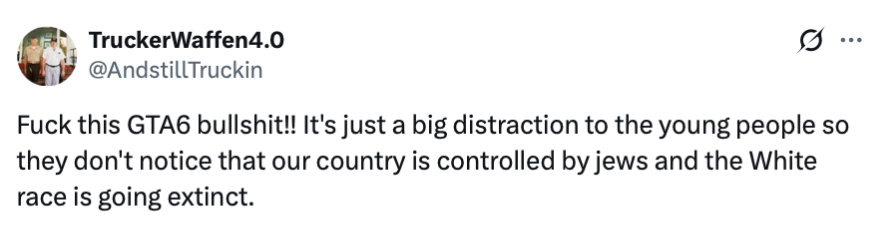
In this narrative, antisemitism becomes intertwined with other forms of hate. Jews are blamed for supposedly propping up women and minorities illegitimately, while supposedly weakening and emasculating white men.
What the GTA VI “Goyslop” Narrative Means
The Great Replacement is an antisemitic conspiracy theory which claims that Jews are trying to destroy white people and replace them with racial minorities. The Grand Theft Auto hate represents a developing variant of this theory where Jews are operating not on behalf of racial minorities but on behalf of women.
The reaction to GTA VI shows how antisemitic narratives adapt to whatever dominates public attention. The idea of Jewish control can attach itself to almost any disappointment, whether a video game, a movie, or the economy.
The specifics of the narrative are largely unimportant. Even the supposed Jewish motivations can comfortably switch between racial and gender equality without any significant problems. These narratives normalize the image of Jews as hidden puppet masters among large, young online audiences. Repeated exposure, often framed as a joke, can make that idea seem like common sense.
The harm does not stop with Jews. By casting women and minorities as pawns in a Jewish plot, the narrative denies them any agency of their own. Antisemitism then becomes a tool for denying those groups’ legitimacy in public conversation and an equal place in society.