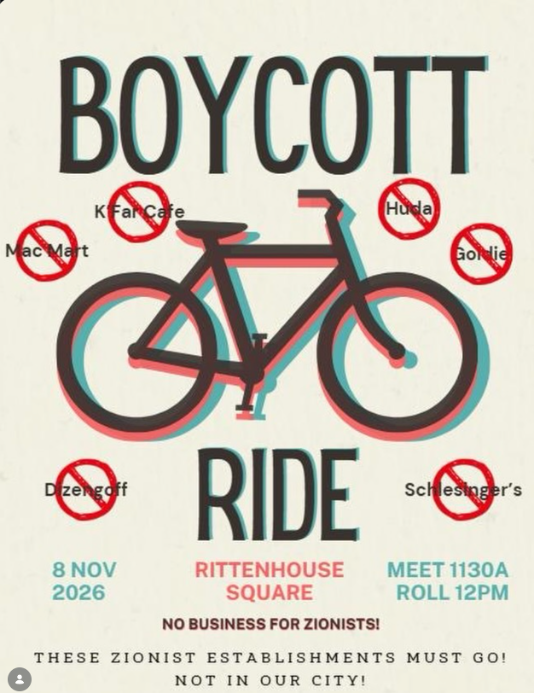
On November 8, 2026, cycling club Philly Bike On Your Left led a boycott targeting six Jewish-owned restaurants in the city’s Rittenhouse Square neighborhood. The event consisted of a bicycle ride through the neighborhood, during which participants distributed flyers that called for those businesses to leave the city. The ride fell the day before the 88th anniversary of Kristallnacht, a state-sponsored day of vandalism and arson against Jewish-owned business in Nazi Germany which resulted in hundreds of deaths and thousands of deportations.
The boycott, which drew about 300 supporters on the day of the event, inspired counterprotests and an outpouring of support for the six affected restaurants. Nearly 200 counterprotesters showed up to the event. In addition, the restaurants reported that hundreds of customers lined up to buy meals that afternoon.
The boycott was also widely denounced by elected officials and other public figures. The scale of condemnation was unusual, as similar prior campaigns did not elicit responses as emphatic or widespread.
Officials and Public Figures Condemn the Philadelphia Boycott
Most of the online reaction happened before the rally took place. By the Friday before the ride, politicians from the Senate and City Hall had denounced the ride. Four features of the wave of condemnation stand out.
It was pre-emptive. Governor Josh Shapiro’s office called the ride “blatant antisemitism designed to intimidate and drive Jewish businesses out of our communities” days ahead. Pennsylvania State Police were engaged with local partners before the event.
It was bipartisan. Senators John Fetterman, a Democrat, and Dave McCormick, a Republican, both condemned the ride.
It crossed the progressive line. District Attorney Larry Krasner, described by JTA as a favorite of the progressive movement, condemned it and joined a solidarity lunch alongside Pennsylvania’s first lady. Mayor Cherelle Parker, Attorney General Dave Sunday and Congressman Brendan Boyle all posted statements. Boyle said the proximity to the Kristallnacht anniversary evoked the darkest chapters of history.
It escaped politics entirely. Baseball Hall of Famer Reggie Jackson, who has no record of involvement in this conflict, published a long statement citing ADL incident counts for Pennsylvania and asking where elected officials were. Out-of-state politicians weighed in too, including Senator Rick Scott of Florida and New York State Senator Sam Sutton.
Blue Square Alliance’s Command Center tracked 15 social media statements posted by elected officials and other public figures to condemn the boycott. We found that, of the 866 replies to those posts, a clear majority (62 percent agreed with the condemnations rather than supported the boycott.
Past Boycott Campaigns Drew Less Public Condemnation
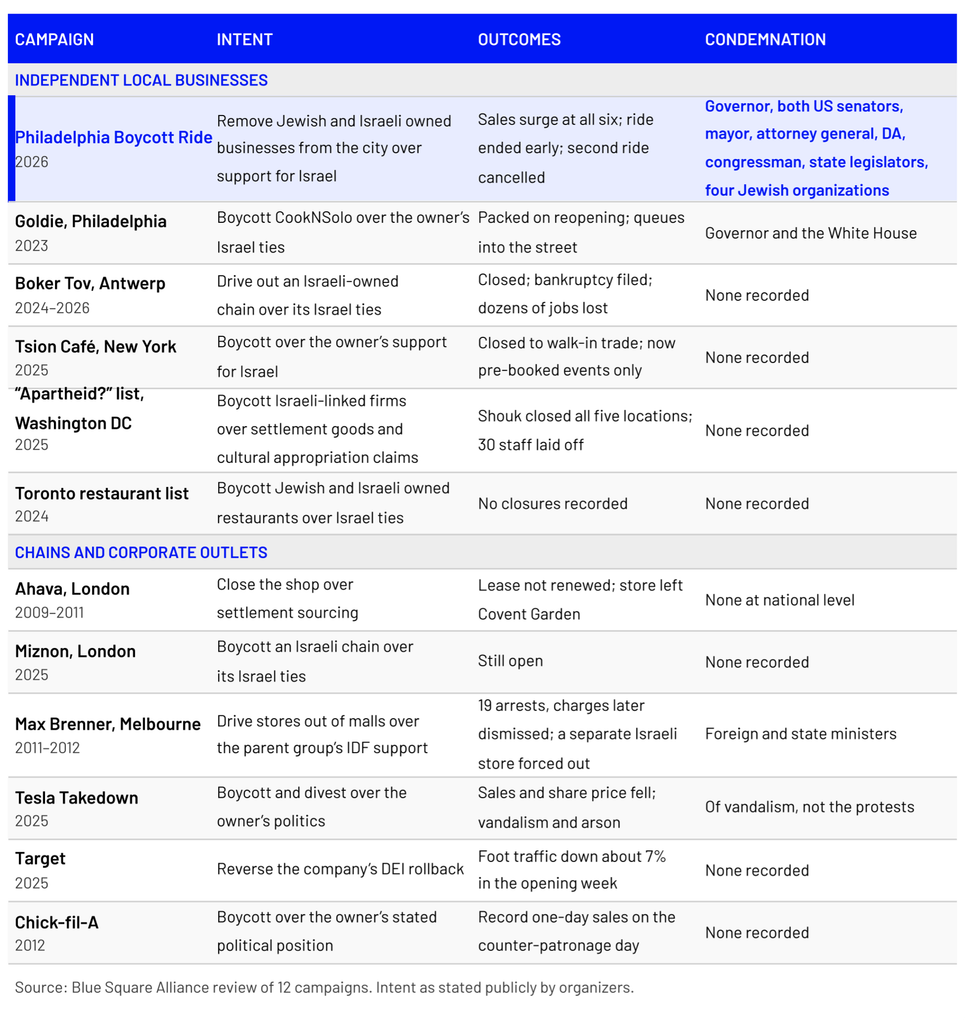
We reviewed 12 boycott campaigns that publicly named specific businesses as targets, all of them in the era of social media, six aimed at independent local businesses and six at chains or corporate outlets. For each we looked for on-the-record statements referring to that campaign, in any format, from elected officials and well-known public figures outside politics. We found none that drew condemnation comparable in range or seniority to Philadelphia’s, and in most cases, we found no such statement.
Among the U.S. cases, the Washington DC “Apartheid?” list, the Toronto list and the campaign against Tsion Café in New York drew no official condemnation we could find, even as Shouk in DC and Tsion Café both ceased normal operations. Among the chains, the Ahava pickets ran in London for over two years with no condemnation from public officials. The Max Brenner protests in Australia drew comment from then Foreign Minister Kevin Rudd, which is senior but narrow. The closest precedent is local. The December 2023 march past Goldie, in the same square against the same restaurant owner, drew condemnation from the governor and the White House within a day. That was fast, but not pre-emptive, and it did not pull in bipartisan or non-political reactions.
Why the Philadelphia Boycott Drew a Different Response
Three things distinguish this campaign from prior ones that drew little or no counteraction.
The flyer advertising the protest asked for a removal of the businesses, not avoidance. The organizers’ October 30 Instagram post declared “No business for Zionists! These Zionist establishments must go! Not in our city!” Earlier campaigns asked people not to buy a product.
The targets were neighborhood businesses, not corporations. Ahava was a foreign company and Max Brenner a chain owned by a large food group, so the claim against them was about corporate conduct. Three of the six Philadelphia targets belong to the CookNSolo group cofounded by Michael Solomonov, and the other three are independently owned by American Jews.
The date removed the ambiguity. The ride fell on the eve of the Kristallnacht anniversary, which gave every speaker an unambiguous frame.
What Blue Square Alliance Survey Data Shows About Attitudes Toward Antisemitism
Our June 2026 landscape survey found Americans’ antisemitic attitudes have noticeably worsened since August 2025. Our segmentation model, which classifies Americans into five groups by their attitudes towards Jewish people, belief in antisemitic tropes, and perceived seriousness of antisemitism, now finds fewer Allies and more Haters than our previous survey in 2025. Despite that change, most Americans (52 percent) still believe it is very harmful to blame Jewish people for the Israeli government’s actions. Among the Unengaged, that rose to 55 percent, while Allies held at 91 percent and Haters at 25 percent.
The Philadelphia boycott ride exemplified that distinction. Naming six Jewish-owned restaurants and calling for them to leave the city landed on the side of the line a growing middle says is harmful, which gave officials broad public backing for condemning it.
Philadelphia Boycott: Turning Point or One-Off?
The businesses the boycott named had their best day of the year, the ride ended early, and on November 12 the organizers called off a second ride planned for the following Sunday.
Campaigns similar to this one have been run in the past fifteen years in London, Melbourne, Toronto, New York, and Washington. Most of them occurred without public condemnation from elected officials, including boycotts which forced businesses to close. Philadelphia broke that pattern, and the reasons appear to lie in how this campaign was conceived and framed rather than in any shift in how officials respond. The test will be the next campaign of this kind.