
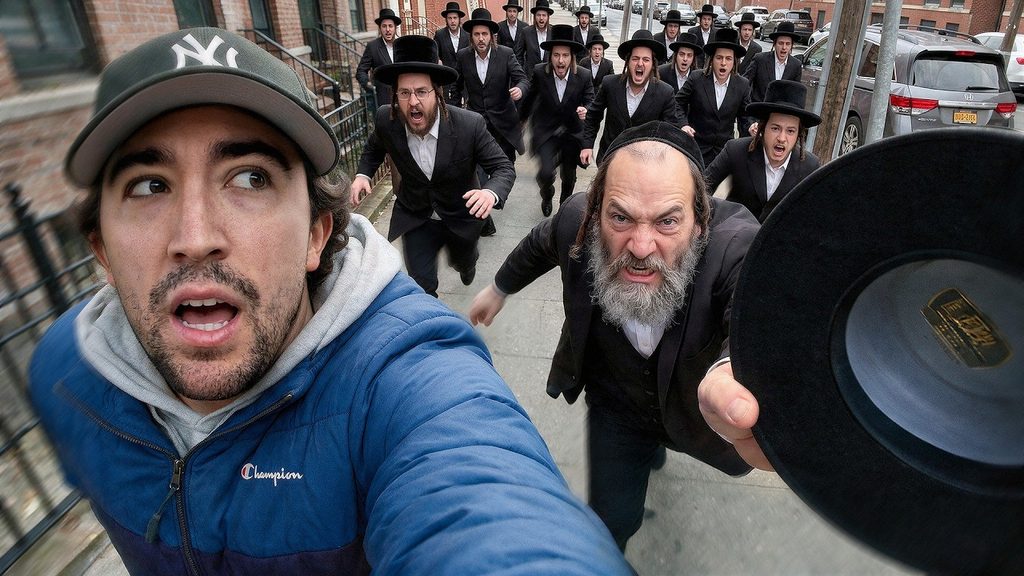
Popular YouTuber Tyler Oliveira recently published a video titled “I Exposed a Jewish Fraud Ring Stealing from Poor Kids.” In this video, he baselessly accuses Orthodox Jewish communities in New York and New Jersey of fraud by deliberately overcharging with E-Rate, a federal program which provides discounted internet for schools and libraries.
Who Is Tyler Oliveira?
Tyler Oliveira is a YouTuber, right-wing provocateur, and self-described independent journalist with nearly 10 million subscribers. Oliveira has a long history of hateful content. Just in the past year, Oliveira has released videos calling each of the following groups invaders: immigrants to Ireland, Indian immigrants in Portugal, Indian Americans in Texas, Jews in New Jersey, Indians in Canada, Jews in Rockland Country, and Somalis in Minneapolis.
Oliveira also has a history of antisemitic conspiracy theories. Blue Square Alliance’s Command Center previously documented how Oliveira published videos he claimed were “investigating” Orthodox Jewish communities and popularized the slogan “Goyim Lives Matter.”
How Tyler Oliveira Connects Past Fraud Cases to Present-Day Claims
Oliveira’s video opens with a description of a prior fraud case involving government payments for internet in schools. Although the events described are real, including a description in his video is willfully misleading because that prior case is unconnected to the purported fraud Oliveira’s video is about.
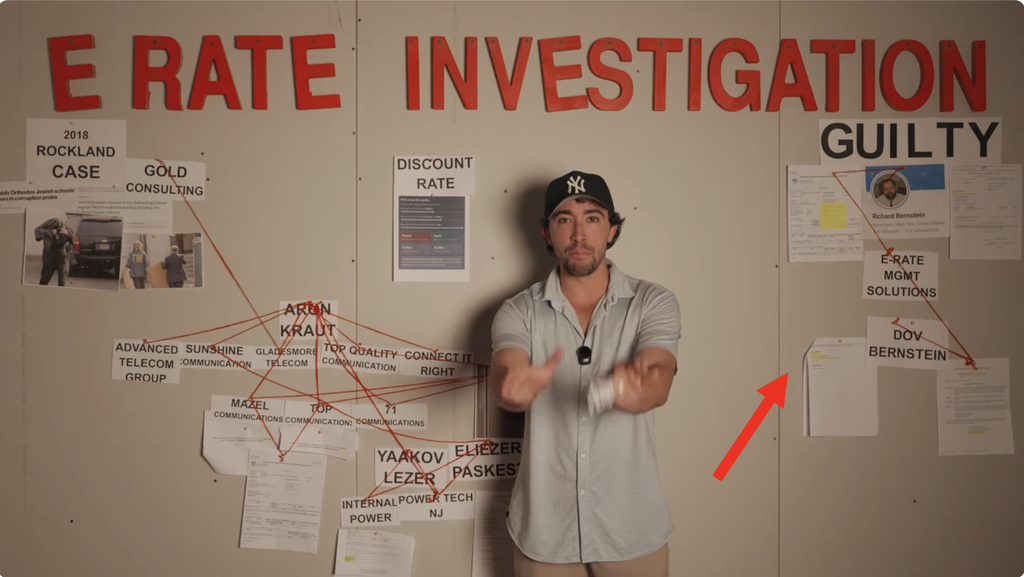
Next, Oliveira mentions a similar incident from 2018, teasing an “ugly truth” the video will subsequently reveal. The remaining runtime shows Oliveira approaching Orthodox Jews employed by the institutions he accuses of fraud, to question them about internet billing. These interviews are interspersed with sections where Oliveira speculates how the supposed fraud scheme may have operated and names the institutions supposedly involved. Throughout these sections, Oliveira heavily implies that Jewish consultants and schools from the 2018 case continued the same fraud scheme through new corporate entities, yet he does not present any corroborating evidence.
Oliveira also builds suspense and suspicion by repeatedly hinting that his video will reveal salacious information, while prolonging a revelation of wrongdoing. The aforementioned “ugly truth” appears right at the end of the video, revealing that in 2018, some of the organizations he accuses of fraud in his video were involved in the prior fraud scheme. So, despite a dramatic lead-up, his video’s conclusion does not deliver on the promised revelation – or any current evidence of fraud.
How Suspense Obscures Gaps in the Evidence
The video’s structure keeps viewers engaged by creating suspense and emotional investment in the case as its scale seems to balloon. This is not how professional journalism is typically presented. However, it is the structure of most movies about journalism . The audience, therefore, experiences the video the way they would watch a journalism movie; going from a clue to a debrief to another clue knowing that even if some puzzle pieces are missing, all will be revealed eventually. This style causes the audience to become more connected emotionally (because they now have a narrative to latch on to) and less connected logically (because they lack the information needed to critically assess it).
Because the audience is watching emotionally, it becomes less obvious when the video contradicts itself or makes specious claims. Most critically, it hides the fact that the interactions with Orthodox Jews provide no useful information whatsoever.
Why Refusing an Interview Is Not Evidence of Fraud
During the interviews, Oliveira mostly walks up to random administrators and demands to speak with them about billing. Most seem to not know the answers off the top of their head and have no interest in discussing finances with an unknown provocateur. Most conversations either end when the person in question realizes that Oliveira is a private actor rather than a government official, or the moment they realize they are being recorded. The pattern then repeats: each time, he pretends to glean information from a refusal to talk, characterizing it as suspicious. Then, he approaches a completely unrelated person which he frames as progressing in the investigation.
Framing Orthodox Jews as a Threat
To compensate for this logical incoherence, Oliveira doubles down on the emotional narrative by encouraging animosity. Oliveira includes tangents and long segments that have nothing to do with his supposed topic of telecommunications fraud in Orthodox schools but do help him frame Jewish people in an antagonistic role. In one long sequence, he visits a yeshiva and is immediately told to leave. As he leaves, a group of Orthodox Jews comes outside for unclear reasons. The footage is edited and scored menacingly, framing Oliveira as surrounded by a hostile force. He then repeatedly emphasizes how much danger he is in.
At the end of the encounter, he admits, “We gained nothing by coming here besides some really funny shots.” That raises an obvious question: if he gained nothing, why include the scene in his serious “citizen journalism”?
How Tyler Oliveira’s Fraud Claims Fuel Antisemitic Conspiracy Narratives
Oliveira would probably disagree with this assessment. Throughout the video, he presents himself as “simply asking questions.” At the very end, and again in the video description, he states that nothing shown beyond the existing indictments is concrete evidence of wrongdoing, and he acknowledges that high prices or single-bidder contracts do not by themselves prove fraud.
However, imagine an alternate scenario where Tyler Oliveira followed a more typical structure: he discusses the scheme in 2018, explains why he thinks it might be happening today, and then tries to interview a bunch of Orthodox Jews who either know nothing about the alleged crime, or know and are unwilling to talk to him. This video would be widely mocked. The sheer pointlessness of the interview segments would be so obvious that no one could ever take the video seriously. Oliveira’s excuse would fall flat because he cannot demonstrate that his questions are even worth asking.
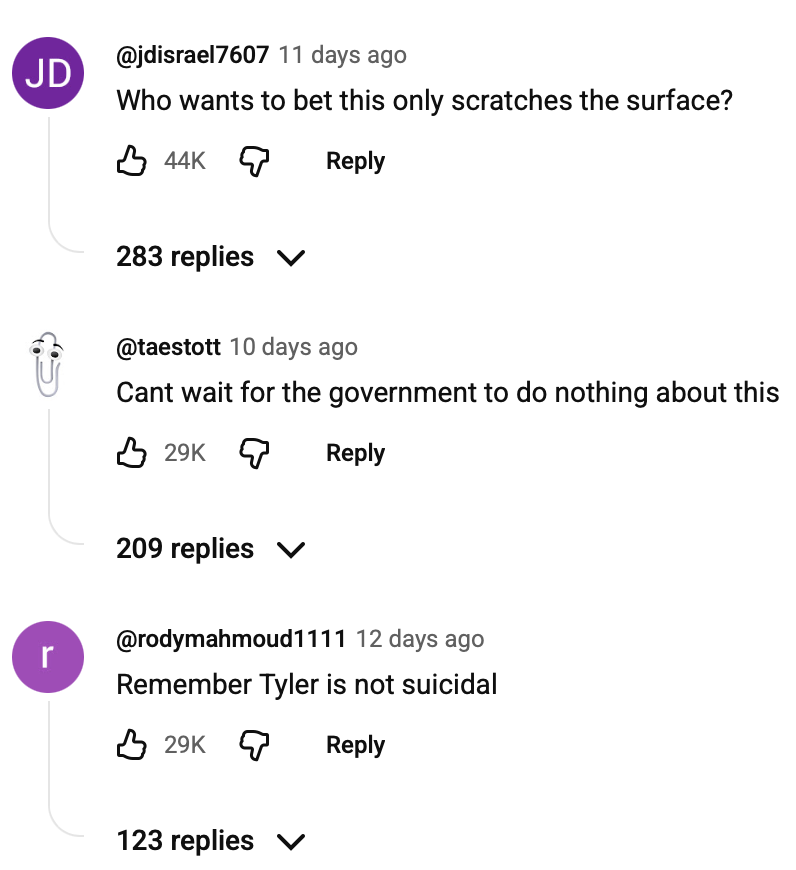
Unable to persuade his audience in a logical way, Oliveira instead relies on a highly emotional narrative portraying the Orthodox community as an insular, hostile mass: a group that refuses to answer questions and menacingly gathers in crowds when outsiders arrive. Tyler Oliveira’s audience seems to agree, with comments that allude to or outright claim the existence of a Jewish conspiracy. Some comments even suggest that Oliveira may be killed for exposing it.
Misleading or false narratives like Oliveira’s “documentary” matter because they further antisemitic narratives which lead to real, often violent consequences. Sixty (60) percent of antisemitic hate crimes in New York target Orthodox Jews. In one high-profile incident earlier this year, an attacker rammed his car repeatedly into the Chabad-Lubavitch headquarters in Brooklyn. And, just this week, a man was arrested for making terror threats after he posted online that he would murder U.S. Defense Secretary Pete Hegseth unless Hegseth killed Jews at a Chabad.
In that sense, the non-sequiturs and pointless conversations are not a weakness of the video. They are just as important as the parts that resemble more traditional journalism. The latter sections give Oliveira’s grievances the appearance of substance, while the former clarifies who exactly should be the target of these grievances. Every refusal to speak becomes evidence of collective guilt, while the lack of evidence implicitly becomes evidence for a coverup. For Oliveira, the pointlessness is the point.



Command Center Insights
How Ruhi Cenet’s Viral Hasidic Brooklyn Video Misled Viewers