
Nearly four in ten Americans fall into the High or Very High categories of general conspiratorial thinking. They are nearly three times as likely as other Americans to endorse antisemitic tropes.
Since 2023, the Blue Square Alliance Against Hate’s Command Center has tracked antisemitic attitudes among American adults. In our latest survey, we examined how common general conspiratorial thinking is and whether people who exhibit it are more likely to endorse antisemitic beliefs.
What We Mean by Conspiratorial Thinking
Researchers distinguish between believing a specific conspiracy theory and having a conspiratorial mindset, sometimes described as a “paranoid style of thinking.” This mindset reflects a general belief that powerful groups operate in secret, hide information, and manipulate events behind the scenes. It is often associated with misinformation and deep mistrust of institutions or groups of people.
A 2025 nationwide study of more than 120,000 American adults found that conspiratorial thinking exists on a spectrum. Researchers asked study participants a series of questions designed to measure broad beliefs about secrecy, hidden information, and powerful groups rather than specific conspiracy theories. While 79 percent agreed with at least one statement on a standard conspiratorial-thinking scale, only 19 percent agreed with all four statements.
The findings align with a growing body of research which suggests that conspiratorial thinking has become more prevalent in the United States.
Conspiratorial Thinking Is Widespread
The Command Center’s latest US Antisemitism Landscape Survey revealed a similar pattern. When asked whether they believe that “a few people run things,” 61 percent agreed. Roughly four in ten also agreed with statements that news organizations coordinate to hide the truth, that powerful groups secretly control people’s lives, or that major events are orchestrated by a powerful few.
We compared these responses across our audience segments, ranging from Allies to Haters. Allies are individuals who recognize antisemitism and are deeply committed to supporting Jews. Haters, by contrast, hold blatant prejudice against Jews and frequently other groups, and are outspoken about their prejudices.
Conspiratorial beliefs appeared across every audience segment but were nearly three times as common among Haters as among Allies.
The Pattern Holds When We Separate Conspiratorial Thinking from Antisemitism
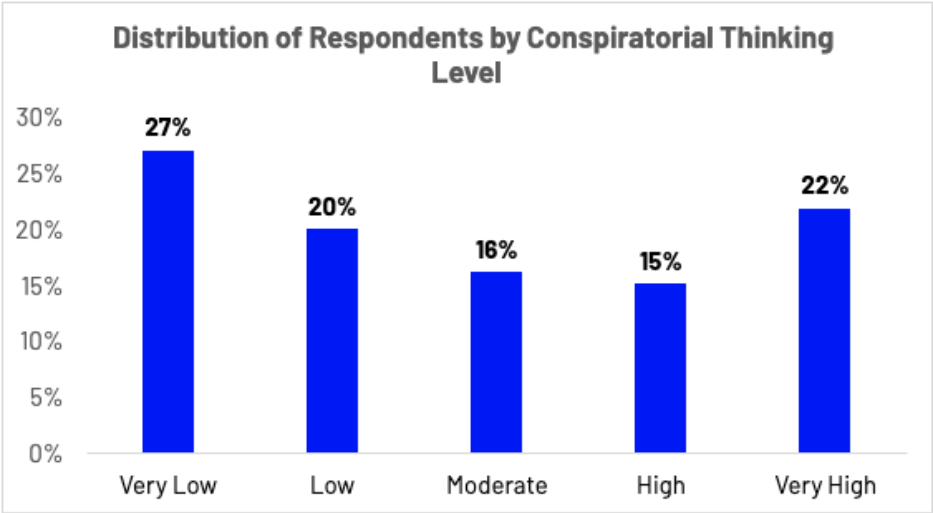
Because our audience segments are partly defined by attitudes toward Jews and beliefs in Jewish tropes, that comparison alone cannot tell us whether general conspiratorial thinking is independently associated with antisemitic beliefs. To test that relationship separately, we created a measure using four statements drawn from the American Conspiracy Thinking Scale, which is designed to capture a general predisposition toward conspiratorial thinking without referencing any specific conspiracy. Respondents were grouped from Very Low to Very High based on how many statements they agreed with.
Antisemitic Beliefs Are Highest Among Those with the Strongest Conspiratorial Thinking
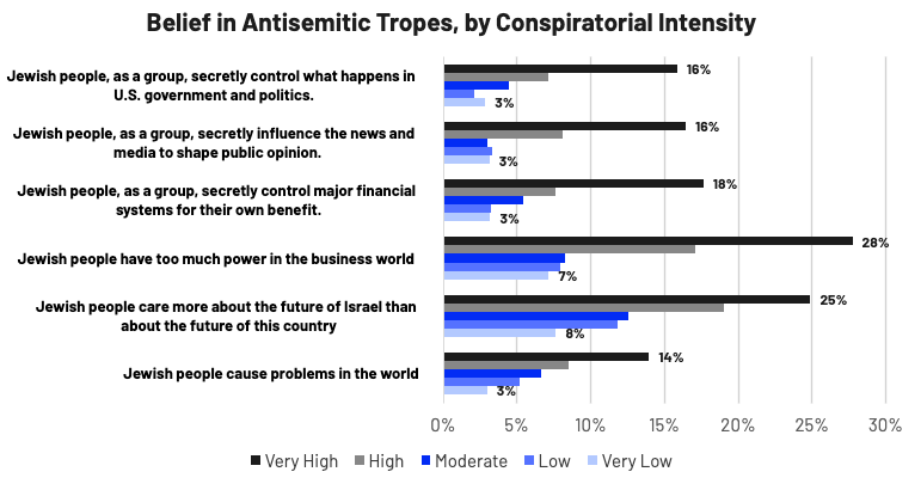
Antisemitic belief does not track general conspiratorial thinking evenly across the spectrum. The relationship is not perfectly linear. The largest differences emerge among respondents with High and Very High levels of conspiratorial thinking. Together, these groups represent 37 percent of respondents and were nearly three times as likely as the rest of the population to endorse antisemitic tropes.
The Next Question
The findings suggest that general conspiratorial thinking may help identify people who are particularly susceptible to antisemitic narratives. Our data suggests one hypothesis worth testing directly: if antisemitic belief accelerates specifically at the highest levels of general conspiratorial thinking, then efforts to reduce conspiratorial thinking overall, particularly among the 37 percent population at the high and very high end of that spectrum, might have a secondary effect of reducing susceptibility to antisemitic narratives, even without targeting antisemitism directly. This remains a hypothesis rather than a demonstrated effect since our survey shows a correlation between general conspiratorial thinking and antisemitic belief but does not test whether reducing the former causes a reduction in the latter.
This article is part of a series published by the Blue Square Alliance Against Hate Command Center, highlighting key findings from our latest study on antisemitic attitudes. The survey was conducted between March and April and includes responses from 7,000 participants. Read the full report here.



Command Center Insights
How Ruhi Cenet’s Viral Hasidic Brooklyn Video Misled Viewers