Every October since 2018, Pittsburgh’s Steelers, Penguins and Pirates have marked the anniversary of the Tree of Life synagogue attack, where a gunman murdered 11 Jewish worshippers in the deadliest antisemitic attack in U.S. history. The posts rarely change: “Today and every day, we honor and remember the victims of the Tree of Life tragedy.” A hometown team honoring its neighbors is one of the last places most people would look for antisemitism. Blue Square Alliance’s Command Center found it there anyway, and in growing numbers.
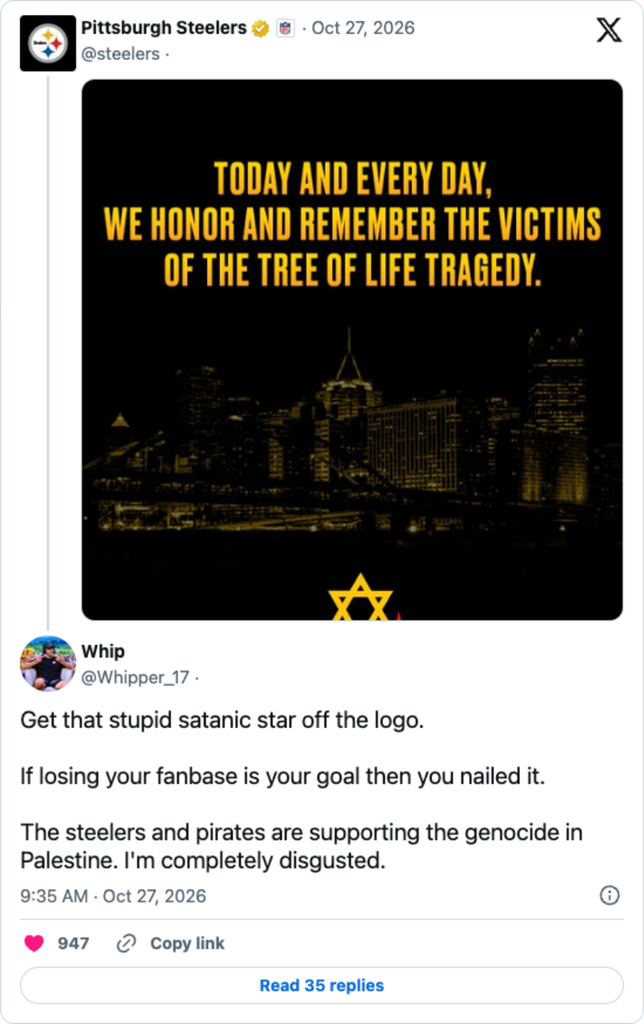
The most-liked visible reply to the Steelers’ 2026 tribute, X, Oct. 27, 2026
The Tributes Stayed the Same, but the Replies Changed
If you only read the teams’ own posts, nothing seems wrong. The real story sits in the replies, which can help shape how readers understand the post itself, as the Command Center has written in The Power of the Comment Section. For years those replies were quiet and few. From 2018 through 2023, not one tracked reply to the teams’ tributes was antisemitic, and in 2022 the posts drew just 14 replies.
Antisemitic Replies Rose From 2024 to 2026
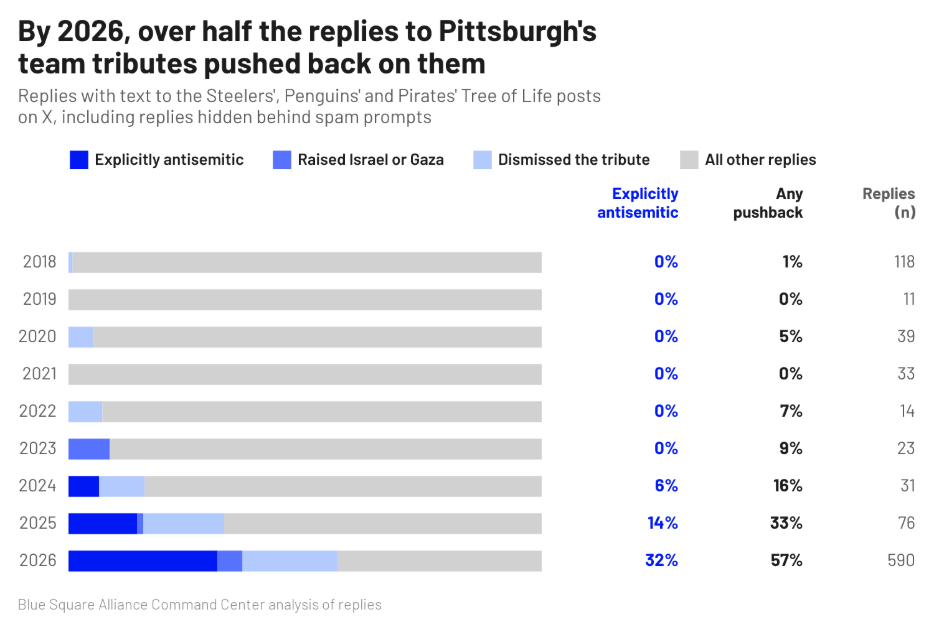
As the chart above shows, that changed quickly. The first explicitly antisemitic replies appeared in 2024, in 2 of 31 replies to the teams’ posts. In 2025, a third of replies (25 of 76) pushed back on the tribute, while only 8 defended it. By 2026, the tributes drew 590 replies, two-thirds of them hidden behind X’s spam prompts. Across all 590 replies, 57 percent pushed back in one of three ways: explicit antisemitism, conflating the commemoration with the conflict in the Middle East, or suggesting the teams stop commemorating the attack.
X Hid Many Antisemitic Replies Behind Spam Prompts
X tucks some replies behind a “Show probable spam” prompt, and in 2026 that is where most of the antisemitism on the teams’ tributes landed: 135 replies, against 51 left in view. The filter largely worked as intended, but it missed some: 51 of 200 replies a reader could see without opening the prompt were explicitly antisemitic. They include the most-liked reply on the Steelers’ post, shown above, and the replies below, all from the visible thread. Some recast the Star of David as a satanic symbol, an old antisemitic trope.
Calls to Remove the Tributes Also Drew Support
Another 22 percent of visible replies told the teams to take the post down, “stick to football” or remove the Star of David from the logo. On the Steelers’ post, the four most-liked visible replies after the one shown above were all in this group. None attacks Jews outright, but each drew more than a hundred likes under a memorial to 11 murdered Jews.
Behind the prompt, only 4 percent of replies defended the tribute. When a public show of solidarity with the Jewish community draws this response year after year, the next organization weighing whether to speak up may decide to stay quiet.
Why the Replies Matter
Much of this hate may not come from real fans. When Cyabra, a firm that tracks bots and other fake accounts, studied the online reaction to a disputed World Cup match this summer, it found that 72 percent of the inauthentic activity was in the replies, not the original posts. To the fan scrolling past, a bot’s reply reads the same as a person’s, and it still teaches that reader what a Jewish memorial is supposed to attract. That is why the Command Center reads the replies as closely as the posts, tracking antisemitism in the places few people think to look.
Methodology
The Command Center collected the replies with text to the Steelers’, Penguins’ and Pirates’ Tree of Life posts on X from 2018 to 2026, with X’s hidden-reply prompts opened. The classification model Microsoft-Decision-1 labeled each reply, and Anthropic’s Claude Opus 5.5 re-read every reply flagged as antisemitic or dismissive. Replies were sorted into explicitly antisemitic, raised Israel or Gaza without blaming Jews, dismissed the tribute without attacking Jews, support, and everything else. Criticism of Israel on its own was not counted as antisemitic.