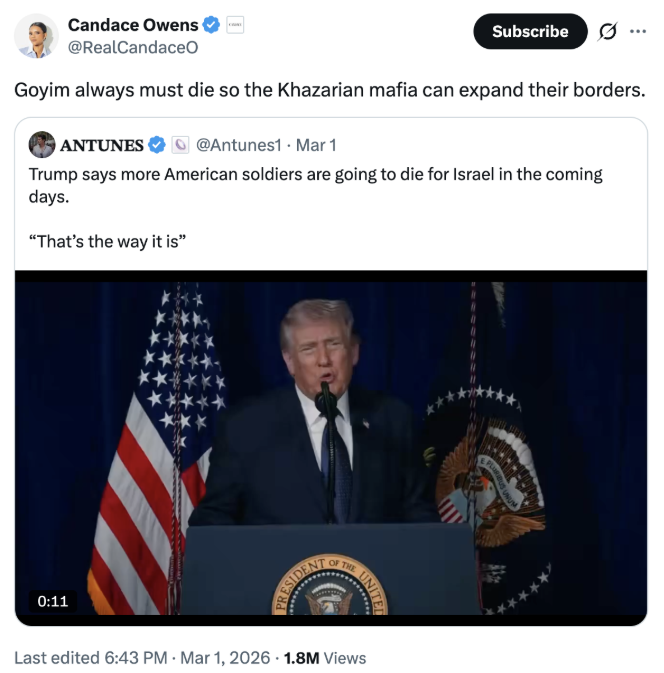
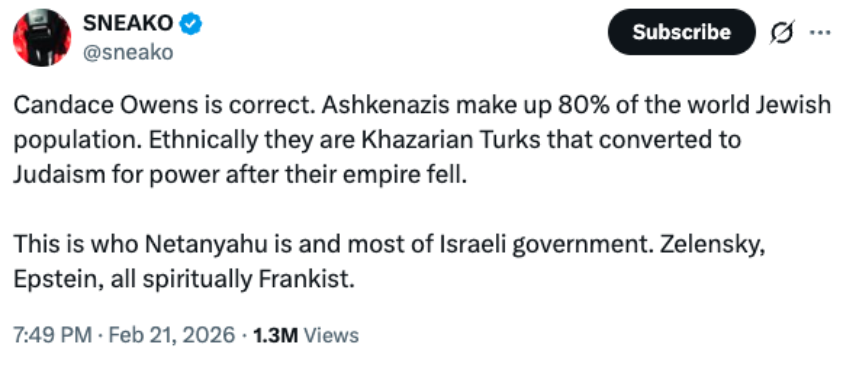
Earlier this year, a cluster of high-profile influencers began using terms such as “Khazarian mafia” and referring to all Jews as “Khazars.” This language that quickly spread across X draws on a fringe conspiracy theory rooted in a much older historical debate about the origins of Ashkenazi Jews.
What Is the Khazar Hypothesis?
The Khazar hypothesis of Ashkenazi ancestry is the historically debated idea that a substantial portion of Ashkenazi Jews descend not from ancient Israelites of the Levant, but from the medieval Khazar Empire, a Turkic polity whose ruling elite is believed to have converted to Judaism between the 8th and 10th centuries. Taken one step further, this idea is often transformed into the claim that the original Ashkenazi Jews were wiped out and that a secretive cabal of Jewish elites descended from Khazars controls global finance, media, and politics.
How Did the Khazar Hypothesis Become Tied to Antisemitic Conspiracy Theories?
Historians generally agree that there is evidence of conversion to Judaism among Khazar elites, but few support the idea of a large-scale population conversion as the hypothesis suggests. Modern genetic research reinforces this view. While one widely discredtied study proposes significant Khazar contribution, the broader body of evidence points to substantial Levantine ancestry among Ashkenazi Jews, alongside European admixture. Even studies that allow for Khazar input generally place it at a relatively minor level, often estimated at no more than 12% of Ashkenazi ancestry.
A major turning point in the debate came with Arthur Koestler’s 1976 book, The Thirteenth Tribe. Koestler, who was Jewish, argued that Eastern European Jews were largely descended from Khazars and suggested that this interpretation could help “make antisemitism disappear by disproving its racial basis.” The book became a central reference point for those advancing the hypothesis in academic and intellectual debates.
The Mainstream Influencers Spreading Khazar Theory in 2026
Although Khazar theory has circulated online for years and saw a significant spike following October 7, 2023, it forcefully entered mainstream conversation more recently, beginning in 2026. This has been driven in part by high profile media personalities and influencers including Candace Owens, Sneako, Tucker Carlson, and Dan Bilzerian, who, on average, have 7.1 million followers on X and have amplified conspiratorial variations of the theory since the beginning of the year.
Khazar Theory on Social Media: Volume, Spikes, and the Absence of Primary Sources
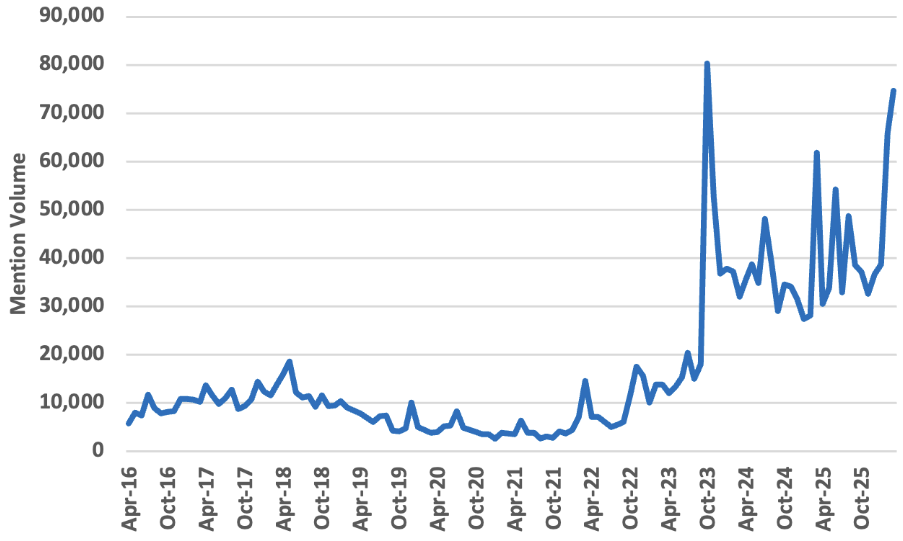
Over the last decade, there have been approximately 2.1 million mentions of the Khazar hypothesis or conspiracy across social media platforms. From 2016 through 2022, volume remained relatively low and steady. Spikes from 2023 through 2025 were driven by a small number of posts from a few conspiratorial accounts.
Social media mentions related to Khazar theory
The historical basis for the Khazar hypothesis rests on a small number of medieval texts (the Khazar Correspondence and the Schechter Letters). These sources are central to scholarly discussions of Khazar conversion, yet they are largely absent from online discourse. Out of the 2.1 million mentions of Khazar theory, fewer than 1% of them mention any of these historical sources. Even mentions of Koestler’s book, which one might expect feature prominently in online discussions supporting the hypothesis only appear in 0.54% of the discussion. These figures highlight a consistent pattern. The texts foundational to the historical debate are almost entirely missing from social media discussions, suggesting that most online engagement is detached from primary sources.
What Is the Khazarian Mafia Conspiracy Theory?
The most prominent modern evolution of the Khazar hypothesis is the “Khazarian mafia” conspiracy theory, which accounts for approximately 18% of total discussion related to Khazar theory. This narrative claims that a hidden elite of Jewish-Khazar descendants controls global institutions. It often includes assertions that prominent Jewish figures such as the Rothschild family, Henry Kissinger, or George Soros serve as fronts for this cabal. The conspiracy gained traction in the mid 2010s through fringe outlets and has since spread across mainstream social media.
How Khazar Theory Has Been Deployed in Ukraine, QAnon, and Political Legitimacy Arguments
The myth has also been weaponized in geopolitical contexts. During the 2022 Russian invasion of Ukraine, claims circulated that Ukraine was a “Khazarian state” or project, blending the theory with broader disinformation efforts. It is also frequently intertwined with QAnon related conspiracies about hidden global elites. At the same time, variations of the theory appear in other ideological contexts. Some groups, including Black Hebrew Israelites, reinterpret it to argue that contemporary Jews are not the true descendants of ancient Israelites, instead asserting alternative lineages rooted in Africa.
The Digital Transformation of the Khazar Hypothesis from Scholarship to Disinformation
Social media spikes in 2023 and 2024 were particularly centered on claims that Israelis are “Khazars” and therefore not indigenous to the land of Israel. This framing represents one of the most common modern uses of the myth, shifting it from a historical question into a political argument about legitimacy. Other spikes were tied to unrelated but highly viral events and narratives. These included discussions surrounding the alleged capture of Nicolás Maduro, the release of JFK assassination files, and recurring claims that the Rothschild family are “Khazarians.”
The trajectory of the Khazar hypothesis over the past century illustrates how a marginal and highly contested historical idea can evolve into something fundamentally different in the digital age. What began as a limited scholarly debate, grounded in a small number of medieval sources and later examined through modern genetics, has been transformed online into a provocative narrative tool, detached from its evidence-based foundations. The persistence and growth of the Khazar conspiracy theory online reflect not new evidence, but new conditions of information spread. Social media environments reward simplicity and emotional resonance over nuance and verification. In that context, a complex and largely resolved academic question has been repurposed into a widely circulating narrative that bears little resemblance to the historical record.