
On July 24, a jury reached a verdict in the case of Shiloh Hendrix, a Minnesota woman whose viral playground confrontation last year, in which she yelled racial slurs at a Somali child and a bystander who filmed her, became a national flashpoint over race and free speech. Hendrix was found guilty of disorderly conduct towards the bystander who filmed the interaction, who was also Somali, but not guilty of disorderly conduct towards the child. Within just 48 hours of when the jury’s deliberations had begun, the case became the subject of over 329,000 posts online, and a share of that conversation had shifted to a new claim – the idea that hidden Jewish influence had engineered the trial’s outcome. Blue Square Alliance Against Hate tracked the online reaction to the verdict and found that what began as a legal story expanded quickly to encompass antisemitic conspiracy narratives that had little to do with the facts of the case.
From Viral Video to White Supremacist Fundraising Cause
Shortly after the original incident occurred on April 28, 2025, Hendrix publicly identified herself as the woman in the video and launched a fundraiser to cover her legal costs. That fundraiser became a proving ground for extremist amplification well before any trial began. As the ADL documented in June 2025, white supremacist accounts helped push the campaign past $860,000, framing the incident through a false narrative of “Black-on-white crime.” After Hendrix was charged in August 2025 with three misdemeanor counts of disorderly conduct, the case continued to move through county court while the fundraiser, and the narrative surrounding it, stayed active online.
After Hendrix’s trial finally began on July 21 of this year, the jury found Hendrix guilty of one charge she had faced. Blue Square Alliance’s Command Center tracked mentions of the trial within the three-day period from when the jury began deliberations to the day after it announced its verdict. Of the 329,000 times Hendrix and her trial were mentioned online, we found that over 10,000 mentioned Jews, Judaism, or Israel, despite the complete disconnect between those subjects and the Hendrix trial’s subject matter. Although those mentions comprised a small portion of the total conversation about the trial (three percent), they reached an estimated audience of 15.5 million people online. Widely viewed X posts and retweets from Alex Jones and Elon Musk helped push the case beyond the local audience that had followed the original trial.
The Antisemitic Influence Conspiracy
A substantial portion of that conversation during jury deliberation and following their verdict fixated on false speculation about the judge and prosecutor’s Jewish backgrounds. Posts describing a “Jewish judge and Jewish prosecutor” framed the verdict as proof that a white woman was punished for defending herself against a Somali immigrant. One such tweet, which was viewed over 67,000 times, invoked a foundational white-supremacist novel called The Turner Diaries to situate the case within a broader imagined plot against white Americans. For the prosecutor specifically, online commentary seized on claims that he wore an Israeli flag pin on his lapel during the trial to speculate that he had a Jewish background.
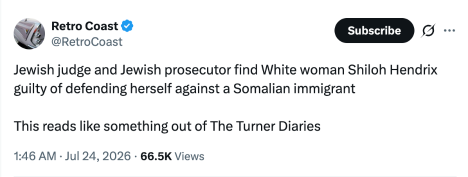
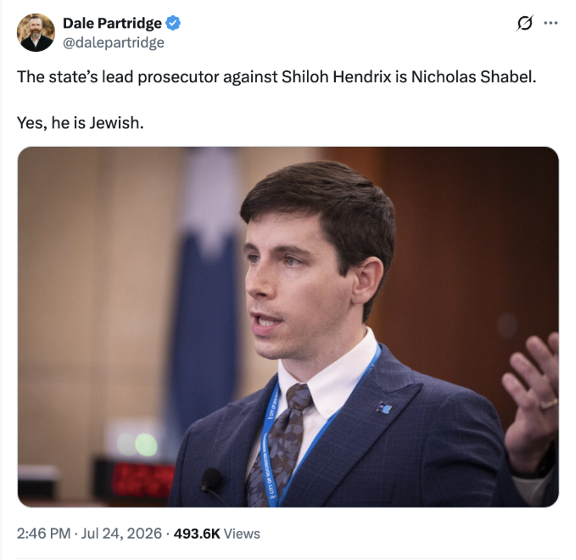
Others described the verdict as evidence of a “two-tier justice system” and, in some posts, attributed the outcome directly to U.S. support for Israel. The case was prosecuted as a misdemeanor disorderly conduct matter under Minnesota’s “fighting words” doctrine, argued and decided on the specific conduct captured on video, and the insertion of Jewish control narratives reflects an existing conspiracy framework being layered onto a case that had no connection to Jewish people, Israel, or U.S. foreign policy.
Conspiratorial Framing and Fundraising Revival
The verdict also revived fundraising appeals for Hendrix, echoing the same networks that supported her in 2025. These renewed appeals were explicitly framed within “Great Replacement” and “white genocide” rhetoric.
Taken together, the Hendrix case illustrates how quickly an unrelated legal proceeding can be absorbed into antisemitic conspiracy narratives once any Jewish-adjacent detail becomes available online. A misdemeanor verdict in Rochester, Minnesota became “evidence” of Jewish control over the American justice system, layered onto a preexisting white nationalist fundraising campaign and conspiracy narrative. Blue Square Alliance continues to monitor how domestic legal proceedings, regardless of their subject matter, become vectors for antisemitic conspiracy content, and how quickly incidental details can be repurposed to fit a preexisting narrative of Jewish control.



Command Center Insights
How the Internet Reacted to the Cost of Jewish Security