

Over the past year, Blue Square Alliance’s Command Center has documented a shift in online sentiment around the Jewish High Holidays. Last Rosh Hashanah, our analysis of online greetings found that wishes for a “sweet” or “joyful” year were giving way to calls for safety and peace, reflecting growing concerns about the threats facing Jewish communities. Last week, we wrote about a JFNA report showing that annual security spending by American Jewish institutions had surpassed a record $1 billion.
This week, we looked at reactions to Rosh Hashanah greetings online, asking how the identity of the messenger shaped both the amount of hostility and where that hostility was directed. We collected every Rosh Hashanah post published this year by notable accounts on X, including politicians, sports teams, and entertainers. We then analyzed all 4,800 replies to those greetings and assessed whether the tone was warm or hostile. Nine percent of replies were antisemitic. Politicians attracted the most hostility, but most of it focused on their politics. Sports teams and entertainers attracted less hostility, but nearly nine in ten of their hostile replies were antisemitic.
Positive Rosh Hashanah greetings were met with negativity
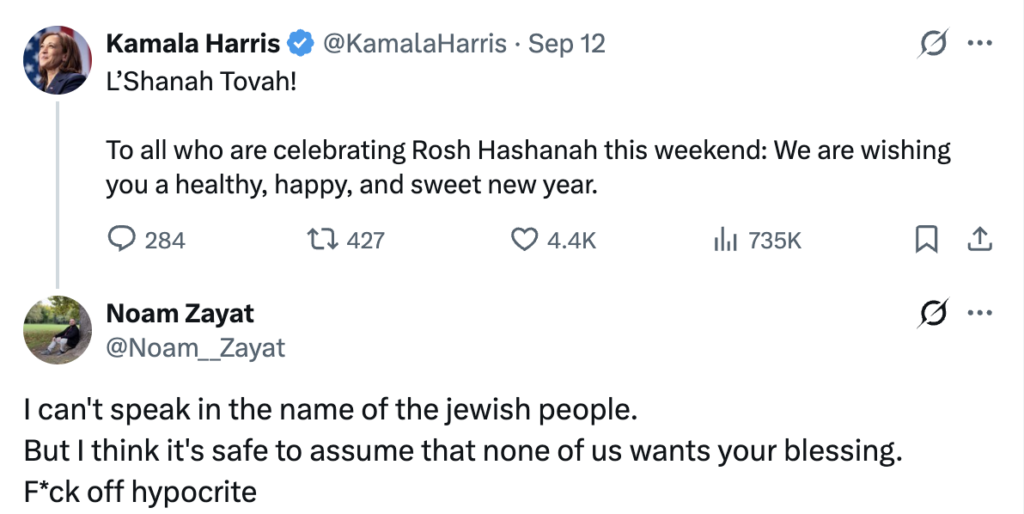
Although every one of the original 26 posts was positive, most replies to those posts did not match their positive tone. Only 1 in 9 replies had a warm tone, outmatched by the roughly half of replies which expressed outright hostility.
But most of that hostility had nothing to do with the holiday. Eighty-three (83) percent of hostile replies were not about Rosh Hashanah or Jews at all. Instead, they targeted the individual who posted the greeting by accusing them of hypocrisy, attacking their political positions, or arguing that their previous statements and actions contradicted the greeting. Only 9 percent of replies were explicitly antisemitic.
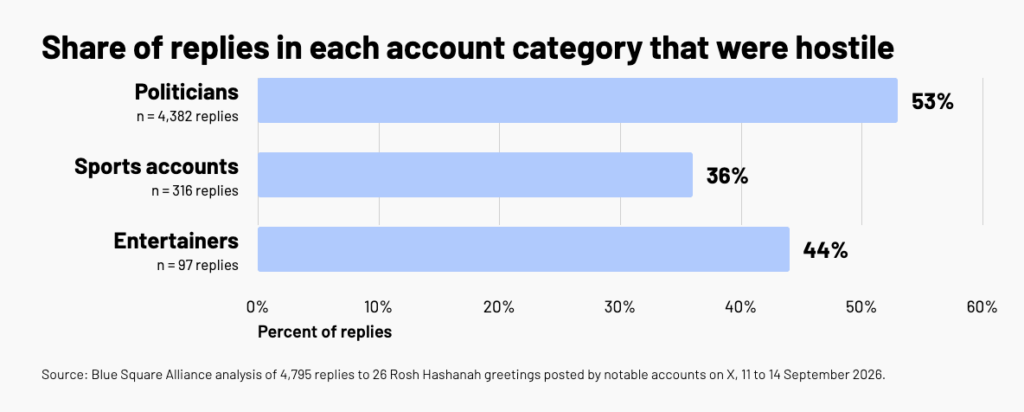
Respondents’ tone varied based on the account holder’s identity. Politicians’ holiday greetings were met with the most antagonism, with 53 percent of replies to their posts containing hostile language, as compared to sports teams (36 percent) and entertainers (44 percent). They also received the fewest warm replies (8 percent), compared to sports accounts (40 percent) and entertainers (43 percent).
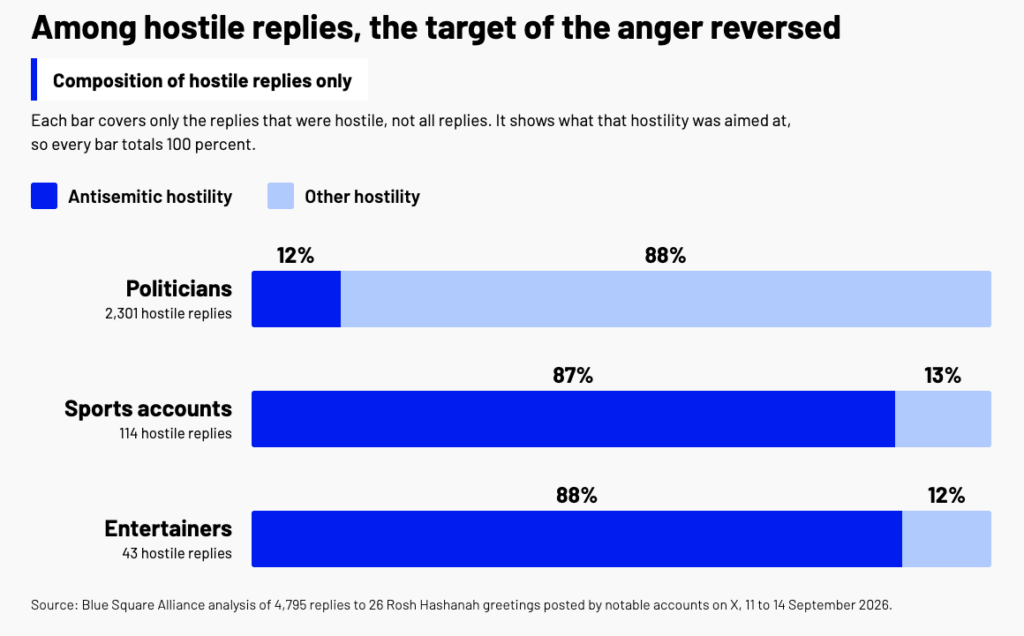
Politicians drew the most hostility — but sports teams and entertainers drew the most antisemitism
But the separation becomes far more pronounced when we look at the target of the hostility in the replies. The antisemitic share of hostile replies differed by roughly 75 points between messenger types. Only 12 percent of the hostility directed at politicians was antisemitic, compared with 87 percent for sports teams and 88 percent for entertainers. The categories that attracted less hostility overall attracted far more antisemitism within that hostility.
In the political threads, the most common response was that the greeting was fake, insincere, or merely a public relations exercise. That appeared in roughly 1 of every 8 replies. About 6 percent contained anti-Muslim abuse directed at the sender, and about 2 percent complained that the sender had honored the Jewish holiday while failing to give sufficient recognition to the victims of the 9/11 attacks, whose anniversary overlapped with the first day of the Jewish holiday.
One way to understand this pattern is through what researchers call “affective polarization,” the tendency to dislike opposing political groups for who they are, not only for what they believe. Research has found that partisan identity can become a source of hostility in its own right. A politician therefore gives readers an immediate target for anger, even when the post itself is not political. The effect is especially strong on social media. A study of 2.7 million posts found that posts about political opponents were shared roughly twice as often as posts about political allies.
Our findings align with that research. When a politician posted a Rosh Hashanah greeting, readers had a list of familiar political grievances ready to use. When a sports team or entertainer posted, those political arguments were largely absent. Their hostile replies were therefore more likely to focus on the greeting, Israel, or Jews. The data cannot prove that political anger displaced antisemitism, but they suggest that the identity of the messenger was strongly associated with where the anger was directed.



Command Center Insights
How the Internet Reacted to the Cost of Jewish Security