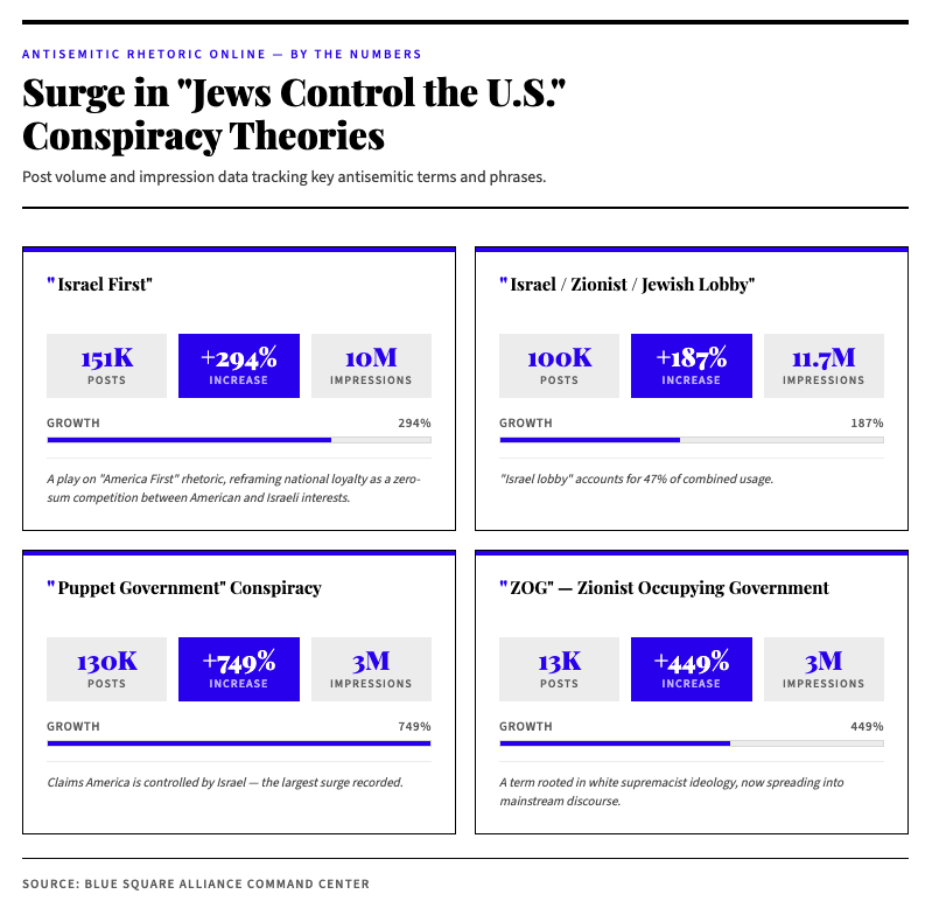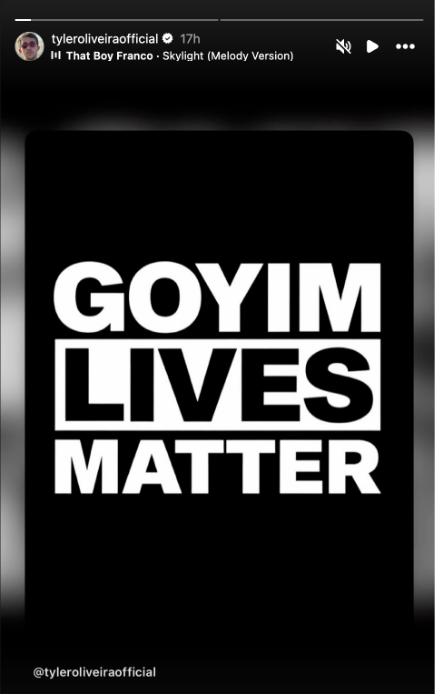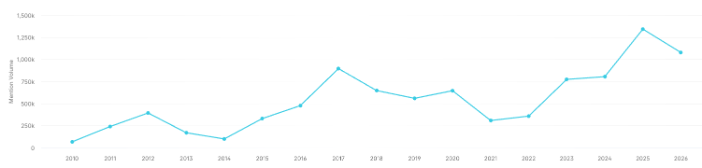
Last week, Tyler Oliveira, a YouTuber with almost 9 million subscribers, posted a video about Kiryas Joel, a mostly Satmar Hasidic town in Orange County, New York. The video has reached over 2.9 million views on YouTube, at the time of writing. It triggered online reactions that went beyond political criticism, into open antisemitism. Oliveira’s not-so-subtle framing pushes the idea that Jews in Kiryas Joel do not work, have many children, and live off government benefits paid for by the “American taxpayer.” That framing draws on some of the oldest antisemitic stereotypes, and the comments and tweets that followed show how quickly those ideas can turn into hatred.
The clearest warning sign is the video title itself, “Inside the New York Town Invaded by Welfare-Addicted Jews.” Calling a town “invaded” suggests a hostile takeover. Calling Jews “welfare-addicted” paints the group as lazy and dependent. This sets viewers up to see Jewish residents as outsiders who are taking advantage of the country. It is a modern version of an old antisemitic trope, in which Jews are described as exploiters of the host society.
How the video turns welfare into a defining “fact” about Jewish life
Inside the video, the welfare narrative is not treated as a complicated question about poverty, municipal funding, housing costs, or family size. Instead, it is presented as the defining fact of Jewish life in Kiryas Joel. Oliveira repeatedly confronts Hasidic men on the street what they do for work, how they earn money, whether they study Torah, whether their wives work, and how many children they have. This is not a passing theme. It is the backbone of the video’s narrative.
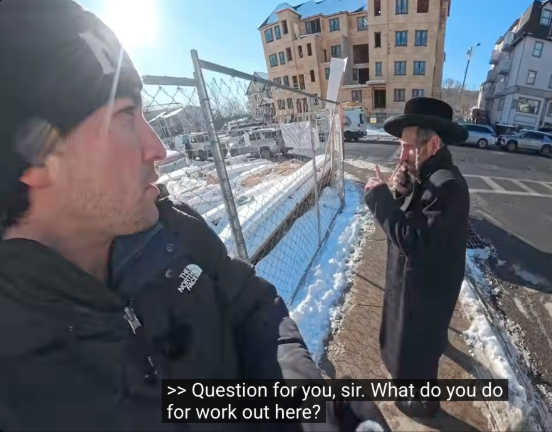
Even when people refuse to speak or give short answers (many times because their first language is Yiddish), Oliveira frames it as proof of guilt. A typical exchange has him asking what a man does for work, then quickly moving to whether the wife works and whether the man studies Torah. This constant focus builds one message in the viewer’s mind. Jews do not work, but still have families to support, so they must be living off public money.
The “taxpayer” storyline and the classic antisemitic exploitation trope
That message becomes stronger when Oliveira frames Kiryas Joel as something paid for by “taxpayers,” as if the town is being funded by outsiders who are being exploited. He asks, “Does the American taxpayer help you, too?” and later narrates, “What I’m hearing is they’ll gladly take money out of the American tax base to support their lifestyle.” That kind of wording suggests the residents are not real taxpayers themselves. It implies Jews are simply taking. This is the same logic behind classic antisemitic propaganda, where Jews are portrayed as living off the labor and money of others.
Oliveira’s visuals push the same idea. At one point he says he notices “only Hispanics” working outside and claims he does not see many Jewish people working. The effect is obvious. Non-Jews do the hard labor. Jews walk around and do not work. Then the government pays Jews anyway. Even if the video never directly says “Jews are parasites,” the storytelling pushes the audience there.
This framing is dangerous because it does not simply criticize policy. It turns religious practices and lifestyle differences into suspicion and resentment. It makes Torah study look like a scam and it makes large families look like a tactic to get more benefits. It makes the town look like a machine designed to steal money from outsiders. That is why the video’s themes slide so easily into antisemitism in the reaction it created.
Frieda Vizel’s critique: provocation over reporting
Frieda Vizel, a former member of the Kiryas Joel community who made a reaction video, argues that Oliveira’s style is closer to provocation than reporting. She says he “makes big claims quickly,” without explaining them properly. She also says the interviews are set up like traps. People do not want to answer personal questions from a stranger who seems to be trying to catch them saying something incriminating. Vizel points out that when residents refuse to engage, Oliveira treats it like suspicion, even though refusing an outsider’s questions is normal in any closed community.
Vizel also explains that Oliveira’s portrayal of Torah learning and work is simplistic and misleading. She says many men study Torah regardless of whether they are employed, meaning they might study early in the morning before work or later in the day after work. She also explains that some newly married men study full time for a period while their wives work temporarily, which is a common structure in some Hasidic communities and does not necessarily mean the man never works. She also notes that some men who study Torah full time are supported through stipends or philanthropy, which is different from claiming they are living entirely off government benefits. Vizel argues that Oliveira treats Torah learning as if it is automatically proof of fraud, rather than a religious practice with many different arrangements around it.
Vizel also highlights a basic reporting problem that affects the entire message of the video. Oliveira films during the day, and he interviews people who are out in public during daytime hours. That is not a random sample of the town. Vizel says that filming at that time means he is more likely to encounter men who study in kollel, where some men study Torah full time, especially during certain stages of life. People who work regular 9 to 5 jobs are at work, not walking around. But the video uses daytime street interviews to imply that the whole community behaves that way. In Vizel’s view, this creates a misleading impression, and it feeds the stereotype that Jews do not work.
What the social media response reveals about modern antisemitism
The response online shows exactly how this kind of framing spreads antisemitism.
One category that appears quickly is the idea that Jews are parasites who steal from the public. This is the “mooching off taxpayers” trope that Oliveira’s video constantly encourages by focusing on benefits and funding. Comments like “These people have been robbing the system forever” and “Everyone is stealing from the tax payers” take the video’s theme and turn it into a blanket accusation.
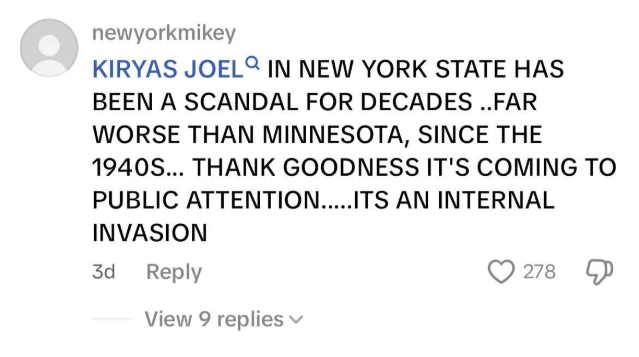
Another category is the idea that Jews are powerful, protected, and able to silence critics, sometimes through threats or violence. Posts like “If you die we all know jews did it” (replying to a post made by Oliveira), “Remember Tyler isn’t suicidal,” and “Something tells me there will be no federal investigation here” do not read like policy critique. They suggest Jews operate like a mafia that punishes people for speaking out. Even “I wonder how long this stays up” fits this mindset, implying Jewish control over media platforms and censorship.
A third category is general antisemitism and dehumanization, where viewers turn the video into an excuse for jokes and extremist language. Comments like “I crawled out of my tunnel to watch this” and “I stopped coin clipping to watch this video” play on old antisemitic myths about secret Jewish behavior and Jewish greed.

Why this matters: from policy critique to targeted group hatred
The point is not that Kiryas Joel is above criticism or that welfare policy cannot be questioned. The point is that Oliveira’s video does not treat these as complex topics with evidence and nuance. It treats them as proof of a simple moral story about Jews. When a video repeatedly shows Jews who are clearly visibly Jewish as non-working, asks constant questions about welfare, and frames public funding as stolen taxpayer money, it creates the conditions for antisemitism to flourish. The social media reactions are not an accident. They are the predictable result of a narrative that recycles antisemitic ideas in a modern viral format.