In American racial discourse, the question of whether Jews in America are “white” is difficult to answer clearly, in part because the categories being applied were never designed to describe Jewish identity in the first place. In recent years, this question has increasingly been used in online discourse to frame Jews as either insiders or outsiders within systems of power, often in ways that oversimplify Jewish identity. The topic has repeatedly surfaced in waves on social media over the past decade. These moments produce a wide range of claims about how Jews should be understood within American racial categories, and examining those spikes in online conversation helps illustrate how the debate unfolds.
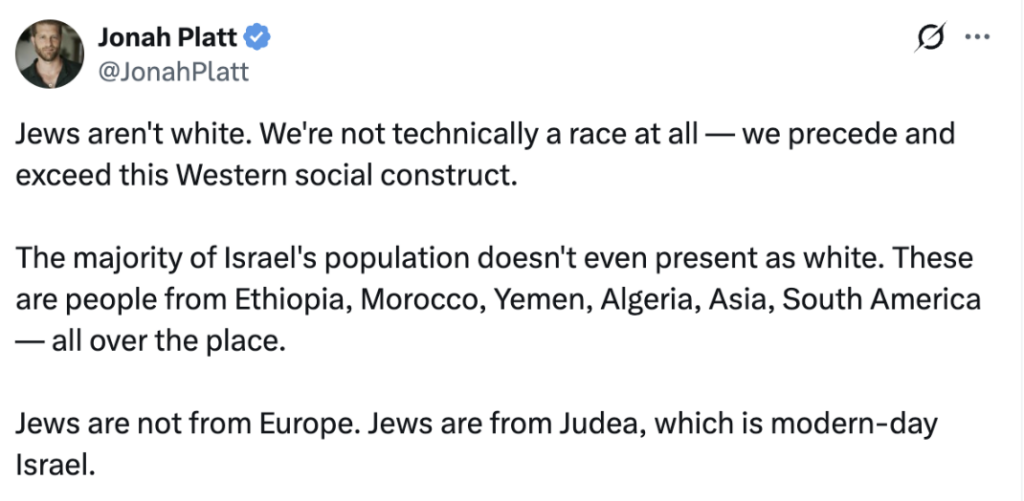
Across these conversations, two recurring and often opposing frameworks appear. In some left-leaning online spaces, Jews are often categorized as part of the white majority because many are perceived as white or white-passing, typically in discussions about social positioning and privilege. By contrast, far-right discourse has long framed Jews as a separate group that is not truly white, drawing on older antisemitic ideologies that portray Jews as deceptive or threatening outsiders. While both narratives question how Jews fit into racial categories, they differ significantly in their origins, intent, and historical impact.
Jewish identity does not map neatly onto racial categories. In traditional Jewish law, Jewish status can be passed down through family lineage, but anyone can convert and become fully Jewish. Because Jewish identity can refer to a religion, a shared ancestry, or a broader sense of peoplehood, attempts to place Jews neatly into racial frameworks often flatten a more complicated identity. These tensions are often amplified when contemporary political frameworks are applied to Jewish identity without accounting for its historical and cultural specificity.
Historically, Jews in Europe and the United States were often treated as a distinct race and excluded from the boundaries of whiteness, particularly within 19th and early 20th century racial theories that positioned Jews as fundamentally separate from European populations. After World War II, many Jews in the United States, who were overwhelmingly of European (Ashkenazi) origin, gradually came to be treated as white in everyday classification systems. The idea that Jews are not truly white has persisted in modern white supremacist ideology, where it continues to underpin antisemitic narratives.
Research on how Jews describe their own identity reflects the complexity of the topic. A 2020 survey by the Pew Research Center found that American Jews understand Jewishness in multiple ways, including religion, ancestry, culture, and family heritage. While most U.S. Jews (92%) identified as white in the demographic survey, many also described being Jewish primarily as belonging to a people or shared heritage rather than a racial category. Among Jews under 30, 15% identify as non-white. In addition, a 2025 national study found that roughly 10% of American Jewish adults are Sephardic or Mizrahi, with family origins in the Middle East, North Africa, and other Sephardic diasporas, and that most of them don’t identify as Jews of color. Jewish communities in Israel include large populations with origins in the Middle East, North Africa, and other regions, further complicating attempts to frame Jewish identity within a single racial category.
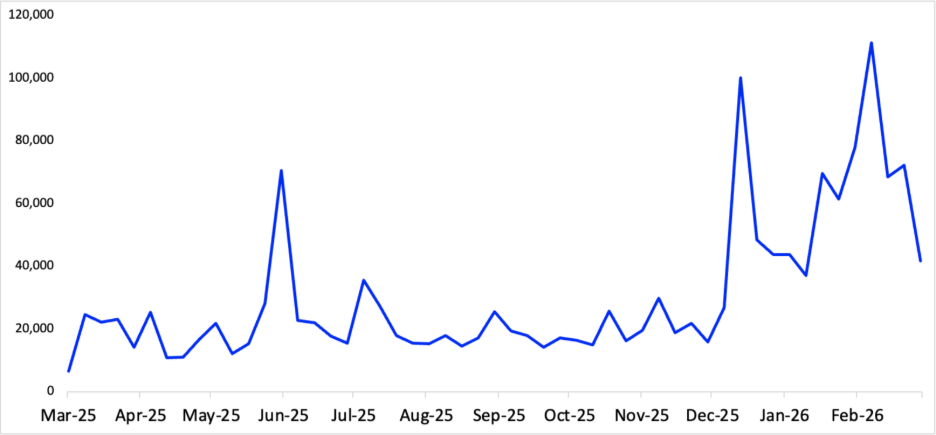
BSA Command Center tracked 21.8 million mentions discussing Jewish people in connection to “whiteness” over the past decade. Since the October 7 attacks, the average daily volume of mentions has been 57% higher than the pre-October 7 baseline. These discussions tend to appear in spikes tied to political and cultural events. In some cases, the same moment produces conflicting narratives simultaneously, with Jews described as both part of the white majority and as fundamentally separate from it.
Social media mentions discussing Jewish people in connection to whiteness
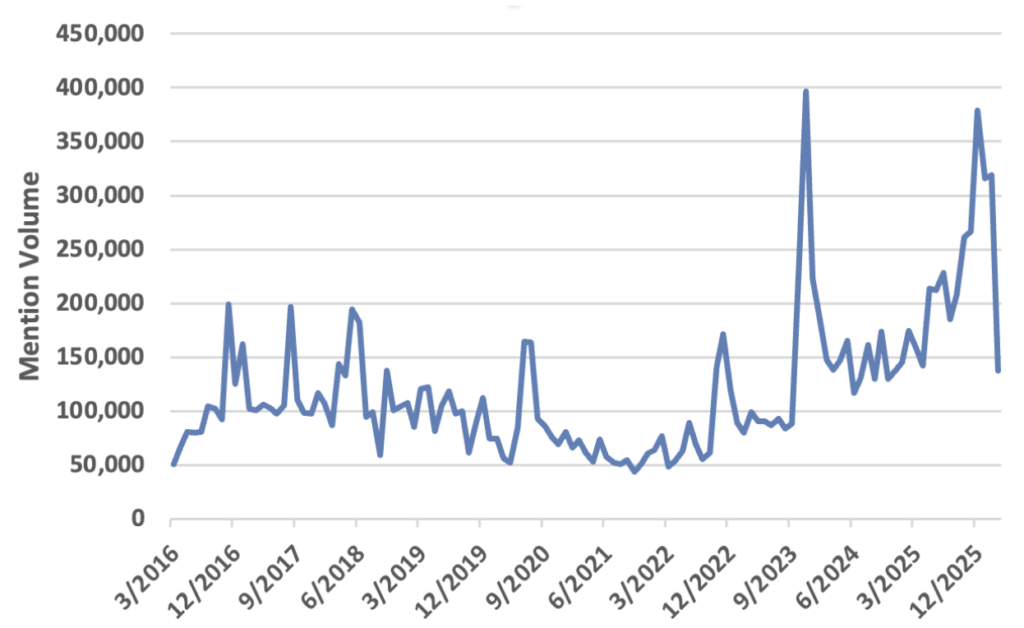
The first spikes in the last decade appeared around late 2016 and 2017. Following the U.S. presidential election, debates about nationalism, race, and identity prompted discussion about where Jews fit within American racial categories. The conversation intensified after the 2017 Unite the Right Rally in Charlottesville, where white supremacists marched while chanting “Jews will not replace us.” The online discussion during this period centered on the contradiction between white nationalist antisemitism and the idea that Jews were part of the white majority.
Another surge occurred in June and July 2020, when the hashtag #JewishPrivilege began trending on social media. Unlike the earlier discussions that emphasized Jews as separate from the white majority, this conversation focused on the claim that Jewish people benefit from forms of white privilege because many Jews are perceived as white, often applying broader frameworks of racial inequality to Jewish identity. At the same time, far-right communities continued to promote a longstanding narrative that rejects the idea that Jews are white and instead frames them as a distinct and threatening outgroup.
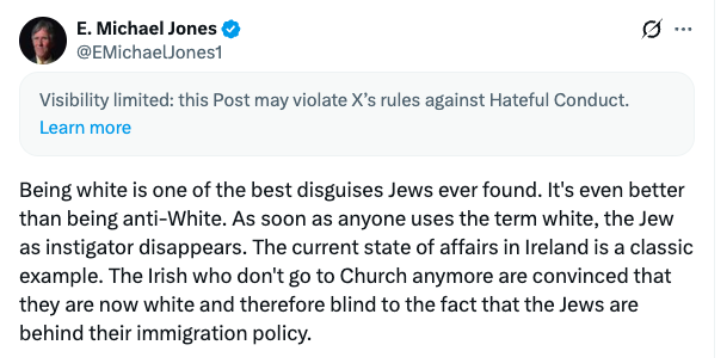
The largest spike in mention volume occurred in October and November 2023, following the October 7 attacks in Israel and the war in Gaza. During this period, approximately 500,000 posts discussing Jews and whiteness appeared in a single month, about 176% higher than the average monthly volume over the previous decade. Large volumes of social media posts described Jewish people as “white colonizers,” particularly within debates about Israel and colonialism. Additionally, some right-wing commentators continued to frame Jews as promoting “anti-whiteness” in the United States. The result was an onslaught of posts that treated Jewish identity through racial frameworks in sharply opposing ways.
The second largest spike appeared in late 2025, after Elon Musk posted multiple messages on X discussing whether Jews are white. In one exchange about global demographics, Musk replied to a user by writing that “Jews are White, if not peak White,” which prompted widespread discussion online. Around the same time, a meme template began circulating online comparing different racial categories, ending with a photo of comedian Jerry Seinfeld labeled “not white.” The meme circulated among white supremacist accounts.
The recurring debate about Jewish whiteness reflects a broader challenge of applying modern racial categories to a group with a complex history. Social media tends to reward simplified narratives, but Jewish identity contains overlapping elements of religion, ancestry, and culture that resist easy classification. As a result, the question of whether Jews are “white” is less a settled fact than a recurring argument shaped by differing political, historical, and social frameworks. On social media in particular, these debates often reflect broader ideological narratives more than they reflect the complexity of Jewish identity itself, and not all these narratives carry the same historical weight or implications.