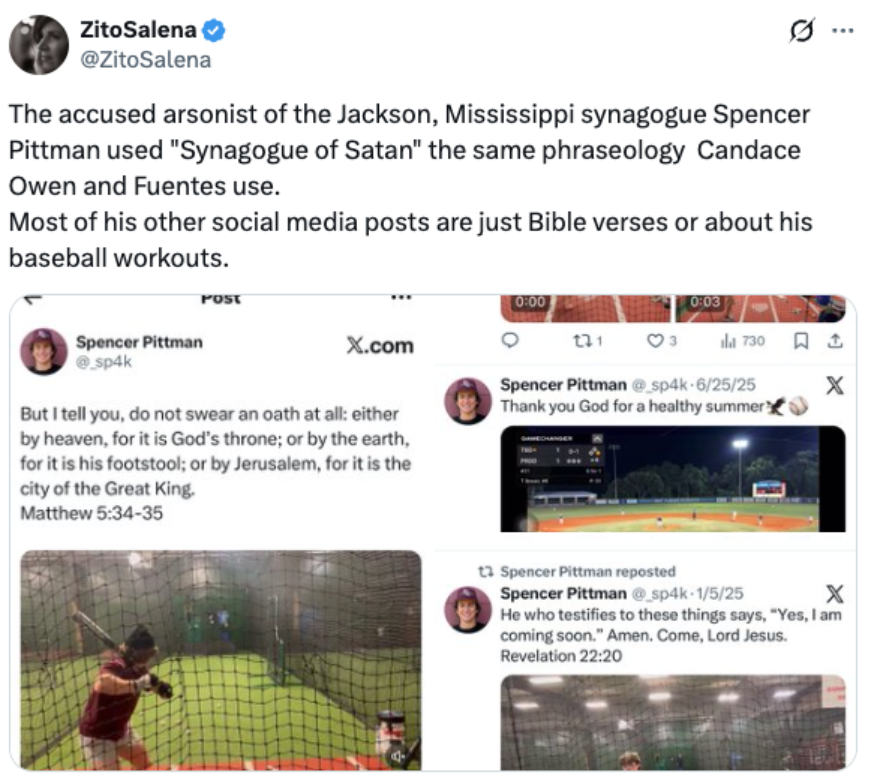
Earlier this week, Mississippi’s largest synagogue was badly damaged in an intentional arson attack. The suspect, identified as Stephen Spencer Pittman, confessed and told investigators he targeted the synagogue because it has Jewish ties. In online posts reviewed by authorities, and during investigation, he referred to the building as “synagogue of Satan,” language tied to well-known antisemitic conspiracy theories.
The phrase is often drawn from Revelation 2:9, which reads, “those who say that they are Jews, and are not, but are the synagogue of Satan.” Over time, this verse has been taken out of its historical and theological context and used to justify antisemitism.
The use of this verse to spread antisemitism has been rejected across Christian denominations, even as extremists continue to weaponize it to justify hate. Contemporary church teaching explicitly condemns such interpretations. In the landmark 1965 Nostra Aetate declaration, the Catholic Church cautioned that preaching must not portray Jews as “rejected or accursed,” and later Vatican guidance urged that Jews and Judaism be taught “free from prejudices and without any offenses
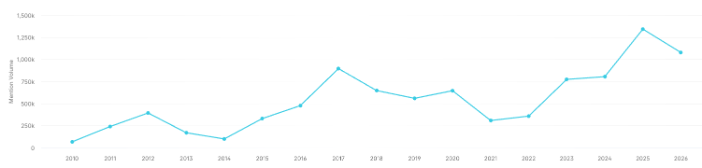
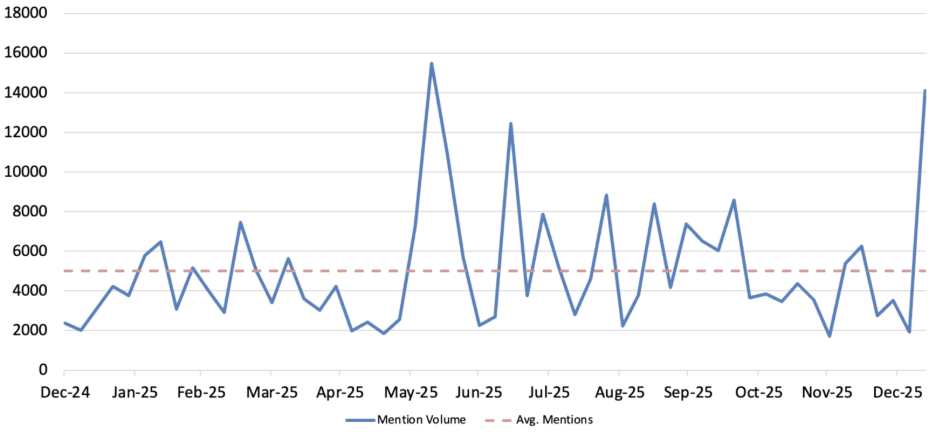
Normalization Through Online Amplification: Just earlier this month, Colorado-based podcaster Joe Oltmann used the phrase while making violent remarks about Jewish public officials, including calls for their execution. In posts shared online, he referred to Jewish leaders as part of the “synagogue of Satan” and said they should be “dealt with.” While widely criticized, this language continued to circulate and be reshared. Over the past year, there has been an average of roughly 5,000 public mentions of this term each week across online platforms. This figure does not include conversations with Grok AI, suggesting the phrase is being used intentionally and openly.
Social media mentions this past year of the Phrase “Synagogue of Satan”
ISD and CASM, released a study, where they found a major and sustained spike in antisemitic posts since twitter post 2022, and “Synagogue of Satan” was one of the major themes in the study. Post October 7, there were also users who complained online about moderation, asking whether they can say “synagogue of Satan,” citing “Revelation 3,” or claiming that “every time I say it my posts get hidden.” Others repeat fragments of the verse itself, such as “they say they are Jews, and are not,” or “Jesus didn’t call [them] synagogue of Satan for nothing.”
Movement-Building and Incitement: One way this phrase is commonly used online is as part of broader movements targeting Jews. Posts often use declarative language, stating that groups “call themselves Jews, but are the synagogue of Satan,” or invoking Revelation 2:9 and 3:9 as proof. Others tie the phrase to broader cultural claims, such as asserting a so-called “tradition of the synagogue of Satan,” or framing the rhetoric as a warning that “Satan’s day is up.”
These messages borrow selectively from religious language to suggest a spiritual or moral battle. They are designed to provoke, unify followers, and encourage hostility toward Jewish communities.
Misinformation and Political Weaponization: The phrase is also frequently used to spread misinformation, including conspiracy theories that deny Jewish identity or falsely portray Jews as part of secret, malicious networks. In political contexts, posts increasingly apply the term to Israel itself, claiming that global events are exposing the “synagogue of Satan in the light,” accusing institutions of “trickery,” or alleging that Israel’s government is the “biblical synagogue of Satan. Especially after October 7, this language has been used to equate Israel to the “synagogue of Satan.”
This normalization has real-world consequences. The steady circulation of this phrase has helped create an environment in which a 19-year-old felt motivated enough to set fire to a synagogue. When violent language is repeated, justified, and reframed as religious or political truth, it lowers the threshold for action. What begins as rhetoric online can escalate into intimidation, harassment, and, ultimately, physical violence against Jewish communities.