Earlier this week, YouTuber Tyler Oliveira, who has nearly 9 million subscribers, released a new video targeting Orthodox Jewish communities in Lakewood, New Jersey. The video titled “I Exposed New Jersey’s Jewish Invasion…” has reached over 25 million views across YouTube and Instagram over the last 4 days. Oliveira presents the piece as an investigation into local politics and community tensions. However, the framing echoes long standing antisemitic narratives, and the online reactions amplify them.
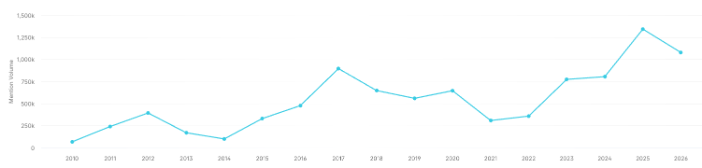
This release follows Oliveira’s January 15 video on Kiryas Joel. Since that first video, mentions of Oliveira’s name on social media alongside terms related to Jewish culture, antisemitism, or Israel have surged by over 4,400% compared to the previous corresponding period. Oliveira’s Kiryas Joel video centered heavily on welfare dependency tropes. The Lakewood video expands the frame to include claims about political influence, demographic growth, and institutional control.
Early in the video, Oliveira emphasizes large family sizes and rapid community growth, warning that expansion from Lakewood is causing non-Jewish residents to fear their town will soon be turned into “Little Jerusalem.” Oliveira interviews Jennifer Galarza, who he introduces as a “Goyim Advocate.” She explains to Oliveira at one point that “the Jewish community is extremely racist.” In another exchange, Mike Caldarise, whom Oliveira introduces as a “Goyim Spokesman,” tells him, “You have a group of people that call themselves God’s people. You are a Semite supremacist.” Caldarise also claims that the Jewish community functions in ways comparable to “organized crime.” The term “goy,” which means a non-Jew in Hebrew and Yiddish, has been adopted by antisemitic online communities recently.
Around the YouTube release, Oliveira posted 7 related Instagram reels using similar language such as Jewish Invasion, Jewish Police, Jewish Values vs Goyim Values, and Stop Anti Goyism 2026. One reel alone surpassed 13 million views and 18,000 comments, while the YouTube video generated more than 60,000 comments.
Audience response data shows antisemitic discourse across platforms. Command Center analysts examined the top 106 comments, ranked by engagement, across Oliveira’s YouTube and Instagram posts. In that sample, about 38% of Instagram comments were tagged as antisemitic. The YouTube share was higher at just over 53% antisemitic. Since the Lakewood video’s release, several of the most common phrases appearing alongside Oliveira’s name on social media include “exposing Jewish fraud,” “funded by the taxpayer,” and “New Jersey scam.” One Instagram commenter, repeating language that Oliveira himself used in the video, stated “Jersey was promised to them 3000 years ago,” which is a recent antisemitic dog whistle. On YouTube, several highly engaged comments suggested organized retaliation, including “Tyler is not suicidal, guys,” implying that “the Jews” may try to harm Oliviera.
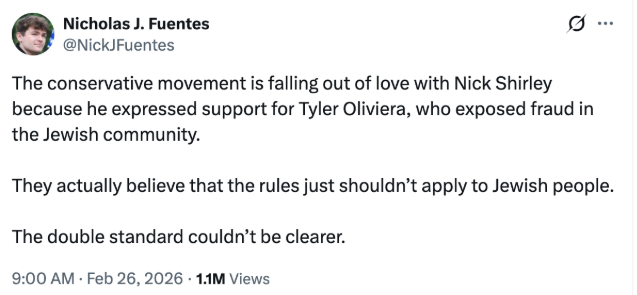
Support for Oliveira’s framing also spread within adjacent online personalities. Nick Shirley, who gained prominence for posting about alleged Somali fraud in Minnesota, publicly expressed support for Oliveira’s investigations. The endorsement triggered antisemitic reactions among some users. One post by Nick Fuentes, which has over 1 million views and reflects many of the reactions that followed Shirley’s promotion, framed the backlash against Shirley (for supporting Oliveira) as evidence that critics believe scrutiny should not apply to Jewish communities.
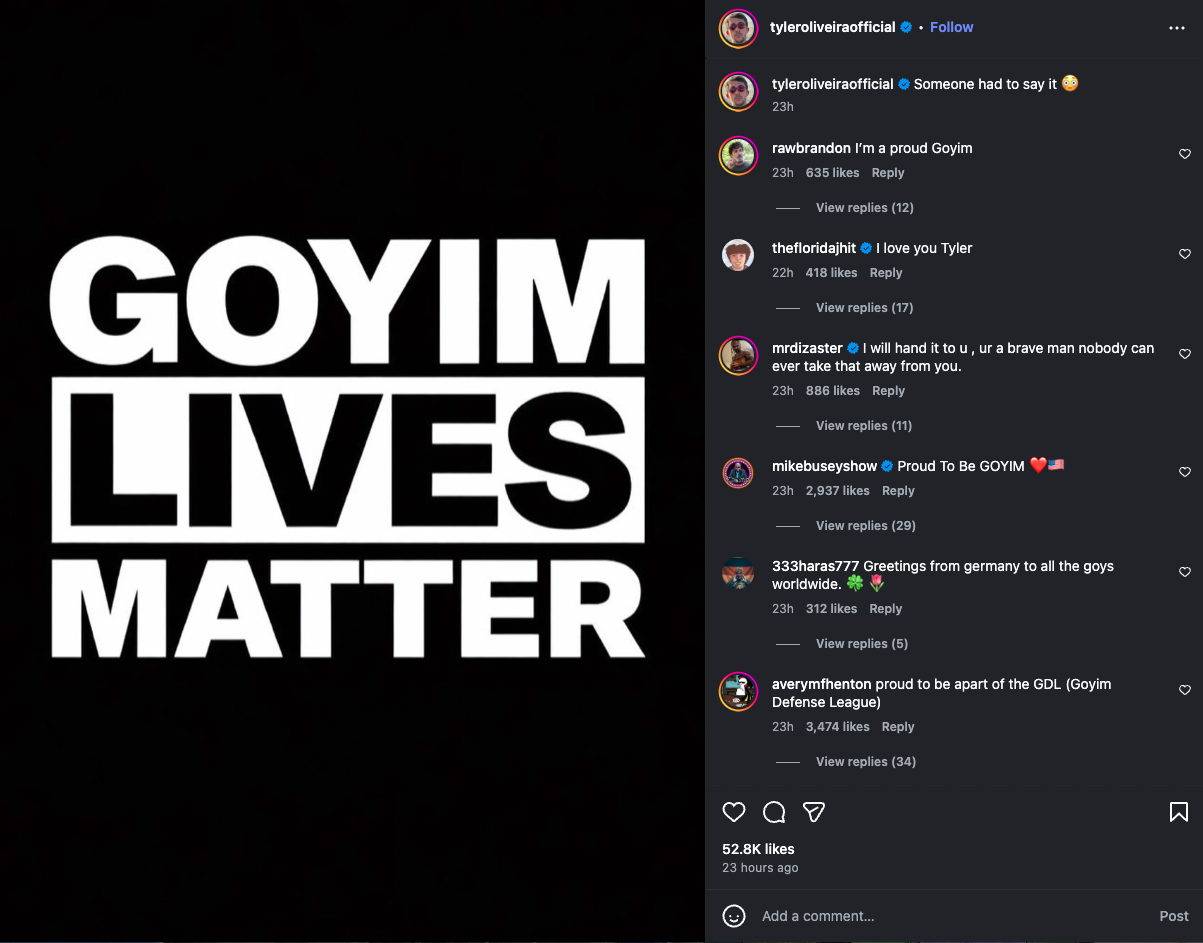
Oliveira’s Patreon (a paid membership platform for creators) account was removed shortly after the Lakewood video was released. That development fed into existing antisemitic audience narratives. Comments such as “They nuked his Patreon for noticing too much,” referencing the event, framed the removal as evidence of coordinated silencing. Oliveira’s own messaging has continued to escalate. On Thursday he posted photos on X and Instagram reading “Goyim Lives Matter.”
Over the past 6 months, mainstream political and commentary figures, beginning most prominently with Tucker Carlson’s programming, have inwcreasingly platformed narratives that frame Jewish communities through lenses of threat, institutional capture, or financial exploitation. While such content often stops short of overtly extremist language, it can normalize the underlying premises of antisemitic conspiracy thinking for mainstream audiences. Oliveira’s recent output fits within this broader pattern but also illustrates its rapid acceleration. His Lakewood videos have drawn more than 25 million views in less than a week, following closely after his Kiryas Joel video. Across these releases, his framing of Jewish communities has become more confrontational, moving from welfare focused claims toward allegations involving political power and demographic threat.
Even when the original content is presented as “investigative” or policy focused by its creator, comment sections and adjacent influencers often escalate the claims into more explicit accusations of Jewish control, fraud, or coordinated power. In this way, mainstream adjacent content can function as an entry point that legitimizes more extreme interpretations.
Local policy disputes in places like Lakewood are legitimate subjects for debate. The concern is how those issues are packaged. When demographic change is described as an invasion, when political participation is likened to organized crime, and when criticism is paired with insinuations of group exploitation, the result is not simply policy discussion. It creates a narrative environment that has historically proven dangerous. The online reaction to Oliveira’s videos shows the pattern clearly. Complex local tensions are morphed into claims about Jews as outsiders, dependents, or hidden power brokers. In the modern media environment, that shift can occur quickly and spread far beyond the original video.