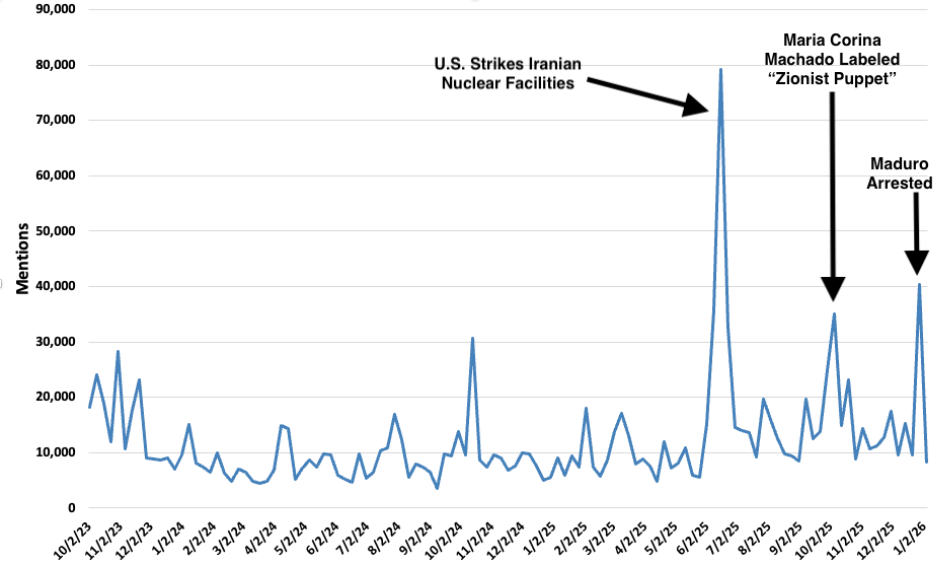
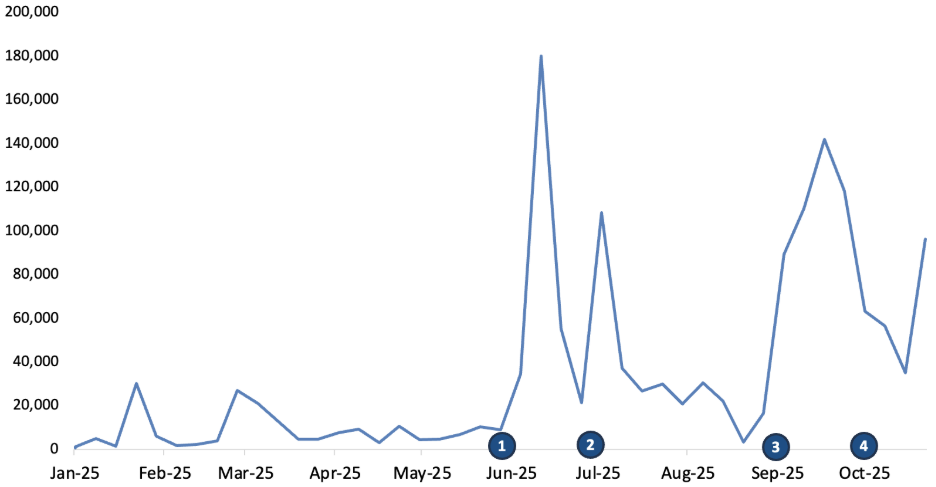
Political influencers and podcasters are increasingly promoting antisemitic conspiracy theories and amplifying extreme online conversations. In recent months, Tucker Carlson, a prominent American commentator, has featured guests for discussions that have drawn large online reactions related to antisemitism. Since June 2025, Carlson’s name has appeared 1.5 million times in our Command Center which tracks online conversations about Jewish culture and antisemitism—a 690% increase since June. This increase aligns with moments when Carlson’s interviews or comments became part of wider online conversations where antisemitic narratives appeared.
Graph Showing Mentions of Tucker Carlson, in relation to Antisemitism, Judaism, and Israel, in 2025
Spikes in Online Mentions
A review of social media data shows several clear spikes in mentions of Tucker Carlson between June and October. Each spike corresponds to a major interview or public remark that generated online discussion relating to antisemitism or Jewish culture
- June: Mentions spiked after Carlson’s earlier remarks about U.S.–Iran relations resurfaced following Israel’s attack on Iran. In those comments, he warned that any American strike on Iran could ignite a wider war. As the clip circulated, Carlson added another statement: “drop Israel. Let them fight their own wars … What happens next will define Donald Trump’s presidency.”
- July: A second spike occurred following his interview with Iranian President Masoud Pezeshkian
- September: Mentions surged again after he amplified antisemitic conspiracies during Charlie Kirk’s memorial alluding that Jews may have caused his death.
- October: The most recent spike came this past week when Carlson interviewed Nick Fuentas and Dr, Andrew Huff, sparking debates over antisemitic rhetoric and conspiracy theories shared during both interviews.
Behind the Numbers: The Posts and Narratives Related to these Online Spikes:
Hosting Guests Known for Antisemitic Rhetoric and Conspiracy Theories:
Carlson’s selection of guests has consistently driven conversation spikes. In July, his interview with Iranian President Masoud Pezeshkian prompted debate over U.S.–Iran relations and Israel’s role, with tweets such as “Never trust the Zionist entity” and “Probably a Mossad sleeper cell” reflecting antisemitic undertones. The most prominent backlash came in October after Carlson hosted Nick Fuentes and Dr. Andrew Huff. Many users criticized him for giving extremists a platform, referencing Fuentes’s history of antisemitic rhetoric and extremist views. Others defended the episode as free speech, praising Carlson for “sitting down with someone unpopular.” Huff’s discussion of COVID‑19 conspiracy theories also drew strong reactions, with comments ranging from disbelief to partial agreement.
Controversial Comments Captured During Interviews and Public Remarks:
Carlson’s own statements and the remarks he amplified have also fueled controversy. In June, comments he made after Israel’s attack on Iran, saying that America should “drop Israel” and let them “fight their own wars.” The statement drew both support and backlash. Later, at Charlie Kirk’s memorial in September, comments made by Carlson were widely circulated online, where he suggested that “Jews killed Kirk.” Many users condemned these interpretations as dangerous, though some echoed them approvingly like one user posting, “Well we do know the Jews killed Jesus… now we just need proof they killed Charlie”, and calls for a “separation of synagogue and state.”
Online Hate Rhetoric Amplifies and Extends These Narratives
Across all months, a consistent pattern emerges: Carlson’s broadcasts and public comments often serve as catalysts for antisemitic rhetoric online. Supporters interpret statements from his programs and remarks as validation of conspiratorial views, while critics amplify them in condemnation—both contributing to their wider circulation.
From claims that Israel manipulates U.S. policy to comments invoking age-old antisemitic tropes, these conversations illustrate how influential voices can ignite harmful narratives that quickly evolve into widespread hate across social media.