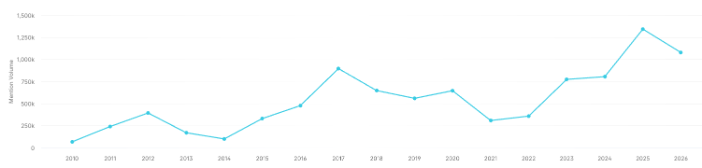
Use of the word “goy” has been trending upwards on social media lately. Our social media monitoring, which goes back to 2010, shows two clear surges in usage: first, between 2015 and 2017, and again in 2023 through today. Use of the term hit its highest level in 2025, and early 2026 is already approaching that peak. Just since the turn of the year, mentions of “goy” are up 295% on social media, amassing over 270 million impressions on X alone.
Social media mentions of ‘goy’ since 2010
The word “goy” has roots stretching back to the Torah, in which it refers to a “nation” or “people”—and is even used to describe the Jewish people themselves. In the Torah, God promises Abraham that his descendants will become a goy gadol (“a great nation”), and Israel is called a goy kadosh (“a holy nation”). Over time, “goy” came to mean “gentile” (a non-Jew), which is now its mainstream meaning. While “goy” is not inherently derogatory towards non-Jews, in some historical contexts shaped by centuries of minority life and vulnerability, it took on a sharper tone used to signal distance or mistrust toward outsiders.
On social media, “goy” often appears less as a neutral descriptor of non-Jews and more as a propaganda prop, especially in conspiracy-driven corners of the internet. In these spaces, extremists have weaponized the word, stripping it of its neutral origins and recasting it as evidence of Jewish contempt for non-Jews. This reframing is deliberate: by portraying “goy” as purely derogatory, bad actors prop up a narrative of perceived “Jewish supremacy.”
This manipulation is frequently anchored to attacks on the Talmud, the central text of Jewish religious law and ethics. In extremist spaces, selectively quoted, mistranslated, or fabricated passages are circulated as “evidence” that Jewish scripture instructs Jews to view non-Jews as subhuman. These decontextualized excerpts, all of which have been debunked or contextualized by scholars, are used to legitimize the claim that “goy” carries inherent contempt within Jewish tradition. This tactic has medieval roots tied to anti-Jewish propaganda, but it has found new life on social media, where a screenshot of a mistranslated religious text can spread much faster than its correct interpretation.
The phrase “good goy” is among the most common deployments of the word online, and its usage reveals the manipulation tactics at work. The phrase is aimed at individuals perceived to be acting according to “Jewish interests.” Antisemitic influencer, Dan Bilzerian, responded to a tweet by Rep. Randy Feenstra denouncing Hamas with the comment, “You do as you’re told. I bet you call your AIPAC handler massa like the good goy slave that you are.” In this example, “goy” is stripped of its neutrality and redeployed to brand its target as being “controlled by the Jews.”
Top 20 phrases used with the word “goy” on social media since 2010
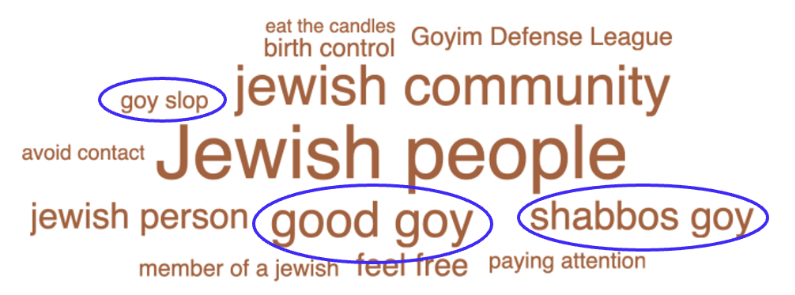
The online use of “Shabbos goy” follows a similar trajectory. Within the Jewish community, the term traditionally refers to a non-Jew who performs tasks that observant Jews are prohibited from doing on the Sabbath. In extremist online discourse, however, it has been stripped of that meaning and repurposed as a way of branding public figures as traitors. “Trump could’ve easily been the greatest president in United States history,” reads one post. “Unfortunately, he’ll only be remembered as a shabbos goy that sold out his people and his country to Israel.” A term rooted in religious observance has been gutted of its original meaning and reframed as a slur.
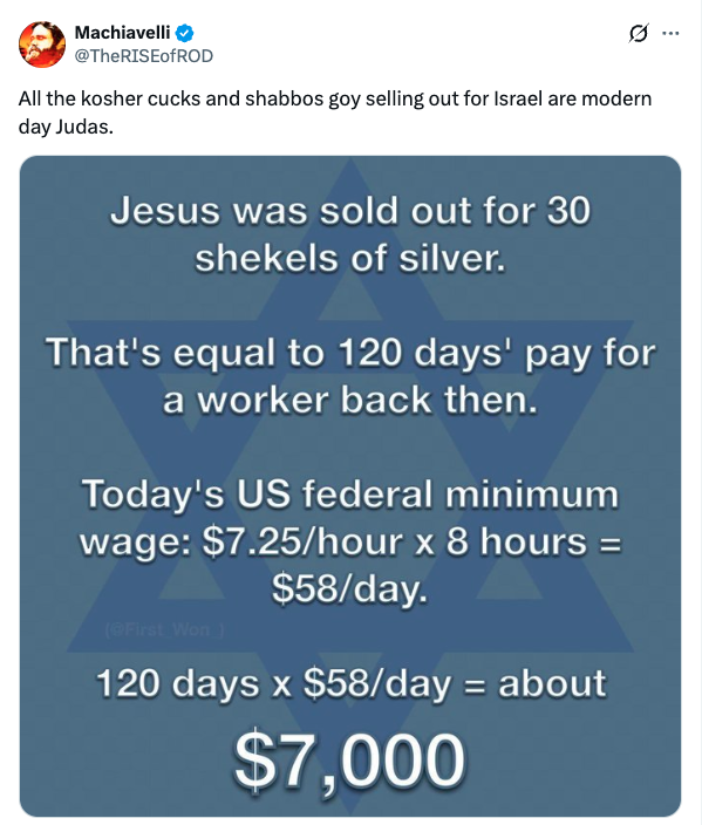
The word has also found its way into newer online slang. “Goyslop,” for example, is used in certain online communities to describe low-quality mass-produced food, mainstream entertainment, or popular culture broadly to keep non-Jews “compliant” and “dull.” On the surface, “goyslop” can be read as cultural cynicism or ironic internet humor, but the term carries a clear conspiratorial undertone. It carries the same conspiratorial tone as “good goy,” just more casual.
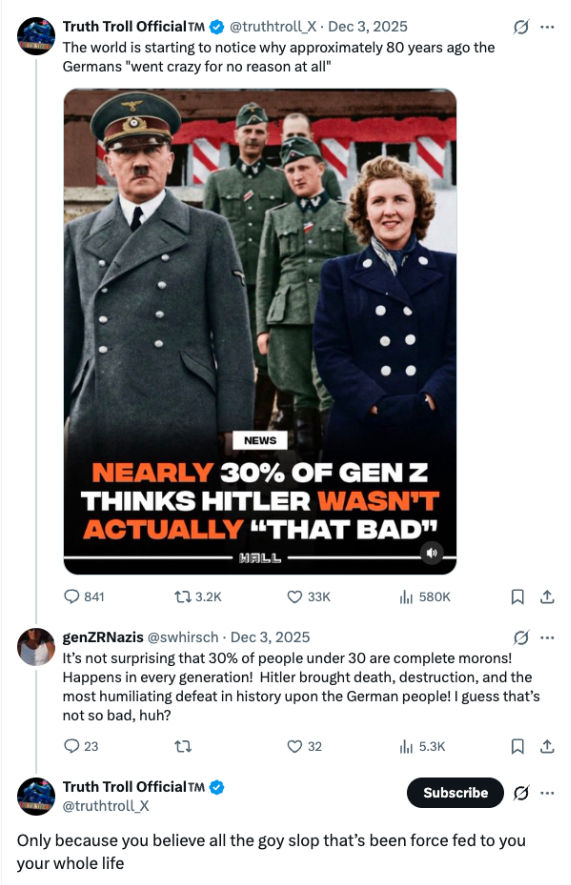
Not every use of the word “goy” is antisemitic and collapsing that distinction does a disservice to both accuracy and to Jewish culture itself. Within Jewish communities, the word is used routinely without malice—as it has been for centuries—to refer to a non-Jewish person. The line is crossed when the word is weaponized: when it is deployed to assert that Jews collectively view non-Jews as inferior, when it is used to brand individuals as pawns of Jewish power, when it is invoked to lend credibility to conspiracy theories about Jewish control or supremacy, or when it is used by Jewish people in a derogatory manner.
The deliberate distortion of “goy” is not incidental—it is a recruitment tool. By convincing non-Jews that the word is proof of Jewish contempt for them, extremists reframe antisemitism not as hatred but as self-defense, pulling people into a conspiratorial worldview by making them feel they are the ones under threat. The real-world consequences of this language are not abstract. The Goyim Defense League—one of the most prolific distributors of antisemitic propaganda in the United States, according to data from the Anti-Defamation League—took its very name from this framework.