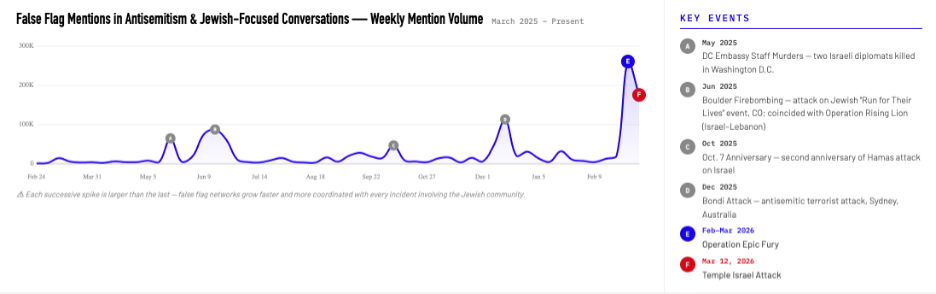
In the weeks following the March 12, 2026 vehicle-ramming attack on Temple Israel in West Bloomfield, Michigan, Oakland County Sheriff Mike Bouchard found himself the target of an antisemitic harassment campaign. Bouchard had helped coordinate the law enforcement response to the attack and had been among the most visible officials publicly defending the Jewish community in its aftermath. The harassment took a specific form: a meme depicting his face digitally altered to include a Star of David on his forehead and payot over his ears. The image did not mock his law enforcement record, his politics, or his professional conduct. It labeled him as Jewish, even though he is not. The intent was not to describe him religiously. It was to use Jewish identity as the slur itself.
On March 19, Bouchard held a press conference to address the rising antisemitism following the attack. He displayed the meme from the podium, describing it as the work of “pond scum” intended to “threaten and intimidate” him, and noted that the individual responsible had been arrested in Wisconsin on an unrelated felony stalking warrant. The announcement was immediately misrepresented online.
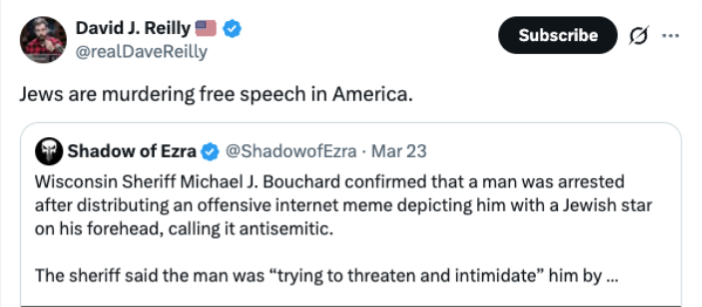
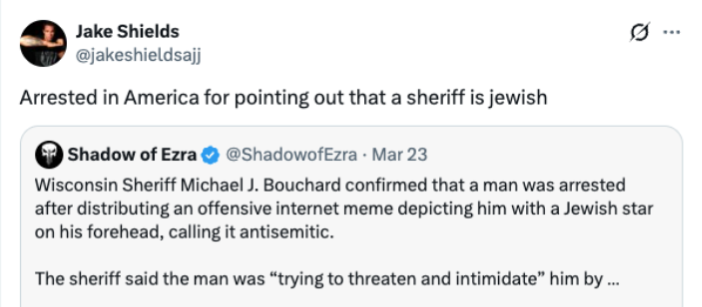
The actual reason for the arrest — an outstanding felony stalking warrant entirely unrelated to the meme — was stripped from the narrative. In its place, thousands of posts framed the event as a Jewish-directed suppression of free speech: a sheriff acting on behalf of Jewish interests, using Jewish power to silence a critic for posting an image. One post called for Bouchard to be “fired and imprisoned for violating an American’s Constitutional rights.” Another declared: “Jews are murdering free speech in America.”
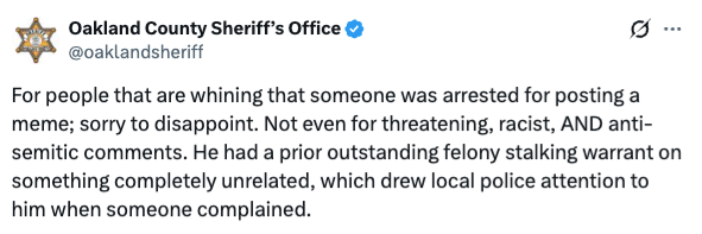
The Oakland County Sheriff’s Office was forced to issue a public correction — clarifying that the arrest had nothing to do with the meme — in a post that itself reached over 1.8 million views, a measure of how broadly the false narrative had already spread.
The behavior directed at Bouchard belongs to a recognized category of antisemitism that extends beyond Jewish targets. The International Holocaust Remembrance Alliance (IHRA) working definition — the most widely adopted global framework for identifying antisemitism — explicitly states that antisemitic acts can be directed toward non-Jewish individuals as well as Jewish ones. In practice, this means non-Jews can be targeted for being perceived as acting in the interests of Jewish people or institutions.
One way this antisemitism manifests is by labeling non-Jewish individuals as “Jewish” as a direct expression of contempt — deployed in the same way one might use any other slur. The label is not offered as a factual description. In this case, the word “Jewish” is used as an explanation for why a person’s actions are suspect, their arguments invalid, or their loyalties compromised. When applied to a person’s perceived loyalties, the accusation draws explicitly from the dual loyalty conspiracy theory that claim Jewish people only act to benefit themselves, other Jews, or the state of Israel.
The labeling of one as a “Jew” does not have one specific target. The use of “Jew” as a slur crosses demographics, political lines, and geographical borders. The underlying idea — that Jewish identity is corrupting, that it explains and disqualifies a person’s actions — is a shared vocabulary of delegitimization that crosses demographic and ideological lines. This accusation takes on multiple forms some more direct and others more covert tied to historical terms — but both serve the same function: to dismiss and delegitimize.
Directly calling someone “a Jew” as a Slur
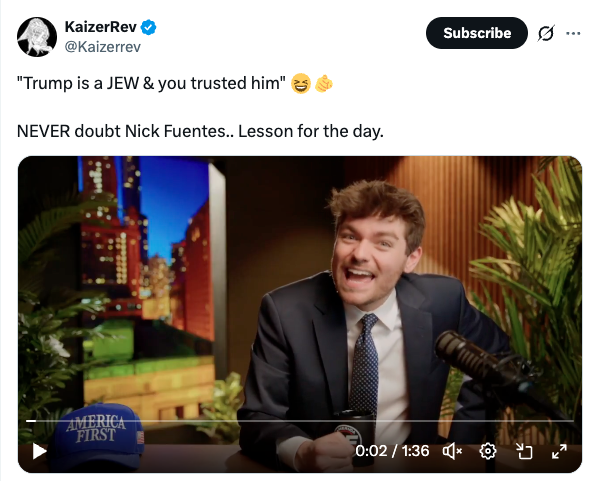
The direct form requires no decoding. It is simple to identify because it is plain and direct. It typically appears as a reply or a comment under a post accusing the original author of being “Jewish” as a terminal explanation for behavior the poster finds objectionable. For example, when voicing opposition to Trump’s policies, right wing influencer Nick Fuentes declared in March 2026 that “Trump is a JEW & you trusted him,” it was not a factual claim — it was a punishment for perceived ideological betrayal following Trump’s authorization of military action against Iran. However, this behavior also crosses political lines, as Biden was also accosted with this language during his presidency. For example, one user posted “Biden is Jewish if he’s anything. He’s definitely not a Christian” in response to a video of President Biden speaking about his support of abortion rights. In the user’s mind, being supportive of abortion rights was not a Christian value.

The Coded Form: “Crypto-Jew”
The more coded expression of this phenomenon borrows a term with legitimate historical roots. “Crypto-Jew” derives from the Greek kryptos — hidden — and in historical scholarship refers specifically to Jews forcibly converted to Christianity during the Spanish Inquisition who maintained Jewish practice in secret. The Inquisition’s central purpose was detecting these individuals, operating on the premise that Jewish identity persists beneath a Christian surface, invisible and corrupting. What was once a descriptor for a documented population of persecuted people became a conspiratorial label — a way of asserting that anyone whose behavior is deemed suspicious or objectionable must have Jewish identity concealed beneath a non-Jewish surface.
Today the term circulates in antisemitic discourse not as a historical reference but as an accusation, applied to politicians, journalists, and public officials who are disliked, distrusted, or simply disagreed with. On social media that logic reappears in posts such as “She is a Jew hiding amongst us” and “You’re a Jew pretending to be Christian in order to spread Jew propaganda” — the Inquisition’s framing, posted in a reply thread.
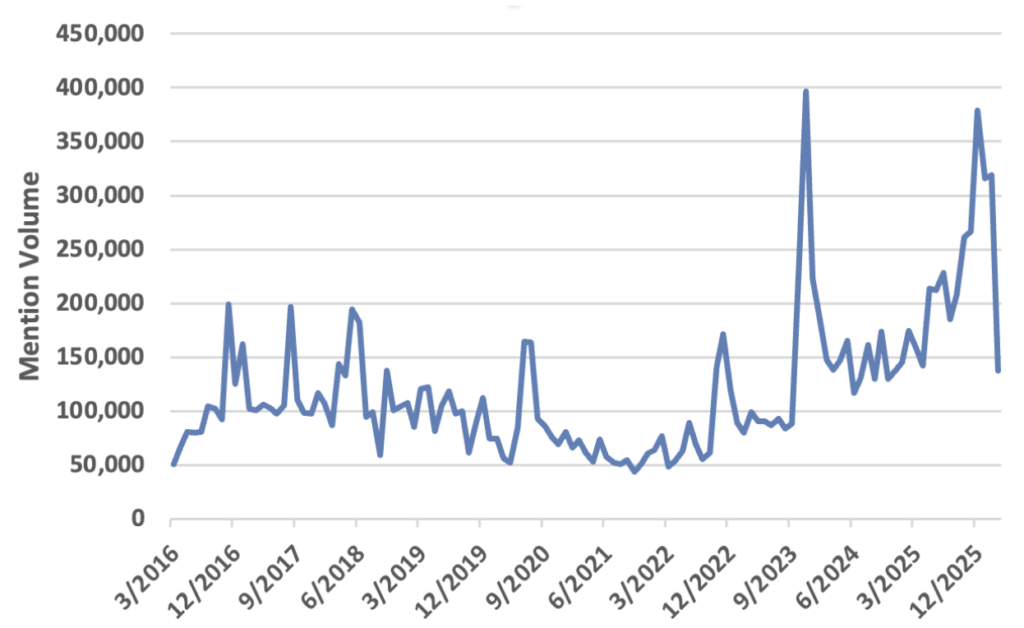
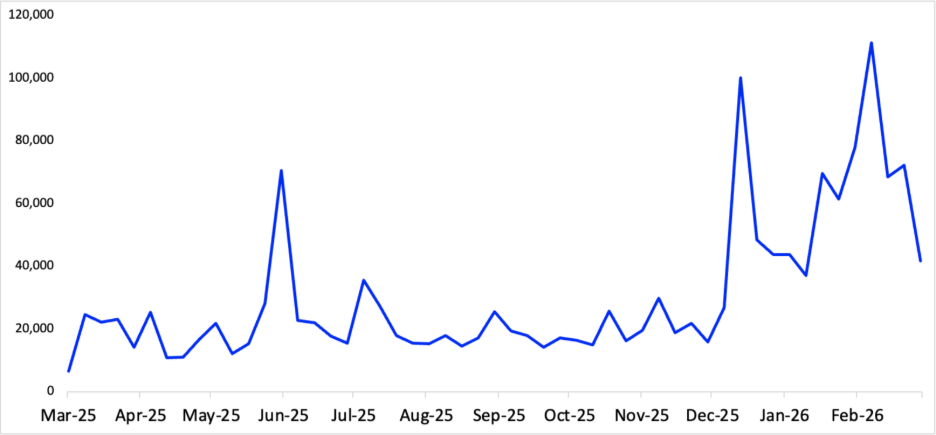
Blue Square Alliance examined the trajectory of “crypto-Jew” and related terms specifically on X (formerly Twitter) since 2015. Usage was relatively contained through the early platform years, then surged between 2016 and 2018 alongside the documented rise of alt-right activity online. Usage declined from 2019 onward as platform moderation and deplatforming efforts reduced far-right activity broadly. Since October 7, 2023, however, the term has undergone a second and steeper acceleration. The period from October 2023 through March 2026 generated 50,409 mentions of “crypto-Jew” and related terms — more than the entire preceding eight years combined. March 2026 is the highest single month on record.
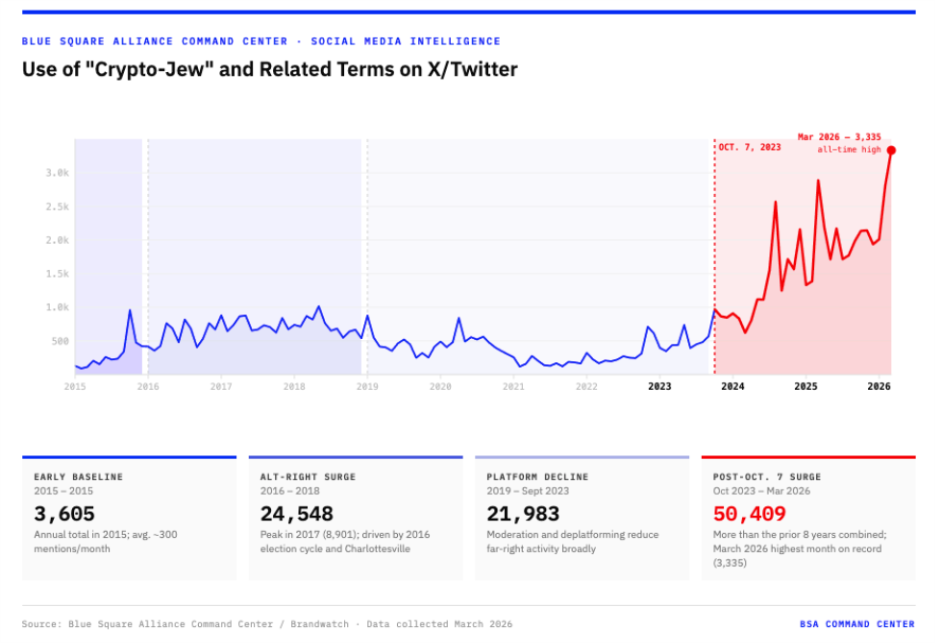
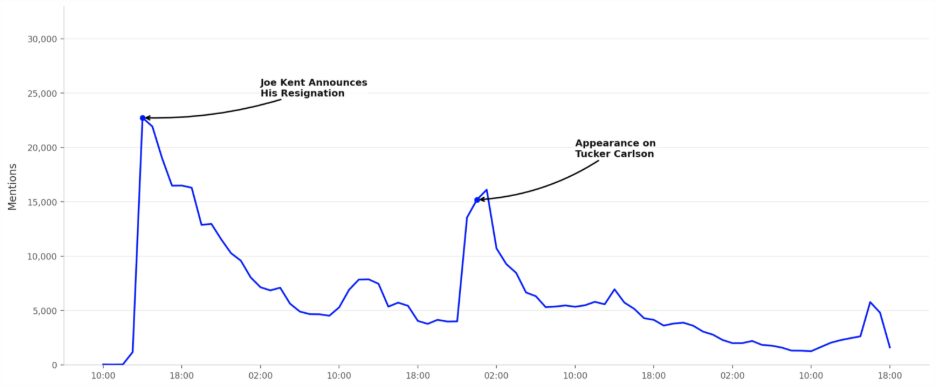
The surge is not plateauing — it is accelerating. Annual totals tell the story clearly: 7,000 mentions in 2023, rising to 16,000 in 2024, and 23,000 in 2025. In the first three months of 2026 alone, the figure has already reached over 8,000— a pace that would put the full year well above any prior year on record. That acceleration has been driven in part by discrete conflict events: in the 25 days following the launch of Operation Epic Fury, the U.S.-Israel military campaign against Iran that began February 28, 2026.
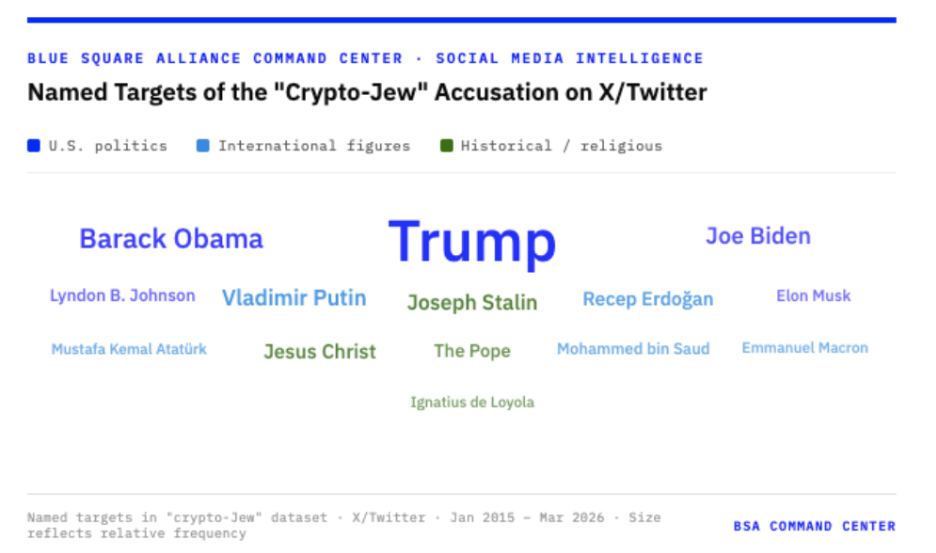
Blue Square Alliance’s analysis of named targets in the dataset since 2015 shows how broadly the accusation is applied. The figures most frequently appearing alongside “crypto-Jew” span the full political spectrum — Trump, Obama, Putin, Stalin, Erdoğan, LBJ, the Pope, and even Jesus Christ and Ignatius de Loyola, the founder of the Jesuits. No political affiliation, nationality, or era is immune. The appearance of historical religious figures reflects how deep the accusation’s roots run — the claim that Jesuit founders secretly harbored Jewish identity dates to 16th-century Catholic anti-converso paranoia, and has simply migrated onto X.
Additionally, Grok — X’s own AI assistant, with 8.4 million followers, introduced only in November 2023 — appears among the top authors in the dataset. Users are querying the platform’s AI to “verify” whether public figures are Jewish, and those AI-generated responses are then shared and amplified in the same threads where the accusation originates. The platform’s own infrastructure is being used to launder and lend apparent credibility to the crypto-Jew accusation in a way that existing monitoring frameworks are not built to detect.
Outside social media, the Netflix documentary Inside the Manosphere (2026) captured the same dynamic on camera. Documentarian Louis Theroux — who is not Jewish — was labeled “a dirty Jew” by live chat users the moment he challenged a pseudoscientific claim during an appearance on a manosphere podcast. A separate figure in the documentary mimicked Theroux tenting his fingers conspiratorially while referring to his “Jew fingers.” The label was deployed in direct response to an act of factual correction.
Why This Matters — and Why It Goes Undetected
This behavior inflicts harm on two groups simultaneously, in distinct ways. Non-Jewish individuals in this context become targets of coordinated hate — subjected to harassment, threats, and abuse from communities that treat the accusation as justification for attack. By invoking Jewish identity as a slur, it places the target inside an antisemitic conspiratorial framework that exposes them to the full range of hostility those communities direct at Jews. For Jewish people, the injury operates differently but runs just as deep. Every deployment of “Jew” as a slur reinforces the premise that Jewish identity is something shameful, dangerous, and worthy of contempt. It places Jewishness in the company of the worst accusations one person can make about another. It does not require a Jewish target to cause Jewish harm.
Part of what makes this behavior difficult to identify and address is that it does not look like antisemitism to many people encountering it. The posts are short, often stripped of the familiar markers of hate speech, and directed at people who are not Jewish. For a casual observer, a post reading “He is a Jew” directed at a non-Jewish sheriff may simply appear to be a factual error rather than an act of hatred. This points to a broader misconception: the assumption that antisemitism only harms Jewish people, and that non-Jews cannot be the targets of antisemitic hate. The IHRA definition explicitly addresses this, recognizing that antisemitic acts can be directed at non-Jewish individuals. Yet that understanding has not fully translated into how people recognize and respond to antisemitism when they encounter it in the wild — particularly in a social media context where the volume and speed of content makes careful reading rare.