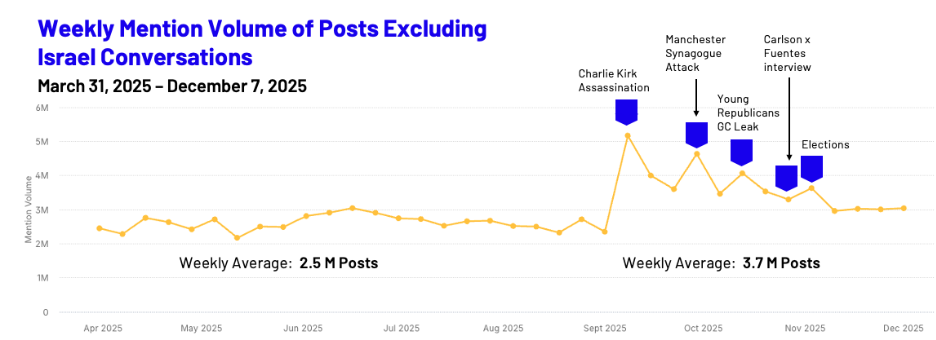
When the ceasefire and the release of Israeli hostages were announced, the Command Center began monitoring how online conversations would shift in the days that followed. At first, we saw that the overall volume of conversation tracked did begin returning to late-summer levels, suggesting the intense spikes we saw in September and early October were tapering off. But when we removed explicit mentions of Israel, Palestine, or Zionism — the terms that typically dominate the conversation — a different pattern emerged. Conversations about antisemitism and Jewish identity remained significantly elevated, revealing a trend that piqued our curiosity and led us to look more closely at what was driving it.
What we found is that the sustained rise in antisemitism-related conversation had far less to do with Middle East dynamics, and far more to do with events unfolding inside the United States.
And the moment that opened the door to this entire wave was the assassination of Charlie Kirk.
Charlie Kirk’s Assassination: The Catalyst for a New Conversation Landscape
Kirk’s assassination triggered an immediate and overwhelming surge in online discourse. The event became a flashpoint in political conversations on social media. Back in September, we reported that we saw over 26 million posts about Charlie Kirk just in the two days following his assassination. During this time period we also tracked a notable surge in antisemitism related conversations driven by an increase of conspiracy theories around Jewish and Israeli involvement in his assassination. Following that moment, the conversation shifted from the tragedy itself to broader arguments about political violence, polarization, and the rise of antisemitism in political spaces.
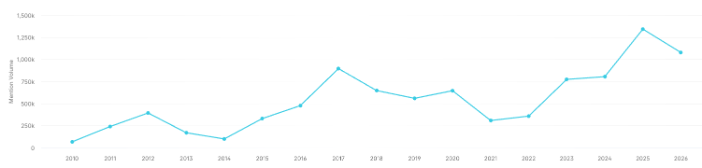
This moment didn’t just create a one-off spike — it reoriented the entire ecosystem. In the wake of Kirk’s death, multiple political and cultural stories broke in quick succession, each connecting in some way to extremism, prejudice, or antisemitism, resulting in a sustained spike tracked by the Command Center. Between March and early September, online conversations about antisemitism and Jewish identity averaged 2.5 million posts a week. Since September 8, that number has jumped to an average of 3.7 million posts weekly, a nearly 50% increase that has not returned to baseline.
What’s driving this surge — and why is it sticking? Our analysis shows that several forces, all emerging at once, have pushed antisemitism into the center of political and cultural conversations across the country.
Antisemitism Became a Central Topic in Online Political Discussions
Over this time period Antisemitism has increasingly been used as political currency across both major U.S. parties. Conversations involving Jewish identity, conspiracy theories, and Holocaust metaphors have become recurring features of political debate, contributing significantly to sustained volume. Several high-impact political stories continued to build on the momentum created by the Kirk assassination:
- Zohran Mamdani’s win in the New York City mayoral race, sparking nationwide discussions about Israel, anti-Zionism, and accusations of antisemitism
- A Democratic nominee in Maine whose Nazi tattoo resurfaced, raising questions about extremism within mainstream politics
- A leaked Young Republicans group chat, revealing casual antisemitic language among emerging political leaders
- Tucker Carlson’s public platforming of Nick Fuentes, which pushed extremist rhetoric into broader conservative media spaces
- Bipartisan arguments, and acknowledgment, over the prevalence of antisemitism within both Democratic and Republican circles
Each of these moments generated new rounds of commentary, keeping the conversation elevated and extending the impact of the initial spike.
A Second Driver: Holocaust Language Returned to the Center of Political Debate
Another major reason conversations stayed high is the resurgence of Holocaust-related comparisons in everyday political rhetoric. Holocaust-related conversations increased 52% and accounted for over one-third of all posts analyzed
Terms such as “Nazis,” “Gestapo,” and “Hitler” have appeared far more frequently in arguments about immigration, policing, and political behavior. Examples include:
- comparisons between ICE and the Gestapo
- Using “Nazis,” “Hitler,” and “fascist” as rhetorical labels for political opponents,
- Following Kirk’s assassination, commentary from high-profile figures saying that people who falsely label others as Nazis or fascists should be held legally accountable and should be treated as incitement to murder.
This kind of language dramatically increases conversation volume. Just the words “gestapo,” “Hitler,” “Nazi,” or “Nazis” appeared over 19 million times during this time period. It triggers wide emotional response, fact-checking, historical correction, partisan conflict, and extremist amplification — all of which keep the topic circulating.
A Third Driver: Public Reactions to Antisemitic Incidents
During the same period, several incidents drew international attention and fueled additional waves of discussion:
- coins thrown at Dave Portnoy, an incident widely viewed as antisemitic harassment
- the ban on Maccabi Tel Aviv fans from attending a soccer match in England
- Students formed a human swastika on a football field and shared it on social media with an antisemitic quote, prompting investigation and backlash.
Each incident intensified public concern and spurred renewed conversation about community safety and the broader climate of hate.
An Amplification Layer: Extremist Influencers and Coordinated Online Networks
While political events and public incidents generated spikes, extremist networks played a major role in sustaining them.
Antisemitic influencers like Nick Fuentes, Mo Khan, Jake Shields, and their networks actively pushed conspiracy theories, sarcastic dog whistles, and antisemitic narratives into mainstream spaces. Phrases such as “early life,” “110,” “promised 3,000 years ago,” and “spiritually Israeli” spread quickly due to their memetic ambiguity.
In particular, Nick Fuentes’ rise during this time due to his interviews with Tucker Carlson and Piers Morgan have given him and his supporters, known as “Groypers,” more visibility and confidence to interject into mainstream conversations.
These networks act as amplifiers — whenever a political story touches on Jewish identity, they escalate it, distort it, and keep it active for far longer than usual.
Seasonal Context: Jewish Holidays Added Additional Visibility
The period from September to November also includes major Jewish holidays such as Rosh Hashanah, Yom Kippur, Sukkot, and Simchat Torah. These naturally increase general conversation about Jewish identity, community life, and safety concerns. While this alone cannot explain the elevated baseline, it added a steady layer of visibility on top of an already activated environment.
What This Means Going Forward
Our post-ceasefire analysis revealed something unexpected: while overall conversation levels around Israel may be cooling, antisemitism-related discussions are nor. They continued climbing — and then held steady at significantly higher levels than before.
Three forces are primarily responsible:
- Political commentary and reactions to political events, with the Kirk assassination acting as the original catalyst
- The mainstreaming of Holocaust references in political argument, which dramatically increases engagement
- Reactions to antisemitic incidents, occurring in an already politically charged environment
Combined with amplification from extremist networks and seasonal Jewish visibility, these forces created a new, higher baseline of conversation — one that is unlikely to fade quickly.
For anyone who cares about the recent rise in antisemitism, the takeaway is clear: antisemitism is no longer surfacing only during global crises or fringe events. Increasingly, it is intertwined with domestic politics, cultural commentary, and online rhetoric. Understanding these patterns is essential to anticipating where the conversation may go and being able to recognize it.