
The manosphere has grown from a loose collection of online communities into a large and influential ecosystem that reaches tens of millions of people through popular media including podcasts, YouTube, and social media. Early focuses were on dating advice, pickup culture, and grievances about feminism. Over time, researchers have documented how these spaces evolved into power-based worldviews, increasingly incorporating conspiratorial, and antisemitic narratives.
Manosphere Antisemitism Is Starting to Break Through in Mainstream Media
Recent media coverage reflects this shift. In Louis Theroux’s Netflix documentary, Inside the Manosphere, Theroux’s exploration of online male subcultures shows how discussions about masculinity increasingly intersect with conversations about power, identity, and Jews.
The Manosphere Radicalization Timeline: 2006 to 2025
A rough timeline of the manosphere based on existing research:
- 2006 to 2015: early manosphere formation
- 2016 to 2018: “red-pill” communities expand and become more interconnected
- 2018 to 2019: “incel” and “blackpill” communities grow, introducing more fatalistic and hierarchical thinking
- 2020 to 2021: COVID and platform shifts accelerate radicalization and the spread of conspiratorial narratives
- 2022 to 2025: antisemitic content becomes more visible and integrated within some manosphere communities
Eleven Manosphere Influencers Studied Across X, Instagram, and Facebook
To examine how this evolution appears in practice, the Blue Square Alliance Command Center analyzed the full post history of several notable “manosphere personalities” across X, Instagram, and Facebook, including Sneako, Dan Bilzerian, Myron Gaines, Adin Ross, Andrew Tate, Tristan Tate, Hannah Pearl Davis, Matt Walsh, Nick Fuentes, Mike Cernovich, and Justin Waller, two of whom were recently named on the Israeli government’s 2025 list of top ten prominent antisemitic influencers released this past week.
Together, these accounts have a combined following of 27.9 million users on X alone, or roughly 2.5 million followers per account on average.
Their posts were filtered into three discourse categories:
- Judaism or Israel
- Immigration or race
- Masculinity, feminism, or gender/LGBT+
How October 7 Became a Turning Point in Manosphere Posting Behavior
The first graph shows mention volume across the full period from January 2020 through early 2026, with a vertical line marking October 2023 as a dividing point between the pre- and post-attack periods.
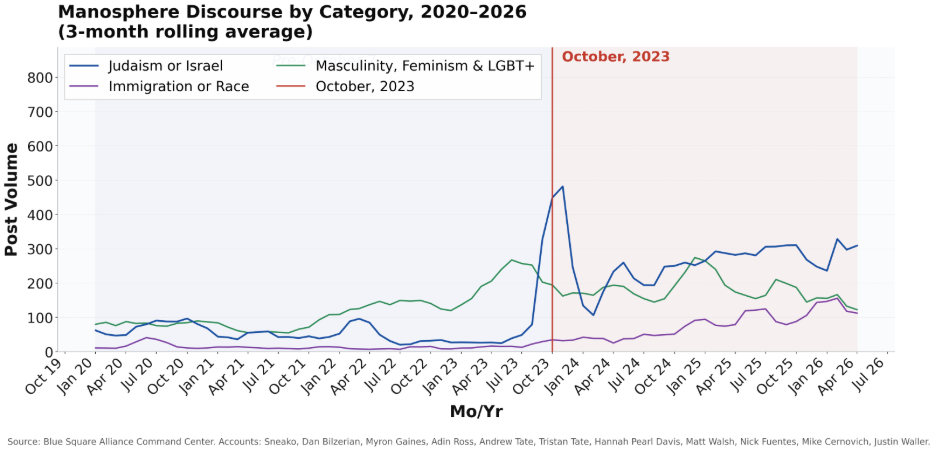
Before October 7, discussion of masculinity, feminism, and gender mostly dominates. Mentions related to Judaism or Israel appear only intermittently, with a few brief spikes but no sustained presence. After October 7, the pattern changes dramatically. There is a large spike in mentions related to Judaism and Israel, followed by a sustained shift in which that category remains at or above the level of gender-related discussion. In recent months, the gap has widened further, with Judaism and Israel now clearly dominating the other categories more than at any previous point in the dataset.
Why Mike Cernovich Skews the Early Dataset
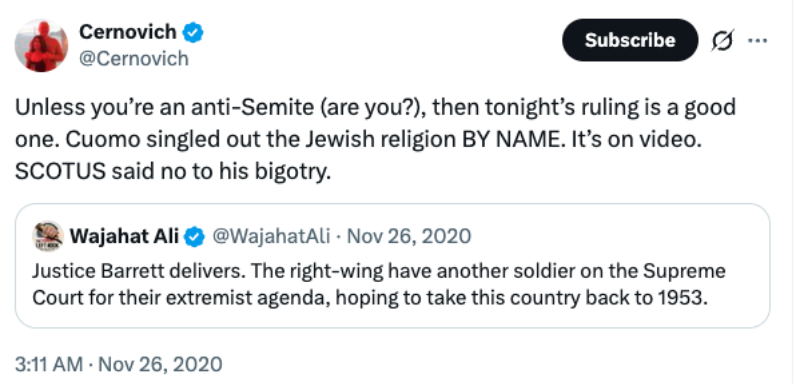
A closer inspection of the underlying posts revealed that much of the pre-October 7 discussion related to Judaism or Israel was driven by a single account, Mike Cernovich. While Cernovich, who is not Jewish, has expressed radically misogynistic views, he has also consistently spoken out against antisemitism. This means that the early presence of Judaism or Israel related content does not reflect the broader behavior of the other accounts in the dataset.
The Rise in Antisemitic Manosphere Content Holds Even Without Cernovich’s Posts
To account for this, we removed Cernovich’s posts and reran the analysis.
The second graph shows the pre-October 7 period with Cernovich removed.
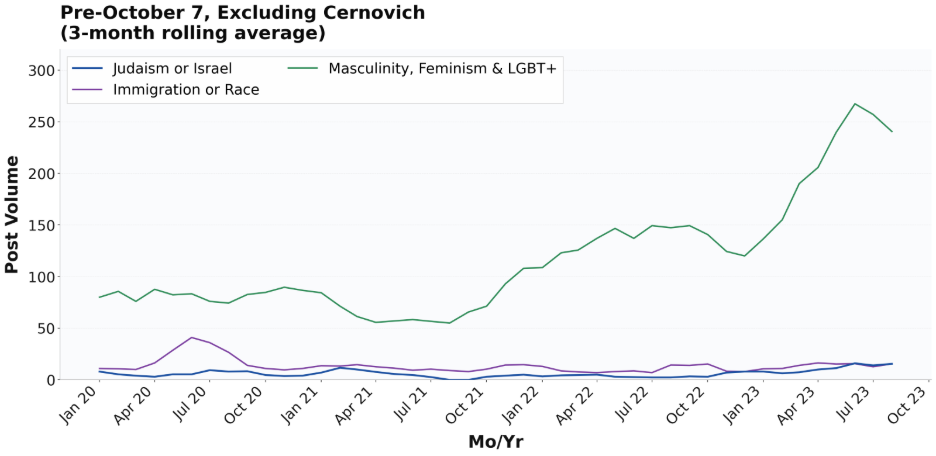
In this version, the change is clear. Masculinity, feminism, and gender dominate almost entirely pre-October 7, while mentions related to Judaism or Israel are minimal and largely flat. This aligns closely with existing research suggesting that antisemitic discourse was not yet a central focus for most manosphere personalities during this period.
The third graph shows the post-October 7 period with Cernovich removed.
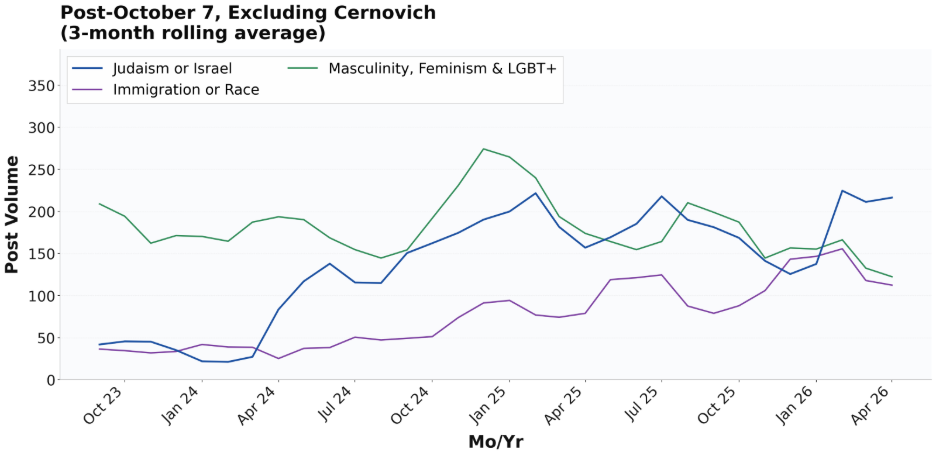
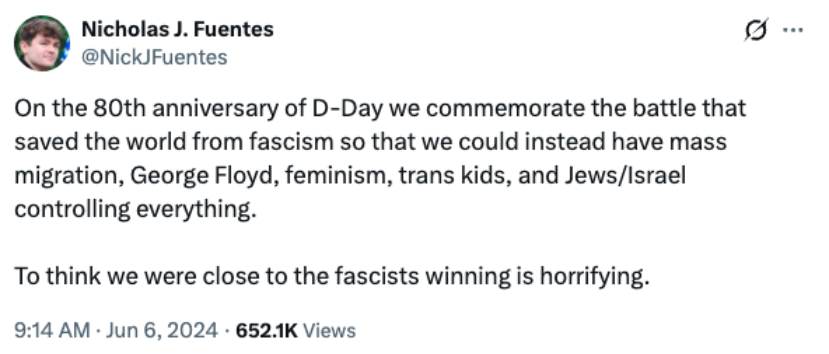
Here, the shift remains evident even without the earlier outlier, but the pattern changes in an important way. Surprisingly, the October 2023 spike disappears entirely, which confirms that it was driven mainly by Cernovich. Mentions related to Judaism and Israel remained relatively low through early 2024, before showing their first significant spike in mid 2024. This timing coincides closely with the May 2024 reinstatement of Nick Fuentes to X, following a period of deplatforming. When Fuentes’ posts are removed from the analysis, the Jewish line still rises, but not until October 2024, suggesting that his return accelerated a trend that was already developing within the broader group of accounts.
Antisemitism Has Overtaken Gender as the Dominant Manosphere Topic
Beginning in 2026, mentions related to Judaism and Israel clearly overtake the other categories and remain the dominant topic. This represents the largest sustained gap between categories in the dataset minus Cernovich’s posts.
Before 2024, discourse among these personalities was primarily centered on masculinity and gender, with references to Jews or Israel appearing only occasionally and often driven by outliers. After mid-2024, and especially into 2026, that balance shifts.
Future installments will examine this shift in more detail, including the rise of specific phrases, the blending of antisemitic language with manosphere slang, and the pathways through which these narratives spread across platforms.



Command Center Insights
How the Internet Reacted to the Cost of Jewish Security