As news of Operation Epic Fury — the military engagement involving Israel, the United States, and Iran — spread across social media platforms, antisemitic themes spiked sharply in online conversation. Analyzing the period from Feb. 28 to March 3, 2026, the BSA Command Center recorded a 264% increase in overall tracked conversation, alongside a significant surge in hateful content. Posts glorifying Adolf Hitler, claiming Jews control the U.S. government, reviving 9/11 conspiracy theories, and using dehumanizing language targeting Jews and Israelis all climbed dramatically — in some cases by hundreds or thousands of percent.
The pattern is one the Command Center has documented before. When Israel launched Operation Rising Lion in June 2025, the BSA Command Center recorded a 165% spike in online conversation about Jewish culture, antisemitism, and Israel. Similar themes dominated then: Jewish control of U.S. government, false flag accusations, Hitler glorification, and dehumanizing language comparing Jews to rats and vermin. Operation Epic Fury appears to have activated the same playbook, this time at an even greater scale.
Hitler Glorification Surges Across Platforms
Over 466,000 posts mentioned Hitler in the four days following the outbreak of hostilities — a 120% increase over the prior period. The content ranged from familiar antisemitic slogans to newly emergent phrases that spread rapidly across platforms.
“Hitler was right” appeared in approximately 7,500 posts, up 248%, generating over 816,000 impressions. More striking was the explosion of posts suggesting the world “owes Hitler an apology” — a framing the Command Center also tracked following Operation Rising Lion in June 2025. This time, that phrase surged 1,700%, producing over 22,000 posts and 1.3 million impressions.
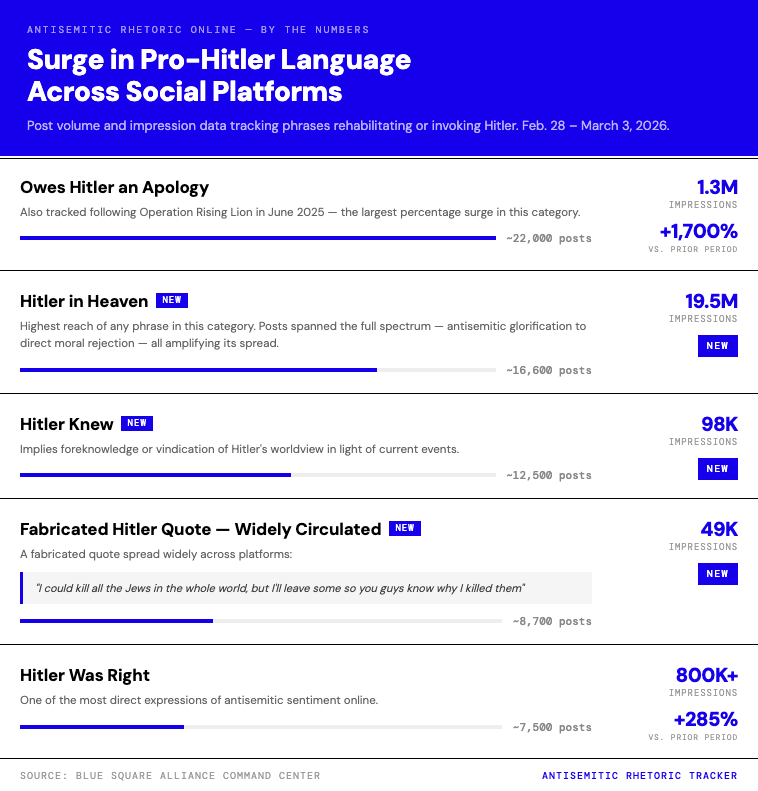
Several phrases emerged as new entries in this conversation. “Hitler knew,” appearing in around 12,500 posts, implied foreknowledge or vindication of Hitler’s worldview in light of current events. A fabricated Hitler quote — “I could kill all the Jews in the whole world, but I’ll leave some so you guys know why I killed them” — also circulated widely, appearing in roughly 8,700 posts with 49,000 impressions. The phrase “Hitler in heaven” appeared in 16,600 posts and generated 19.5 million impressions — the highest reach of any phrase tracked in this category. The posts were not all antisemitic in intent. The highest-reach post used the framing to celebrate: “Hitler in heaven getting told that the whole world is against the Jews now.” The second-highest reach post inverted it entirely: “Hitler in heaven seeing Jewish people succeed worldwide after everything he did to stop and erase them.”
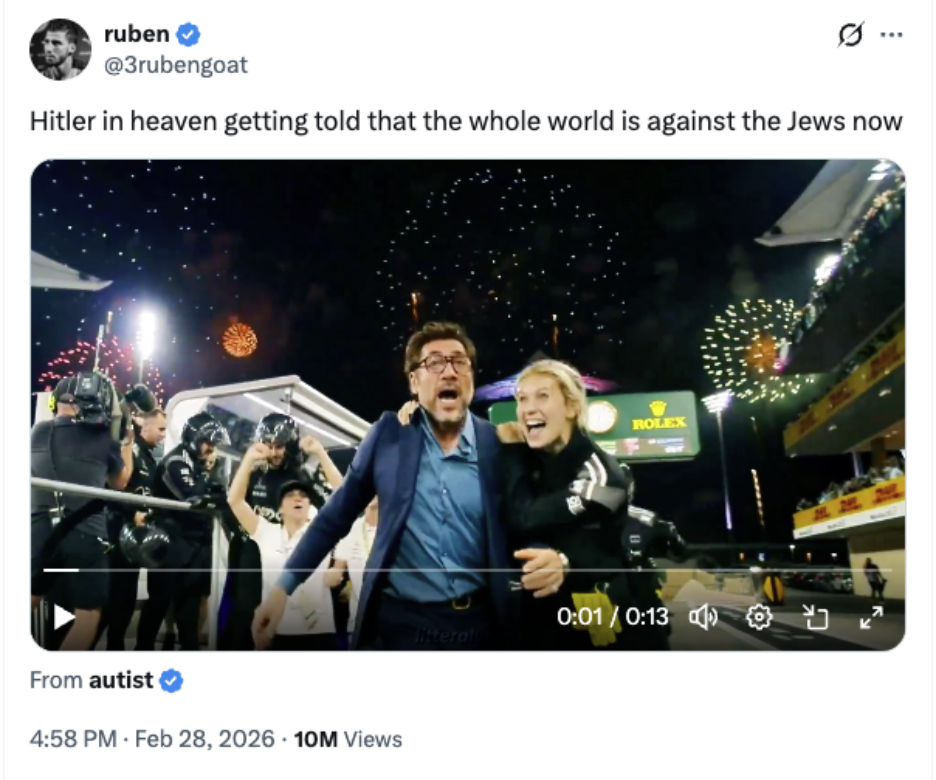
The phrase provoked strong reactions precisely because of what it implies. Across the major Abrahamic traditions, heaven is understood as a destination for the righteous — the notion that Hitler, architect of the genocide of six million Jews, could occupy that space strikes many as not just factually wrong but morally obscene. That tension is exactly what made the phrase so combustible online. Some users engaged with it earnestly, others ironically, and a visible cohort responded with raw disbelief — “Adolf Hitler in WHAT” — treating the premise as too absurd to engage with seriously. All of it, regardless of intent expanded its online reach.

This pattern did not emerge with Operation Epic Fury. Blue Square Alliance’s Command Center has been tracking Hitler glorification phrases since October 7, 2023. revealing a longer trajectory: each conflict moment drives volume sharply upward, and each recovery settles at a higher floor than the one before it.
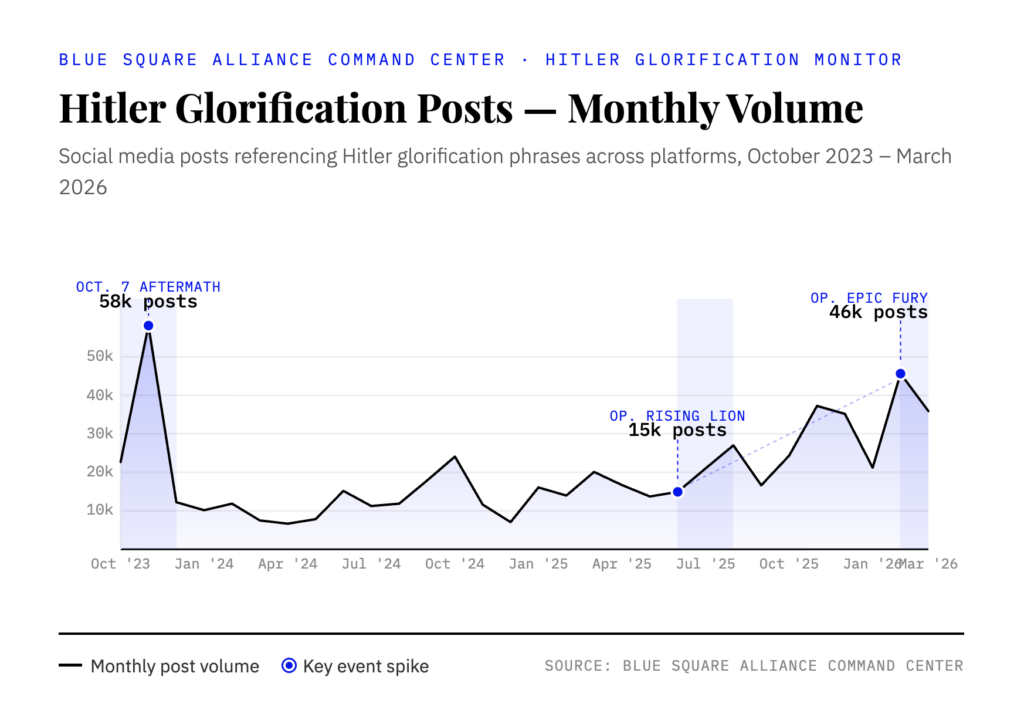
The first major spike came in the weeks following October 7. Volume then declined — but never returned to pre-attack levels. A second inflection followed Operation Rising Lion in June 2025, after which monthly volumes climbed steadily through the second half of 2025 and into early 2026. By the time Operation Epic Fury began, the baseline had already risen significantly from where it stood two years prior. The operation produced the largest surge yet — but it did so against a backdrop that had been quietly escalating for months.
The data points to a ratchet effect: this language is no longer confined to moments of acute conflict. It has become a persistent feature of the online environment, one that spikes in crises and recedes only partially when they pass.
Conspiracy Theories Frame Jews as Controllers of U.S. Policy
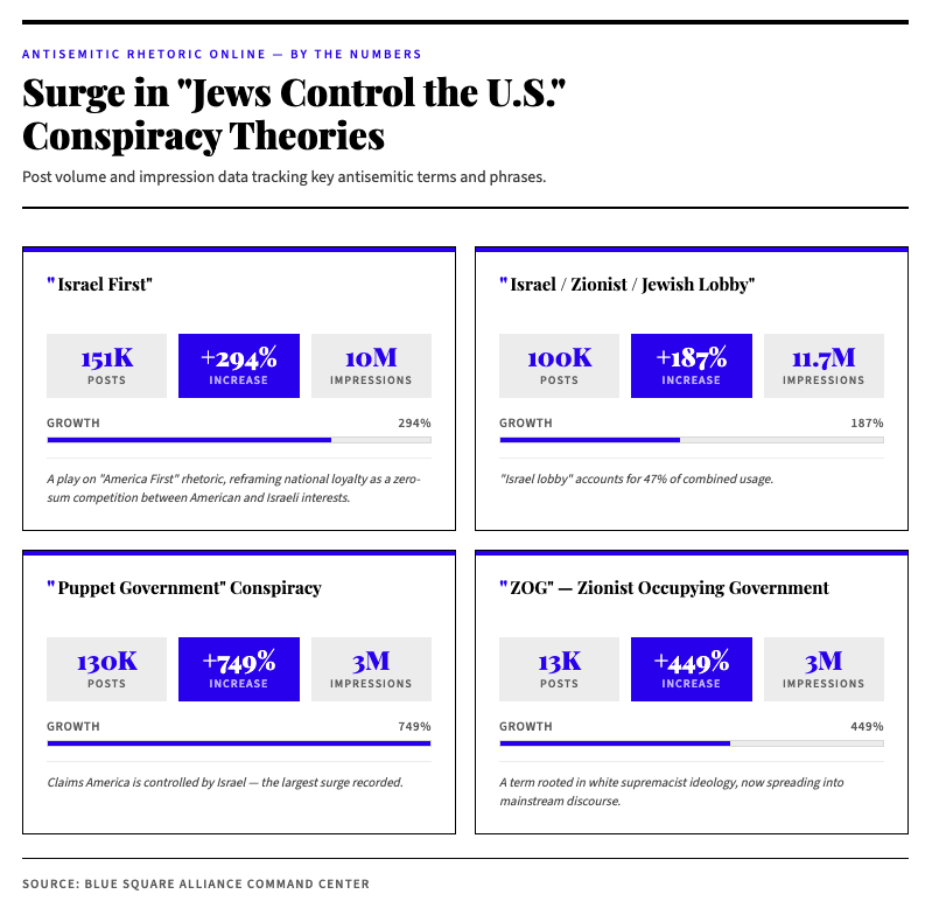
Conspiracy theories about Jewish power and influence rose 194% during this period, with accusations of Jewish or Israeli control over the U.S. government representing the most common thread. Top phrases in this category included “America first,” “Zionist lobby,” and “American soldiers” — language that frames U.S. involvement in the conflict as a betrayal of American interests on behalf of Jewish or Israeli power.

“Israel first” appeared in approximately 151,000 posts, up 294%, with 10 million impressions. References to an “Israel lobby,” “Zionist lobby,” or “Jewish lobby” totaled 100,000 posts — a 187% increase generating 11.7 million impressions — with “Israel lobby” accounting for the majority of usage at 47%. The conspiracies that America is a “puppet government” for Israel surged 749%, appearing in over 130,000 posts with 3 million impressions. “ZOG” — short for “Zionist Occupying Government,” a term with roots in white supremacist ideology — appeared in 13,000 posts, up 449%, with 3 million impressions.
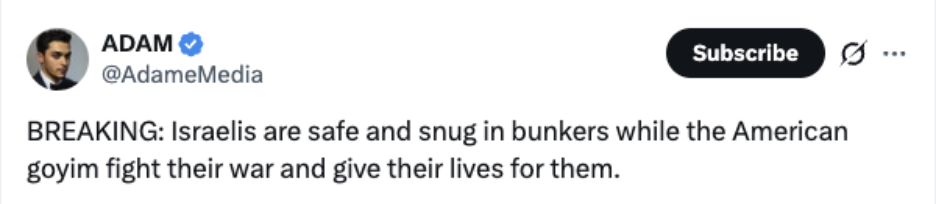
A prominent sub-theme framed the conflict as American soldiers being sent to die for Israeli interests. Posts suggesting that “Israelis are sitting in shelters while Americans are sent to die” emerged as a newly tracked phrase, generating 65,600 posts and 16.6 million impressions.
Closely tied to this framing was a sharp rise in use of the word “goy” or “goyim” — a Hebrew term for non-Jews that has been widely weaponized in antisemitic online spaces to suggest that non-Jewish people exist to serve Jewish interests. The term appeared in 263,700 posts, with 32 million impressions.
9/11 Conspiracy Theories Resurface
The conflict also triggered a significant revival of 9/11 conspiracy theories, which the Command Center tracks as part of a broader category of narratives blaming Jews for engineering crises and wars. That broader category increased 180% during this period.
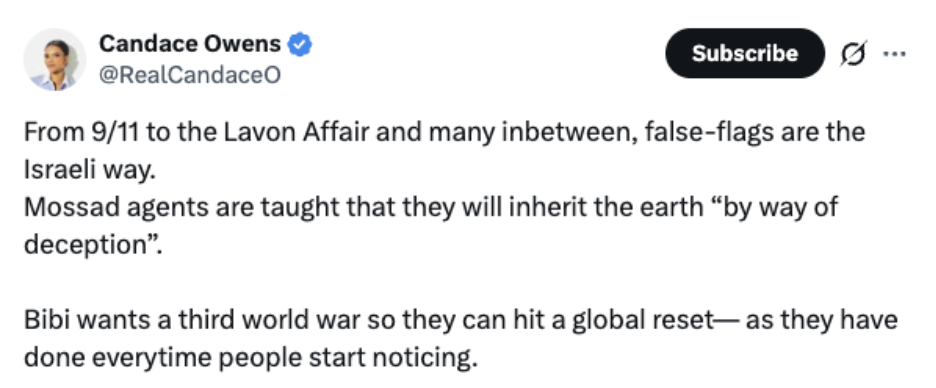
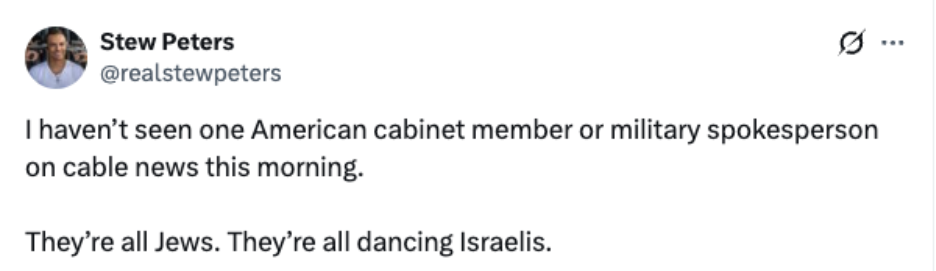
The Command Center tracked 126,000 posts advancing 9/11 conspiracy theories — a 184% increase — generating over 16 million impressions. A recurring phrase in this conversation was “dancing Israelis,” a reference to a long-debunked conspiracy theory alleging that Israeli agents celebrated the September 11 attacks. As the Israel/U.S.–Iran conflict escalates, extremists are repurposing this trope within a broader “false flag” narrative that casts Israel as secretly manipulating the United States into war. The phrase is used as shorthand to connect today’s strikes to an older antisemitic storyline that frames major crises as orchestrated for Jew’s/Israel’s benefit. The phrase is now being repurposed in the context of the current conflict, appearing in posts such as “every time there is war, there are ‘dancing Israelis’” and “dancing Israelis is never a good thing…”
Dehumanizing Language Spikes to Record Levels
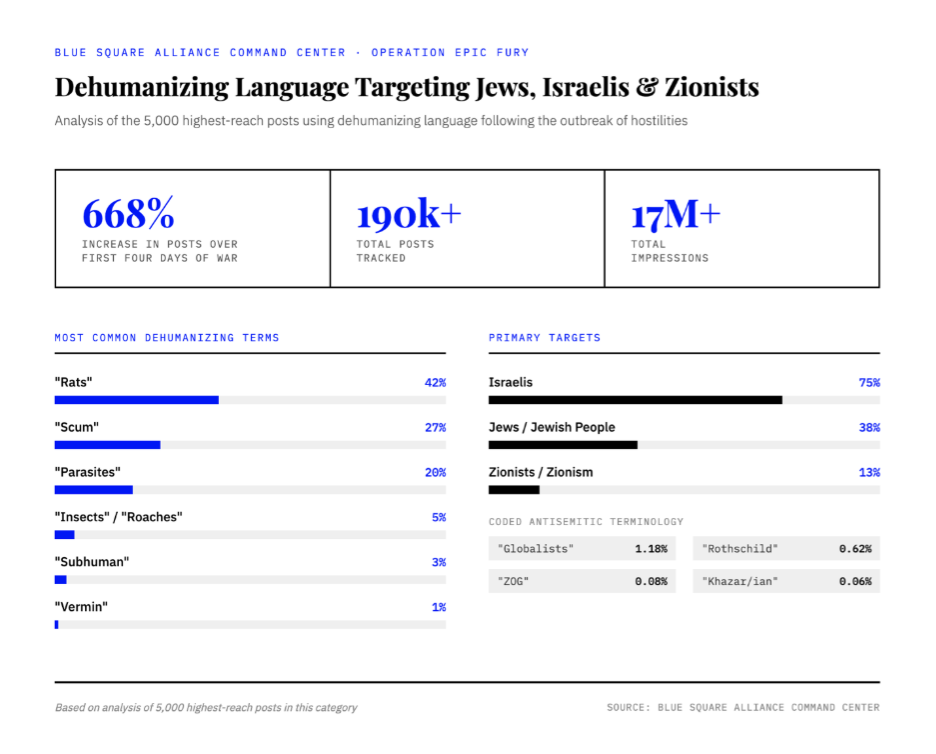
Among the most troubling patterns the Command Center tracked in the wake of Operation Epic Fury was not just the volume of hate — but its character. Dehumanizing language targeting Jews, Israelis, and Zionists increased 668% over the first four days of the war, producing over 190,000 posts and more than 17 million impressions.
Dehumanizing language, as tracked by the Command Center, refers to content that strips human identity from a group — reducing people to animals, vermin, or sources of disease or contamination.
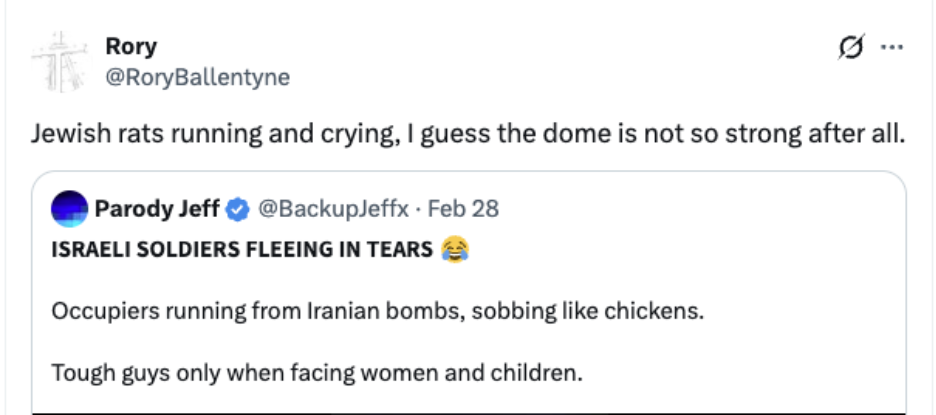
Analysis of the 5,000 highest-reach posts in this category reveals the most common terms. “Rats” appeared in nearly half of posts at 42%, followed by “scum” at 27%, “parasites” at 20%, “insects” or “roaches” at 5%, “subhuman” at 3%, and “vermin” at 1%.
Israelis were the most common target, appearing in 75% of posts, followed by Jews or Jewish people at 38%, and Zionists or Zionism at 13%. Coded antisemitic terminology was also present, including “globalists” (1.18%), “Rothschild” (0.62%), “ZOG” (0.08%), and small mentions of “Khazar/Khazarian” (0.06%).
This type of language has historical precedent that makes its resurgence particularly concerning. As the Command Center documented following Operation Rising Lion, comparing Jewish people to rats, vermin, and disease-carrying pests was a central feature of Nazi propaganda in the 1930s and 1940s, used to dehumanize Jewish communities ahead of and during the Holocaust. Its reemergence in the context of the current conflict — applied to Israelis, Jewish people, and Zionists interchangeably — reflects a pattern in which modern geopolitical events become vehicles for some of the oldest and most dangerous forms of hate.
Taken together, the themes documented in this report reflect something more than a reaction to a military conflict. The conspiracy theories, the dehumanizing language, the Hitler glorification — these are not spontaneous expressions of political frustration. They are a coherent set of narratives that have targeted Jewish people for centuries, now spreading at a speed and scale that was not possible before social media. What makes them particularly insidious is that they do not always announce themselves as antisemitism. They arrive dressed as foreign policy critique, historical revisionism, or political commentary. But their target is consistent: Jewish people, collectively cast as manipulators of governments, instigators of wars, and threats to be eliminated.
What the data ultimately reveals is a deeper problem: antisemitism has become a reliable feature of how significant numbers of people process world events involving Israel and Jewish people. The conspiracy theories, the dehumanizing comparisons, the rehabilitation of Hitler — they are connected by a single, persistent idea that Jewish people are a problem to be solved. That idea has consequences. It shapes how Jewish people are perceived, how they are treated, and how safe they feel in their own communities. The Command Center has now documented this pattern across multiple conflicts and news cycles. Conflict does not create this hatred. It surfaces it — and gives it an audience. Tracking and exposing these narratives is not an academic exercise. It is part of a broader effort to ensure that hatred — however coded, however viral, however normalized it becomes — does not go unchallenged.