
In the immediate aftermath of the antisemitic attack on a Hanukkah celebration at Bondi Beach in Sydney, online attention split in two very different directions.
Alongside messages of shock and solidarity, a fast-growing subset of posts began insisting the shooting was not an antisemitic terror attack at all, but a “false flag” operation orchestrated by Israel or Israeli intelligence. For people inclined to distrust the news or reject the reality of antisemitic violence, these claims offer a convenient alternative narrative — one that replaces facts with a story that feels easier to believe, while quietly fueling anger and hate toward Jews
This follows a pattern the Command Center has observed after previous attacks on Jewish communities.
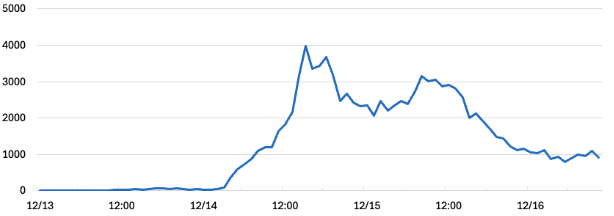
Online, posts alleging the Bondi Beach attack was a “false flag” began rising sharply on December 14 at 4:24a.m. EST, less than an hour after the gunfire started, and before police concluded the attack was against the Jewish community. In the 48 hours following the attack, we identified more than 123,000 posts referencing “false flag” in relation to antisemitism, Jewish culture, and Israel, pushed by over 65,000 accounts and generating more than 17 million impressions on social media.
Hourly Mention Volume of “False Flag” In Social Media Conversations Related to Antisemitism, Jewish Culture, and Israel
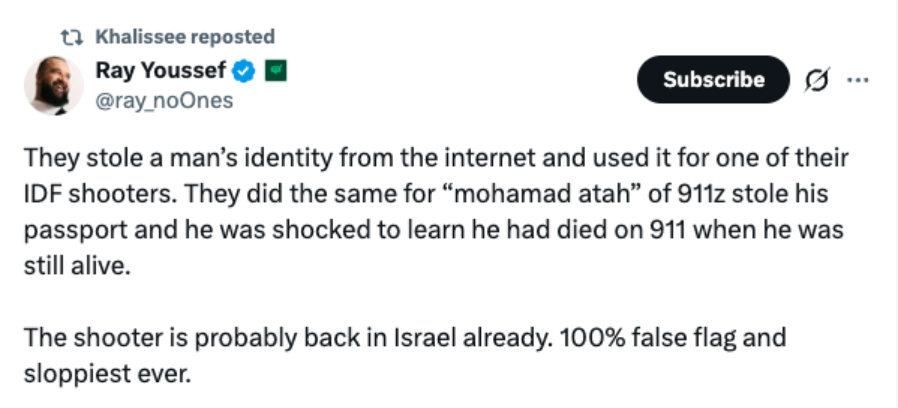
Despite the attack taking place in Australia, the conversation is heavily international. An estimated 43% of posts come from accounts based in the United States, compared with 5.4% from Australia-based accounts. The narrative is not confined to one platform: “false flag” claims have been documented on X, YouTube, Reddit, Bluesky and Facebook, including from a number of known antisemitic or conspiracy accounts such as @AdameMedia, @Kahlissee and @JakeShields.

What Is the “False Flag” Conspiracy Theory?
At the center of this conspiracy is a simple but sweeping idea:
that violent attacks or other shocking events are not what they appear to be, but are secretly staged or orchestrated by a hidden actor to frame someone else or justify a political agenda.
The term is borrowed from military history, where it referred to ships sailing under another country’s flag to deceive opponents. Online, it has become a catch-all label used by conspiracy communities to cast doubt on almost any high-profile tragedy. In practice, “false flag” claims are almost never backed by credible evidence; instead, they are built from speculation, decontextualized clips, and fabricated or misleading “proof,” and they routinely end up denying or distorting the experiences of real victims.
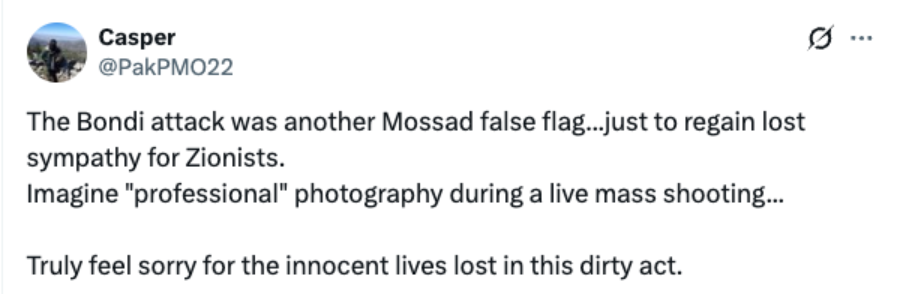
In the Bondi narrative, people are suggesting the attack was secretly organized or staged by Jews, “Zionists,” or Israel – often specifically by Mossad – rather than being an antisemitic act of terrorism targeting Jews. Different posts offer different storylines as “evidence.” The details shift, but the end goal is the same: to dismiss or delegitimize the experience of the victims and their community.

A Pattern, Not an Isolated Incident
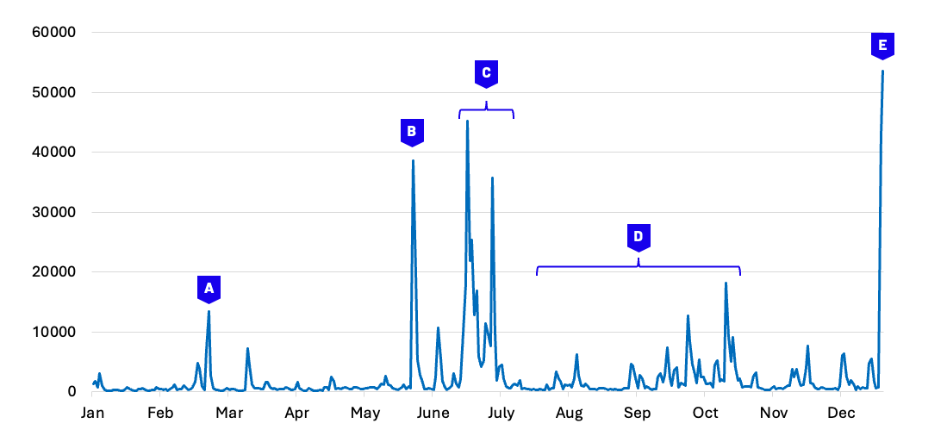
The Bondi false-flag narrative closely mirrors patterns seen around other violent attacks against Jews or Israel. Just in 2025, we tracked a spike in “false flag” conspiracy theories following these events:
- A – February – Three buses exploded in Bat Yam and Holon
- B – May – The murder of Yaron Lischinsky and Sarah Milgrim in Washington, D.C.
- C – June – Allegations that Israel would carry out an attack in the United States to drag it into war with Iran
- D – Summer & Fall – Accusations that Israel will carry a false flag attack on US soil
- E – Attack against Jewish community in Bondi Beach
Daily Mention Volume of “False Flag” in Social Media Conversations Regarding Antisemitism, Jewish Culture, and Israel in 2025
These conspiracy theories have long played a role in antisemitic discourse and are part of a much larger trend. Beyond 2025, “false flag” rhetoric has surfaced after 9/11, the Tree of Life Synagogue shooting in 2018, and the October 7 Hamas attack in 2023. These narratives draw on a broader antisemitic trope that portrays Jews as deceptive and manipulative, frequently accusing them of staging crises to control media narratives or influence foreign policy.
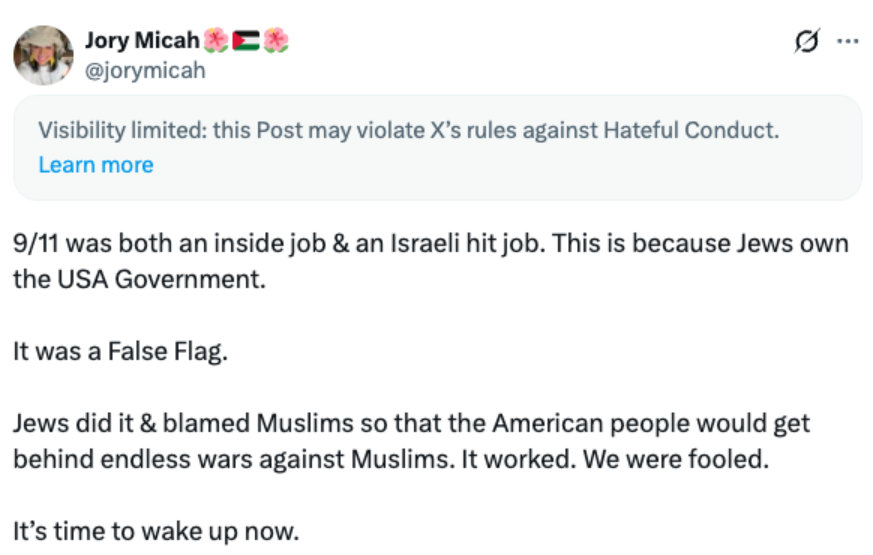
The Bondi conversation is no different, but the scale and speed of the reaction this time were extraordinary. Within minutes, a violent attack on Jews at a religious event was not only questioned, but recast as further evidence of a long-running conspiracy in which Jews or “Zionists” are imagined as powerful orchestrators rather than targets of hate. Tens of thousands of posts, millions of impressions, and cross-platform spread suggest that antisemitic conspiracy networks are now primed to mobilize almost immediately when an attack on Jews occurs.
Why the False-Flag Narrative Is Dangerous
False-flag conspiracy theories are not just wild speculation at the margins of the internet. They cause real harm.
First, they turn victims into villains. When an attack is framed as a staged operation, the people or communities who were targeted are recast as the ones pulling the strings. Instead of acknowledging trauma and loss, these theories suggest that victims are complicit, lying, or even deserving of what happened. The effect is to dismiss the pain of the affected community and deny them basic empathy.
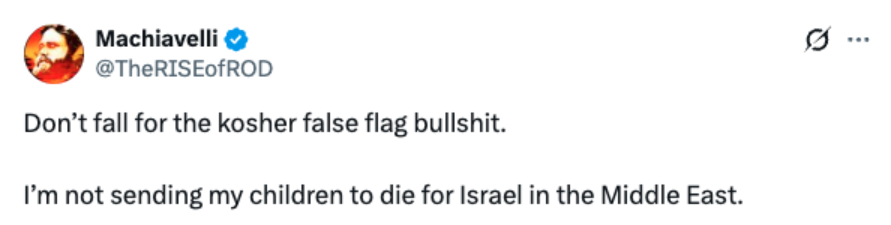
Second, they recycle classic antisemitic myths about Jewish manipulation and control.
In many cases involving Jews or Israel, false-flag narratives lean on old tropes: that Jews secretly run governments, choreograph global events, and manufacture crises for their own gain. The details may be updated for the social media age, but the underlying story is familiar – Jews as omnipotent, deceptive actors who cannot be taken at face value. That framing has a long history and has never been harmless.
Third, they erase the reality of rising antisemitism. If every attack on Jews is explained away as a hoax, a setup, or a public-relations stunt, then antisemitism itself is treated as an illusion. Real patterns of harassment, violence and fear are waved off as manufactured drama. That makes it harder for governments, platforms and the public to recognize antisemitism as the growing threat it is – and easier for those who spread it to avoid accountability.
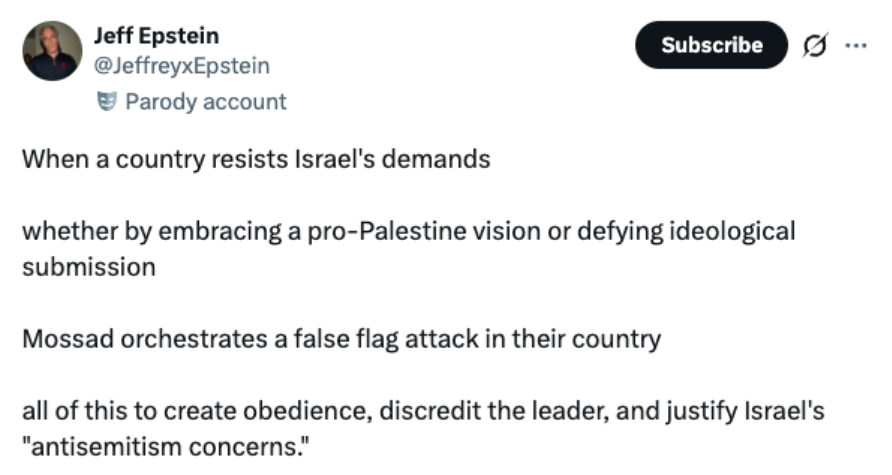
False-flag conspiracy theories offer a simple way to deny harm: every tragedy is recast as a setup, every victim as suspect, and every hard truth as “the story they don’t want you to know.” They can latch onto almost any crisis, but when Jews are involved they reliably snap back to old ideas about hidden Jewish power and manipulation. In that way, they are not just random internet rumors – they are a modern delivery system for very old prejudices.
The reaction to the Bondi Beach attack shows how fast this pattern now moves. Within minutes of a Hanukkah celebration being gunned down, tens of thousands of posts were already insisting it was staged, smearing Jewish witnesses as actors and casting doubt on the role of antisemitism. The specific rumors may be unique to Bondi, but the script is the same. As long as false-flag narratives drive the conversation, attacks on Jewish communities will be rewritten as Jewish, or Israeli, plots – and the wider rise in antisemitism will be treated not as a crisis to address, but as something to dismiss.



Command Center Insights
How the Internet Reacted to the Cost of Jewish Security