
The data reveals that the surge of antisemitism has leveled off, but at alarming levels. While the growth of antisemitism has slowed, it remains harmful. Amid war in Gaza, politicization at home, and misinformation and apathy online and offline, it’s not just that Americans on average exhibit more antisemitic attitudes than just two years ago. They’re also less aware antisemitism exists, less convinced it’s serious, less likely to think it’s important enough to fight, and less likely to stand up to prejudice against Jews when they encounter it.
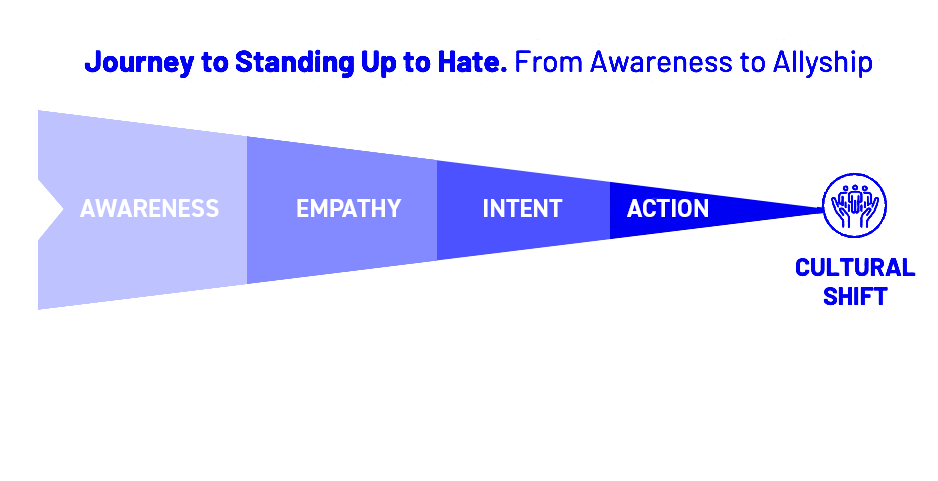
These are the central findings of the US Antisemitism Landscape Survey from the Blue Square Alliance (partnering with SSRS and Research Narrative), the largest tracking study of American attitudes related to antisemitism. In this research, we measure beliefs and actions at each point along the journey of responding to prejudice: from awareness that antisemitism exists to recognition of the issue’s importance to willingness to stand up against it.
At most points in this journey, Americans’ beliefs are more negative in 2025 than they were two years ago. Further, as prejudice feels more widespread, many Americans are losing faith that they can change it—and no longer feel pressure from others to stand up.
Awareness of Anti-Jewish Prejudice Has Fallen
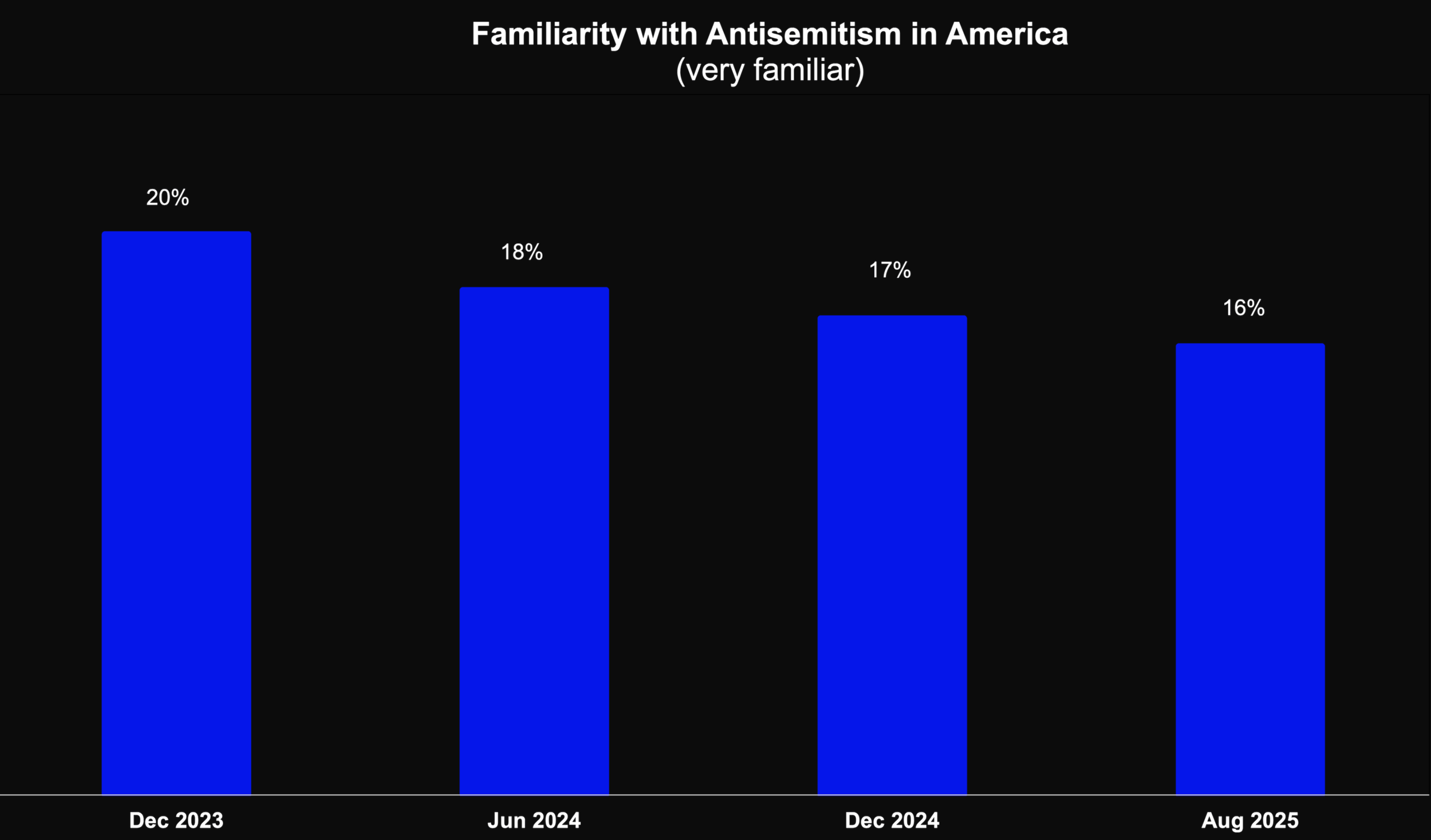
Fighting any injustice begins with baseline awareness of that injustice, and awareness of antisemitism is decreasing even as antisemitic incidents in this country are increasing. In our most recent survey (fielded in August and September), only 15% of US adults report they are very familiar with recent events in the US regarding prejudice against Jewish people. That number was 20% at the end of 2023. Similarly, only a minority of Americans are aware of historical prejudice against Jews, such as Jews once being banned from practicing medicine and law.
This lack of awareness stands in sharp contrast to reality. Despite a surge in antisemitic speech and incidents nationwide, most Americans do not believe they see or hear antisemitism in their own lives. Only 29% say they have heard someone they know say something prejudiced about Jews, and this has been consistent since 2023. In comparison, almost half of respondents remember someone they know saying something prejudiced about Black Americans or the LGBTQ+ community. For many, antisemitism is simply not something they believe they encounter.
Low exposure to anti-Jewish prejudice is in many cases the result of low exposure to Jewish people. 45% of US adults don’t personally know any Jews—or at least don’t realize they do. For millions of Americans, if they don’t know any Jews and they never see antisemitism themselves, the absence of personal connection makes antisemitism feel distant and less urgent. Efforts to encourage people to stand up to antisemitism can’t succeed when so many people don’t even know that it exists.
Many Americans Don’t Believe Antisemitism Is That Important
Even if awareness of antisemitism were to skyrocket, the next obstacle is skepticism about its seriousness. Our survey shows that 58% of US adults think antisemitism is a minor problem or not a problem at all. That number has been fairly steady over the last two years, even as antisemitic hate crimes rose 86% just from 2023 to 2024. Many Americans don’t think prejudice against Jews has gotten worse.
In fact, an increasing number of people think the issue of antisemitism is exaggerated. 37% of US adults believe it’s blown out of proportion, up from 28% in 2023 and higher among younger people. It’s no surprise, then, 46% of US adults believe Jewish people can handle antisemitism on their own—up 6 percentage points from two years ago.

In our research, we have observed that what often holds people back is the simple fact that antisemitism feels less familiar, harder to speak about, and less urgent than the issues they face day to day. Even though 74 percent of respondents believe prejudice and hate are rising, antisemitism often feels distant to them. They know less about Jewish people, have had fewer personal encounters with antisemitism, and don’t feel equipped to speak up. In a world where so many are juggling urgent concerns in their own lives, people tend to focus their energy where they feel more confident and connected.
That dynamic shows up consistently in our qualitative studies. Participants told us things like, “I am not very familiar with their (Jewish) culture. I do not know many Jewish people,” and, “I just think that other people are better qualified (to stand up to antisemitism). So, I’m putting my energy towards where I feel I am the most qualified to make an impact.” Others compared what they see in their own lives to what they assume Jewish people experience: “I don’t see ICE detaining and deporting Jewish US citizens that happen to look undocumented or the police shooting unarmed Jewish people. It’s not the same.”
These comments reflect a broader pattern. People dismiss antisemitism because it feels less visible, less familiar, and outside their expertise. Our job is to close that gap in understanding, build confidence, and show that speaking up for Jewish people is something anyone can do.
People Are Less Likely to Stand up to Antisemitism
Given the declines in awareness and in perceived importance, the decline in likelihood to speak up against anti-Jewish prejudice naturally follows. Only 32% of Americans say they are very likely to speak up on behalf of a Jewish person experiencing hostility or prejudice. In 2023 it was 38%.
Feeding this trend are a rising sense of powerlessness and a loss of social pressure. In June 2023, 21% of Americans believed there was nothing they could do to counteract prejudice against Jewish people. Since then, that number has risen to 38%. The biggest change is visible for 18-49-year-olds, who are now more than twice as likely to believe there’s nothing they can do compared to 2023. That’s a lot of Americans who assume they can have no impact whatsoever, so why try?
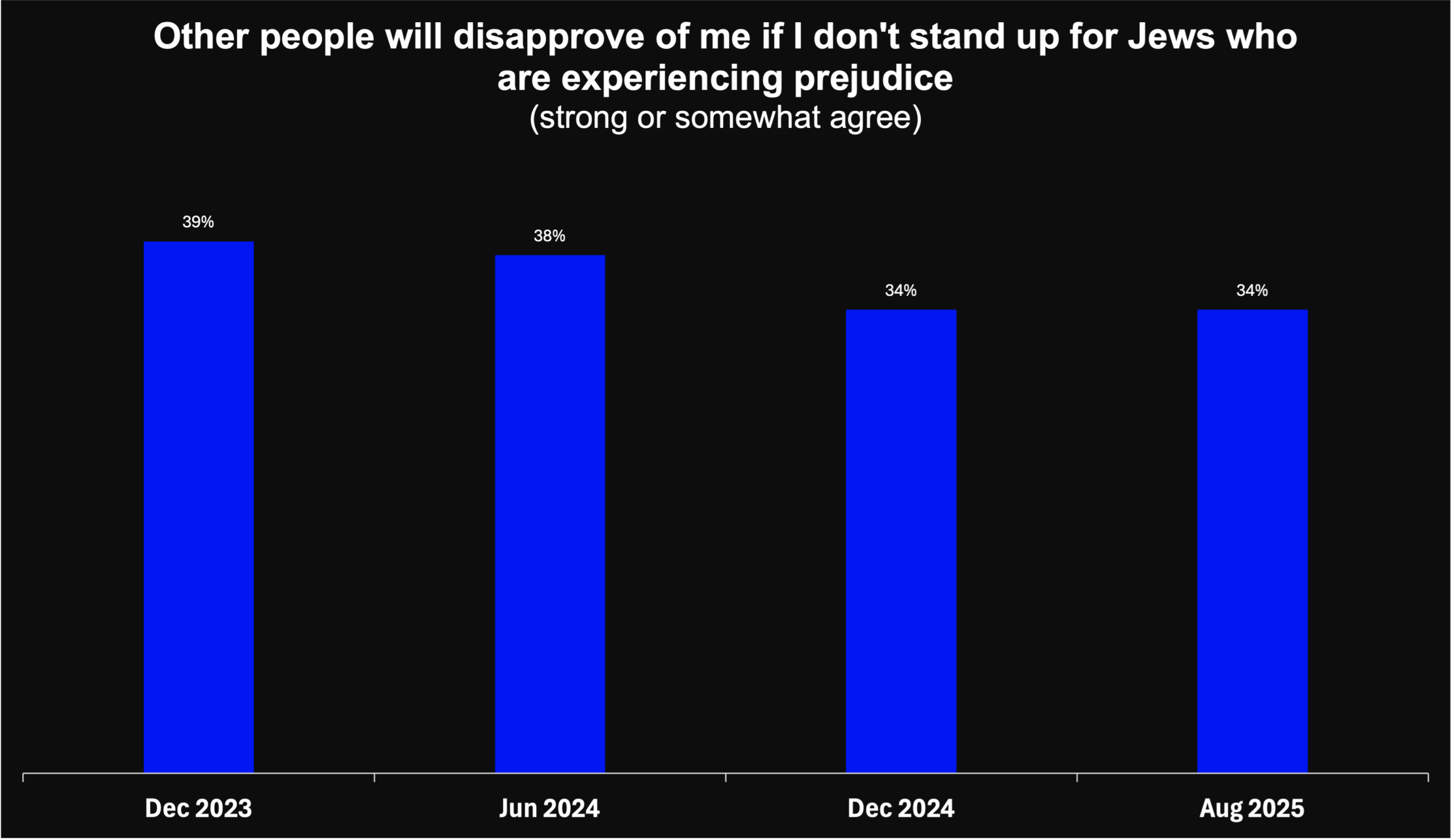
Combine that individual powerlessness with lack of social pressure on this issue. In 2023, 39% of respondents thought other people would disapprove of them if they don’t stand up for Jews experiencing prejudice. That number has dropped across our semiannual surveys and now sits at 34%. We observe this trend across all demographic groups, including age and race/ethnicity. For so many Americans, speaking out feels pointless, and silence feels acceptable.
The Israel/Hamas war, underway when this survey was conducted, is no doubt a factor. In our qualitative research, people often said that supporting Jewish people might be interpreted as siding against Palestinians, a perception that made them hesitate to speak out. As a result, even when antisemitic incidents increased, many Americans became less willing to speak out.
Antisemitism Has Plateaued at Levels Far Worse Than Two Years Ago
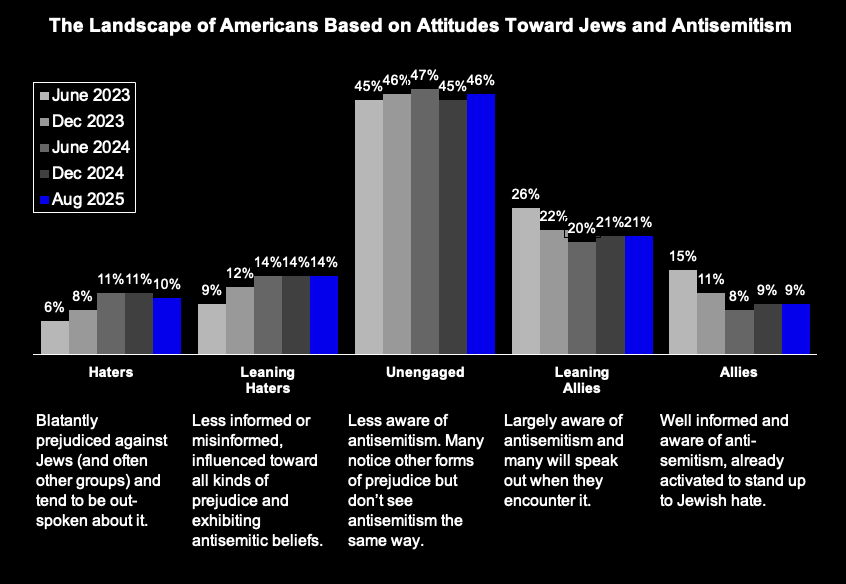
The result of all of these trends: US attitudes around antisemitism noticeably grew and metastasized starting in 2023, and since 2024 have plateaued at alarming levels. Our research includes a proprietary segmentation model that classifies respondents into one of five groups based on their answers to key questions about:
- Jewish people (e.g., do Jews cause problems, are they a threat)
- Jewish tropes/stereotypes (e.g., Jews are penny pinchers, run the media, are more loyal to Israel than to the US)
- Antisemitism/prejudice against Jewish people in the US (e.g., is it a major issue, blown out of proportion)
Americans’ attitudes in all three areas relating to the Jewish community and antisemitism have moved negative on average, resulting in 40% fewer Allies compared to June 2023 and 67% more Haters.
Driving this significant shift are increases in:
- Overt antisemitic beliefs:
- 18% of US adults think Jews are at least somewhat a threat to the unity of American society, up from 12% in June 2023.
- 27% believe Jewish people cause problems in the world, up from 19%.
- Belief in anti-Jewish tropes, such as:
- Jewish people are penny pinchers.
- They run media in America and/or have too much media influence.
- They care more about Israel than their own country.
- Skepticism about the importance of antisemitism (as discussed earlier)
The loss of Allies and growth in Haters have stabilized since a year ago. While the end of a steep negative trend is good news, the plateauing of antisemitism in the US at these profound levels is definitely not a good outcome.
In our most recent summer survey, there are glimmers of hope. The percentage of Americans who believe Jews are a threat or cause problems in the world dropped slightly compared to the previous winter survey. But they are still far above 2023 levels. Similarly, belief in anti-Jewish tropes might be softening slightly, though unevenly—but they are still far above 2023 levels.
Combined, these slight improvements aren’t moving the needle significantly this year. It is our sincere hope that they are an early sign of real improvement in the coming months and years, and that what we are currently experiencing in this country is not a “new normal” but a temporary reality.
Proof that Counter-Messaging Makes a Difference
Even in this ugly surge in antisemitism, we can reach millions of Unengaged Americans with messages that build awareness, make the importance of antisemitism visible, and motivate people to take a stand. At the Blue Square Alliance Against Hate, our mass media campaign is focused on data-driven messaging that has proven impact with the Unengaged group, and that work continues to pay off even in these difficult times.
Over the last 12 months, our ads have reached the vast majority of Americans, with 2.4 billion impressions on TV and online. These messages continue to have a positive impact with Unengaged Americans.
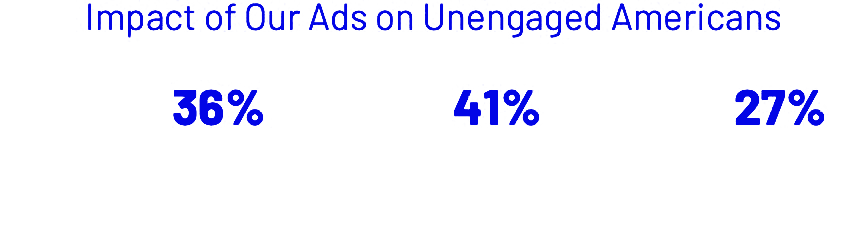
Our data shows that people exposed to Blue Square ads are more likely to:
- Recognize that Jewish people are victims of a disproportionate amount of hate.
- Feel less powerless; believing they can make a difference combating it.
- Have conversations about antisemitism with people you know.
- Self-report on actions taken to respond to antisemitic social media posts or real-world antisemitism.
In a time of rising antisemitism, now is the time to double down on what works. The story of the last two years has been one of increased Jewish hate and stronger headwinds in fighting that hate. It’s a cancer that has taken hold in this country, and we’re now at a new low that many couldn’t have imagined. Through research like this we face the challenges head on, deeply understanding both the reality of antisemitism in this country and what the data shows makes a difference despite the strong headwinds. And we do so with the determination to not let this current reality become the new normal.
Methodology
| The US Antisemitism Landscape Survey is semiannual research on Americans 18 and older conducted by Blue Square Alliance Against Hate, SSRS, and Research Narrative. This ongoing study tracks Americans’ attitudes and actions around antisemitism in the context of recent events. The latest survey of 7,028 US adults, fielded August–September 2025, used a nationwide sample balanced by census-representative nested quotas for age and race/ethnicity, weighted to match the US population. Participants are classified into segments (e.g., Allies) based on a weighted scoring methodology applied to a set of attitudinal questions about Jewish people and about antisemitism. The survey was conducted online and has a margin of error of ±0.95. |
About the Blue Square Alliance
The Blue Square Alliance Against Hate was founded in 2019 by Robert Kraft to stand up to Jewish hate and all hate – a mission that is now funded by over 30,000 Americans. We uniquely reach unengaged non-Jewish Americans, moving them to become allies through empathy-building national mass media and social content. We partner and convene diverse leaders and groups to create awareness and understanding, and our Command Center monitors the digital landscape 24/7 to understand where and how hate is spreading and completes national research on this topic.
For more information about this research, email us at [email protected]



Command Center Insights
How Ruhi Cenet’s Viral Hasidic Brooklyn Video Misled Viewers